Tag Archives: cartridge

Audio-Technica unveils 60th anniversary headphones and phono cartridge

Two limited products from the audio giant.

To celebrate its 60th anniversary, Audio-Technica has announced two limited products – the ATH-W2022 headphones and AT-MC2022 phono cartridge.

With only 100 available units, the ATH-W2022 are closed-back, dynamic headphones, sourced and assembled in Japan.  Through the Japanese maki-e lacquer technique, the headphone housings include “hand-painted Sakura and hou-ou phoenix designs, with mother-of-pearl on the left and right sides”.

The headphones will also have a commemorative wooden storage case and “two detachable 3.0 m, cloth-wrapped cables made from 7N-class D.U.C.C. (Dia Ultra Crystallized Copper): one with a 6.3 mm (1/4) gold-plated stereo plug, the other with a 4-pin XLRM balanced connector”.


The AT-MC2022 is a dual-moving coil stereo cartridge that uses “a unified stylus-cantilever, formed from a single, lab-grown diamond”. Only 60 cartridges will be available.


“It is an honour to provide a quality audio experience to millions of people throughout the world. What begins as a simple vibration – a subtle movement – results in an emotional connection, whether that be when listening deeply to an album or sharing your voice with the world,” says Audio-Technica President, Kazuo Matsushita.

The ATH-W2022 and AT-MC2022 will retail for £7900 and £8700 respectively. Both products will be available this Winter.

DS Audio DS 003 Optical Phono Cartridge

If you’ve been following my phono cartridge reviews in TAS or Ken Kessler’s in HI-Fi News & Record Review, you already know that DS Audio’s optical cartridges (oc’s) are the hottest new things in LP playback. Though the theory behind using a massless beam of light rather than comparatively massive coils or magnets to convert the movements of a stylus into electricity is not new (it dates to the 1940s), it took a latter-day technology whiz, Japan’s Tetsuaki “Aki” Aoyagi (head of DS Audio), to perfect it. 

The optical groove-reading system is fairly easy to explain: The intensity of a light from a miniaturized “lamp” inside the cartridge is continuously modulated by the movement of an extremely low-mass “shading plate” attached to the stylus/cantilever. As the stylus vibrates, the shading plate vibrates in sympathy, blocking varying amounts of the light coming from the lamp. This variable luminosity is then turned into variable voltages by photoreceptors and sent on to a dedicated phonostage unit, where it is equalized and boosted to line level. 

Aki’s contribution to the perfection of the optical cartridge was based on the development of the computer-era optical mouse at the Digital Stream Corporation (his father’s company). By substituting the cool-running, miniaturized LEDs and miniaturized photoreceptors found in optical mice for the hot, tiny, unreliable incandescent bulbs and bulky, low-sensitivity “electric eyes” used in previous-gen optical cartridges, he turned an unreliable twentieth-century curiosity into a wholly reliable twenty-first-century success story.

Over the years, Aki has made improvements to each successive generation of DS Audio oc, culminating (just a year ago) in his chef d’oeuvre—the fabulous and fabulously expensive Grand Master cartridge and Grand Master phonostage. What the Grand Master offered (in addition to a diamond cantilever and a micro-ridge diamond stylus) was a fundamental change in the optical “engine” itself (the first such change in DS Audio’s relatively brief history). Instead of using a single light source and photoreceptor for both channels, the Grand Master used separate ones for each channel. Coupled with the much-improved tracking and tracing of the GM’s micro-ridge stylus, this “dual-mono” optical/electrical engine raised the bar in every audible and measurable category. Channel separation (and, hence, soundstage width, depth, and height) was substantially increased, and the very low noise floor (always a huge plus with Aki’s oc’s) was lowered even further, making for the kind of silent backgrounds and abundant musical detail that you only hear on reel-to-reel analog tape—and in a concert hall, of course. 

Though digital fans are used to it (or at least to a frighteningly dead, interstellar version of it), this depth of background silence is new in LP playback. As I’ve said before, we analog hounds have becomes so inured to the way in which RF audibly modulates the signal that a transducer/phonostage without RF simply must be experienced to be believed. Even then, it’s hard to fathom. It’s as if you’ve been listening to music with your window open on a noisy street. All of a sudden, the DS Audio closes the window. You just hear so much more, so much more purely and faithfully. 

Thanks to the oc’s inherent rise in the bass, which, in theory, goes down to 1Hz, and absence of background racket (including the occasional AM station or passing CB), its similarity to the sound of R2R tape (which also has a robust low end and little-to-no susceptibility to RF) is far closer than what you get from conventional magnetic playback. As a result, the DS Audio Grand Master is a revelation to fidelity-to-source listeners, for whom the sound of the mastertape is the golden fleece. However, it’s also a dream come true for as-you-like-it and absolute-sound listeners, since its noise-free clarity is accompanied by rich, full, unusually deep-reaching tonality, excellent imaging and soundstaging, superb dynamic response, and the genuine illusion of real musicians making music in a real space. Indeed, the only area in which the Grand Master doesn’t challenge or equal the sound of a great tape player is in the treble, where a rise in the topmost octave makes the Grand Master a little more scintillant than tape (though it is no longer bright sounding, since the rise now begins well above the presence range, about halfway through the brilliance range).

The trouble is—or was—that to get all these great new advancements you had to buy the $15k Grand Master cartridge. (If you wanted the whole megillah, you also had to chip in another $45k for the Grand Master phonostage/equalizer.) 

However, hold onto your hats (and wallets). Aki has now “trickled down” much of the Grand Master technology into one of his latest “entry-level” products—the DS 003, the subject of this review. At “only” $2500 (with another $3500 for its dedicated DS 003 phonostage/equalizer), it is not dirt cheap. But $6k is still a far cry from $60k. What do you get for one-tenth the money? Well…just about everything that makes the Grand Master the benchmark that it is.

No, you don’t get that micro-ridge stylus. You’ll just have to live with a line-contact diamond one. And you don’t get the diamond cantilever; the DS 003’s is aluminum. Though sleek, rigid, and extremely well damped, the DS 003’s body is machined from A5052 aluminum and not from the GM’s ultra-strong, ultra-light duralumin. These stylus/cantilever/chassis differences aside, however, there is not a whole lot else that separates the DS 003 cartridge from the Grand Master.

Like its ten-times more expensive brother, the DS 003 uses DS’ new “dual-mono” optical/electrical generator, with independent LEDs and photodetectors for each channel. Like the Grand Master, it uses a featherweight, 99.9% beryllium shading plate that is 50% lighter than the aluminum one used in DS Audio’s previous oc’s (prior to the Grand Master). And like the GM, the DS-Audio’s internal wiring is 1.6 times thicker than it was in first- and second-gen DSes. 

These advancements make for virtually the same kind of sonic improvements that they do in the Grand Master. Because of the dual-mono setup, channel separation is greatly enhanced—to the benefit of soundstaging and imaging. (Andre Jennings measured 32dB+ channel separation at 1kHz, where the first-gen DS oc’s barely made it to 20dB.) The reduction in mass (claimed to be 1/10th that of a conventional mc cartridge) helps to improve tracking and lower noise to a near-inaudible level, increasing resolution and dynamic range. (The more-affordable first- and second-gen DSes had trouble tracking highly modulated passages on LPs and collected dust like Swiffers; the third-gen DS 003 has no such issues, tracking tough grooves and plowing through debris like a Clearaudio Goldfinger.) The better wiring and improved equalization (for which see the next paragraph) helps render tonality in the same lusciously rich, full-bodied, deep-reaching fashion that you hear on the GM, with tape, and in life.

Like the Grand Master unit, the DS 003’s companion phonostage/equalizer benefits from thicker circuit boards (increased from 1.6mm to 2.0mm) and denser copper-foil traces (up from 35μ to 70μ). Of course, the compact DS 003 phonostage is not nearly as large, complex, and state of the art as the two-chassis Grand Master one. Though it does provide four different roll-off curves for the low frequencies (the GM has six), it doesn’t have the flexibility, power-supply storage capacitance, channel separation, S/N ratio, etc. of the pricey GM. As a result, the sound of the cartridge played back through it is just a little less firmly controlled in the low end, finely resolved in the midband, vast in staging, and tape-like smooth top to bottom. (If you run the DS 003 through the Grand Master phonostage, as I did for an experiment, you will see that the primary sonic difference-maker here is the DS 003 equalizer, not the cartridge itself.) Ten times more dollars better buy you something, and it does in the DS Audio line, though the extent of improvement which that added investment makes will depend, to a degree, on the transparency of your speakers, amplification, and turntable.

It is now time for the traditional “and then I listened to” portion of the review (see sidebar). However, in this case it’s not really necessary, as the virtues of the DS 003 can be summed up in a few words. To wit, no, the DS 003 duo (cartridge/phonostage) is not the equal of the Grand Master duo (particularly the phonostage), but it comes so close to the beautiful, transparent, spacious, noise-less, dynamic, uncannily tape-like (which is to say, uncannily lifelike) sound of that paragon—on any recording of any kind of music—that I would be hard put to recommend the Grand Master ahead of it for most listeners. 

If you have a system that is capable of highest-resolution playback, then by all means go whole hog and get the Grand Master set. You won’t regret it. But if you don’t have Magico M9s or Wilson Chronosonic XVXes or Stenheim References or Estelon Forzas or MBL 101 X-tremes or Maggie 30.7s—and you’re not equipped with a Walker Audio Proscenium, Acoustic Signature Invictus Neo, Basis Transcendence, TechDAS Air Force Zero, or top-line Soulution, Constellation, Pilium, CH Precision, Zanden, Air Tight, etc. amplification (with appropriate cabling and interconnect, of course)—then the choice is easy: Go for the DS 003. Maybe even if you do have these goodies, you’d want to think about it. This is just a marvelous transducer. It will certainly be my nominee for TAS Phono Cartridge of the Year.

Specs & Pricing

DS 003 Optical Cartridge
Signal output: Photo-electric conversion
Channel separation: 27dB + (1kHz)
Weight: 7.7g
Output signal level: 70mV (1kHz)
Cantilever: Aluminum
Stylus: Line contact
Body material: Aluminum (A5052)
Cantilever holder material: Stainless
Tracking force: 2.0g–2.2g (2.1g recommended)
Price: $2500

DS 003 Phonostage
Output voltage: 500mV (1kHz Equalizer output)
Output impedance: RCA 120 ohms
Preamp input impedance: > 10k ohms
Input terminal: RCA
Output terminal: RCA x2
Dimensions: 33cm x 9.2cm x 29.5cm
Weight: 5.0kg
Price: $3500

MUSICAL SURROUNDINGS (U.S. Distributor)
(510) 547-5006
[email protected]

JV’s Reference System
Loudspeakers: MBL 101 X-treme, Stenheim Alumine Five SE, Estelon X Diamond Mk II, Magico M3, Voxativ 9.87, Avantgarde Zero 1, Magnepan LRS+, 1.7, and 30.7
Subwoofers: JL Audio Gotham (pair)
Linestage preamps: Soulution 725, MBL 6010 D, Constellation Audio Altair II, Siltech SAGA System C1, Air Tight ATE-2001 Reference, Zanden 3100
Phonostage preamps: Soulution 755, Constellation Audio Perseus, DS Audio Grand Master
Power amplifiers: Soulution 711, MBL 9008 A, Aavik P-580, Constellation Audio Hercules II Stereo, Air Tight 3211, Air Tight ATM-2001, Zanden Audio Systems Model 9600, Siltech SAGA System V1/P1, Odyssey Audio Stratos, Voxativ Integrated 805
Analog source: Clearaudio Master Innovation, Acoustic Signature Invictus Jr./T-9000, Walker Audio Proscenium Black Diamond Mk V, TW Acustic Black Knight/TW Raven 10.5, AMG Viella 12
Tape deck: Metaxas & Sins Tourbillon T-RX, United Home Audio Ultimate 4 OPS
Phono cartridges: DS Audio Grandmaster, DS Audio Master1, DS Audio DS 003 Clearaudio Goldfinger Statement, Air Tight Opus 1, Ortofon MC Anna, Ortofon MC A90
Digital source: MSB Reference DAC, Soulution 760, Berkeley Alpha DAC 2
Cable and interconnect: CrystalConnect Art Series Da Vinci, Crystal Cable Ultimate Dream, Synergistic Research SRX, Ansuz Acoustics Diamond
Power cords: CrystalConnect Art Series Da Vinci, Crystal Cable Ultimate Dream, Synergistic Research SRX, Ansuz Acoustics Diamond
Power conditioner: AudioQuest Niagara 5000 (two), Synergistic Research Galileo UEF, Ansuz Acoustics DTC, Technical Brain
Support systems: Critical Mass Systems MAXXUM and QXK equipment racks and amp stands and Center- Stage2M footers
Room Treatments: Stein Music H2 Harmonizer system, Synergistic Research UEF Acoustic Panels/Atmosphere XL4/UEF Acoustic Dot system, Synergistic Research ART system, Shakti Hallographs (6), Zanden Acoustic panels, A/V Room Services Metu acoustic panels and traps, ASC Tube Traps
Accessories: DS Audio ION-001, SteinMusic Pi Carbon Signature record mat, Symposium Isis and Ultra equipment platforms, Symposium Rollerblocks and Fat Padz, Walker Prologue Reference equipment and amp stands, Walker Valid Points and Resonance Control discs, Clearaudio Double Matrix Professional Sonic record cleaner, Synergistic Research RED Quantum fuses, HiFi-Tuning silver/gold fuses

The post DS Audio DS 003 Optical Phono Cartridge appeared first on The Absolute Sound.

Thales TTT-Slim II, Simplicity II, X-quisite CA turntable, arm and cartridge

Switzerland is home to more than watchmakers, cocoa-wranglers and discreet bankers; it’s also a hotbed of high-end audio manufacturers whose wares have been making their way to our shores for some time. Those with long memories will recall brands like Revox and its pro arm Studer, Goldmund and no doubt a few more. Another legend is EMT, which largely operated in the pro arena but now makes generators for MC cartridges. EMT might be the best known of the trio, but is actually now a sister brand to Thales and X-quisite owned by engineer/entrepreneur Micha Huber.

Thales started out making tonearms with the distinction of tangential headshells, that is the angle of the headshell changes as the cartridge traverses the vinyl. This is a clever way of getting around the fact that traditional pivoted arms are perfectly aligned at only two points on the vinyl, the rest of the time the stylus is not parallel to the groove and therefore tracking is compromised. Tangential headshells are not a new thing, I recall hearing a wooden one fitted to a Garrard 301 with a Decca MkII cartridge from the 1950s once, it was more than thrilling but probably less than accurate. However, it’s uncommon to see them among today’s high-end offerings. The intrinsic problem is maintaining rigidity whilst allowing the correct degree of movement.

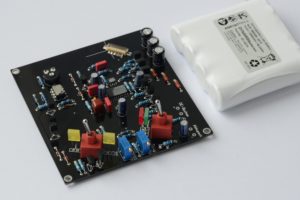
Battery Power Supply

The name Simplicity II does not indicate that it was easy to design, manufacture and build but rather that set-up is relatively straightforward, as long as you ‘RTFM’. Thales has come up with an arrangement of two arm tubes that are joined at the bearing and headshell and share a split counterweight. The headshell such as it is fixed by two precisely tensioned bolts that allow it to change angle but remain as rigid as possible. Fitting a cartridge is a two-stage process, first you fix the cartridge to a shoe and then you slide that shoe sideways onto the plate at the end of the arm, fixing it in place with a very small grub screw. Thales supply all the tools required to set up the turntable and arm in this package but in practice, I only needed to use two, and of these the 0.9mm Allen key got the most use.

Installing and setting up expensive cartridges is nearly always a nerve-racking process, so it’s good to see that Thales does its best to reduce the stress. In order to align a cartridge in the Simplicity II once it has been bolted to a shoe, there is a rather nicely finished and substantial jig that you slide the shoe into and align using a grid on its Perspex cover.

The TTT-Slim lives up to its name with an aluminium plinth that’s only 27mm thick but thanks to some clever machining looks even thinner. It’s suitably weighty, however, especially when the platter is in place. The drive system is neatly hidden beneath this aluminium platter and consists of a large Delrin hub driven by a motor that’s decoupled to some extent by spring-like fixings on either side. Drive is from a DC motor via a thin, round section belt. The bearing is a hardened steel shaft in a bronze bushing set into a cast-iron case. The power for the motor is provided by rechargeable batteries within the plinth, which allow this turntable to run for up to 20 hours according to the manual. A charger is supplied and can be left plugged in at all times but equally, it can be removed during playback to achieve electrical isolation. I encountered hum problems with the Thales in my system and found that removing this connection cured them by breaking a ground loop.

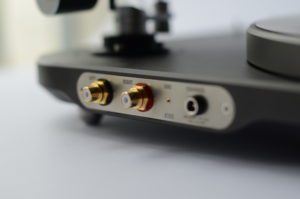
The TTT-Slim and Simplicity II combo can be had with full arm wiring or with plinth mounted RCA outputs, I reviewed the latter and used Townshend Fractal interconnects. Thales supplied an X-squisite CA, this is a moving coil cartridge with a micro ridge stylus on the end of a single piece or monobloc cantilever and coil body. The main cartridge body is made of wood and aluminium and the coils themselves are pure copper.

The post Thales TTT-Slim II, Simplicity II, X-quisite CA turntable, arm and cartridge appeared first on Hi-Fi+.

New Linn Klimax LP12 turntable, Ekstatik cartridge

From the Linn press release:


Glasgow, Scotland: Linn announces the latest iteration of their flagship turntable, Klimax LP12. It will make its public debut at the Dutch Audio Event, Eindhoven, this Saturday 30th October.

Klimax LP12 now features new Radikal, comprising hyper-accurate speed management technology, a whisper-quiet power supply, and state-of-the-art motor design. Additionally, this turntable scales new heights of fidelity thanks to extensive experimentation in material science – culminating in the breakthrough that is the all-new flagship cartridge, Ekstatik.

This marks the conquest of a new summit of performance, at the top of the industry-leading Sondek LP12 range. With new Klimax LP12, listeners will experience their favourite albums – both cherished classics and those freshly unwrapped – as if it were for the first time.

New Klimax LP12 sustains rotation closer to 33⅓rpm than any turntable; and thus produces the most musical, pitch-perfect performance from a Sondek LP12 ever.

Linn has designed, manufactured, and released more than forty upgrades for Sondek LP12 in the course of its forty-eight year history; with each consecutive upgrade improving its performance, and keeping it ahead.

Gilad Tiefenbrun, Linn’s Managing Director, said: “Announcing Sondek LP12 upgrades is always an exciting time at Linn; but when they improve our very best version, the Klimax LP12, it’s doubly exciting. Between our new Radikal motor, motor control unit, and power supply – and our new reference cartridge, Ekstatik – we’ve achieved an astonishing leap in performance.”

Detail

New Klimax LP12 is an equally exciting prospect for existing Sondek LP12 owners. Its announcement heralds the arrival of two new components, available to order as upgrades to existing decks from today thanks to our peerless, modular turntable platform, established almost five decades ago.

New Radikal

33.3333333 is the magic number

Motor Control 

Even minor speed changes from a turntable’s motor will result in the music’s pitch deviating from the original performance.

Linn’s new, reference turntable power supply features hyper-accurate speed management technology; generating sustained, uniform rotation closer to 33⅓rpm than any turntable.

Customers will experience even more of their music, in perfect pitch, thanks to a digitally (FPGA) managed motor control, and the latest, precision-engineered motor technology.

Accurate to five times tighter tolerance than its predecessor, new Radikal’s persistent auto-calibration makes for more consistent and accurate speed management than ever before – rendering its performance hyper-accurate and faithful to the recording.

Power Supply

The improved board design at the heart of new Radikal incorporates whisper-quiet power supply rails, coupled with the use of smaller, more modern components – yielding the all-time lowest noise floor in a Sondek LP12.

An all-new, 6-layer board – designed and manufactured in-house – facilitates shorter signal paths, smaller componentry, and minimal overall noise, via dedicated ground and power planes.

These quieter, regulated supply rails not only provide impeccably pure power to the motor, but have the added halo effect of making Linn’s Urika phono stages sound even better.

What’s more, new Radikal has migrated to a precision reference voltage, served up by a new DAC derived from technology found in Linn’s network streamer range.

Motor

New Radikal’s cutting-edge motor design generates negligible electromagnetic interference, effectively eliminating it as a source of distortion. To make things mechanically quieter than ever, an all-new acoustic housing decouples the motor from the deck more effectively. The motor itself features smaller, lower-noise components, making everything electrically quieter than ever too.

Ekstatik

All-new flagship moving coil cartridge

In order to make its best cartridge ever, Linn needed to look further afield, and at more varied materials. They conducted extensive experiments; auditioning different materials and configurations for the body, inserts, cantilever, suspension, windings and leads. The result is Ekstatik – the new jewel in the crown of the Linn cartridge range.

Setting a new bar for arm/cartridge synergy; Ekstatik’s unique construction forges an harmonious synergy with the Ekos SE tonearm; wicking away more unwanted resonances along the arm, and out through the suspended sub-chassis.

In the search for ever better materials, Linn’s experiments led them to the implementation of aluminium-bronze inserts. Now a feature of Ekstatik, these inserts allow listeners to reap the sonic benefits this alloy possesses.

With a custom honeycomb cut into the cartridge body, Ekstatik is skeletonised so that overall mass is reduced to Linn’s preferred sweet spot of close to 7g.

A micro-ridge stylus on a sapphire cantilever makes for an extraordinarily responsive cartridge. The sapphire cantilever is far stiffer than boron or aluminium, resulting in less loss between the stylus and the generator.

Ekstatik is an agile, responsive cartridge, with the added performance yielded from specifying these materials; masterfully matched in unique configurations.

Pricing & Availability

New orders of Klimax LP12 placed from today will ship with new Radikal and Ekstatik fitted as standard, providing an astonishing performance boost for new customers. New Radikal and Ekstatik are also available to order from today as upgrades to existing Sondek LP12s.

  • New Klimax LP12 (Complete Turntable) £21,795
  • New Radikal (Machined Enclosure) £6,500
  • New Radikal (Standard Enclosure) £4,250
  • New Radikal (Upgrade) £1,750
  • Ekstatik (MC Cartridge) £5,500 

Supported trade-in offer

Existing Linn customers can part-exchange their Kandid, Akiva, Krystal, Klyde or Adikt cartridges, or their existing previous-generation Radikal or Lingo power supply, at their local Linn specialist. 

Manufacturer: Linn

URL: linn.co.uk

Back to News

The post New Linn Klimax LP12 turntable, Ekstatik cartridge appeared first on Hi-Fi+.

MoFi Ultragold MC phono cartridge

From the Karma AV press release:

Karma-AV is proud to introduce Mobile Fidelity’s UltraGold Moving Coil phono cartridge to the UK’s vinyl replay fans. Precision crafted in Japan and voiced by Spiral Groove founder Allen Perkins, the UltraGold MC offers analogue lovers the exceptionally wide frequency response, tonal richness, lifelike separation, and true-to-the-source faithfulness of a class-leading audiophile MC design.


Guided by proprietary inputs from Allen Perkins, superlative manufacturing unites UltraGold MC’s nude Shibata diamond profile stylus and boron cantilever with a neodymium magnet and Permendur yoke, housed within an ultra-low resonance aluminium/brass extrusion to deliver palpable low-end energy, high transient responsiveness, and compelling openness and transparency from vinyl discs. In essence, UltraGold MC exists to liberate the astonishing musical glory of Mobile Fidelity Original Master Recordings and other reference pressings.


For all its exceptional audiophile endowment, UltraGold MC is easy to set up in virtually any system: the threaded cartridge body permits mounting to a headshell or integral tonearm with just two screws: no bolts or nuts required.


Developed with the same philosophy that has produced world-famous Mobile Fidelity reissues over four decades, UltraGold MC promises to set the gold standard of MC cartridges in its class.


Specifications

  • Type – Dual Moving Coil Stereo
  • Weight – 7.3g
  • Tracking Force – 1.8-2.2g
  • Recommended Load – > or = 100 Ohm
  • Static Compliance – 40 x 10e-6/dyne
  • Dynamic Compliance – 10 x 10e-6/dyne
  • Frequency Response – 20 – 35,000Hz
  • Stylus – Shibata
  • Output Voltage – 0.4mV
  • Colour – Gold and Black
  • Typical UK retail (inc VAT): £1499.00
  • Availability: November 2021

Manufacturer: Mobile Fidelity

URL: mofi.com 

UK Distributor: Karma-AV

Tel: +44(0)1423 358846

URL: karma-av.co.uk


The post MoFi Ultragold MC phono cartridge appeared first on Hi-Fi+.

Naim Audio Solstice turntable system

It’s a little strange that for all its importance in vinyl replay over its first 48 years as a manufacturer, Naim Audio has never made a turntable. Sure, there have been power supplies, phono stages, and even the Aro tonearm, and yes… a heavily modified turntable or two were bounced around the Salisbury-based company’s ‘skunkworks’. But a company that was one of the two defining vinyl brands for more than a generation of music lovers never made a turntable; until the Naim Audio Solstice turntable was released on the Summer Solstice of 2021.

Solstice is that first complete turntable from Naim Audio, a 500 turntable run special edition turn-key package launched – as befits the name – on the Summer Solstice (Naim’s Salisbury HQ is precisely 2.5 metric Druids from Stonehenge, and sometimes that rubs off in moments of uncontrollable tie-dye). This really is turn-key – the turntable is supplied with arm and cartridge fitted, and the power supply feeds both the turntable and a separate phono stage, all of which come in a series of quality boxes that give the product the look and feel of something special right from the moment of box-opening. The Naim Audio Solstice turntable is also supplied with an album from Naim’s own label, although that wasn’t supplied at the time of review.

The paradox, however, is a lot of this case-candy is going to be experienced at first by the installer; Solstice is only sold through Naim’s most tippity-top dealers (which perhaps explains why it’s in white on black ‘Statement’ livery) who have to install it as part of the package. However, for the most part the installation process is refreshingly free from PhD grade installation demands; fitting the platter on the magnetically levitating bearing while keeping the belt in place has a bit of a knack to it, but otherwise it’s more about keeping the turntable level and making sure the cables are well-dressed and destressed. Your only options with Solstice out of the box are the choice of cable from the phono stage to the preamplifier and which sort of equipment stand to use.

Naim recommends its own Super Lumina cables, which were supplied, used, and proved a good match… natch. Also, one of the design criteria Naim imposed on the Solstice is that it should be able to fit on a Naim Fraim stand. This means while the platter sits relatively tall and the plinth relatively low (‘relative’ in this case comparing it to the brand of turntable that was at least once commonly associated with Naim systems!), the footprint of the turntable will not challenge standard sized equipment supports (it fitted on a Quadraspire without a problem) and the two off-board units (PSU and phono stage) could sit side-by-side on a single shelf.

In the past, turntables associated with Naim systems have tended to be suspended designs, so it might come as some surprise that its first complete turntable eschews a suspension and goes more down the high-mass route. Well… not quite. The use of a floating magnetic bearing is a sort of best of both worlds option, combining the temporal precision and quicksilver leading-edge definition of a bouncy deck with the more stentorian bass depth and dynamic range of the more ‘hewn from solid’ designs. While these are sweeping generalisations, they have more than a grain of truth behind them, and similarly the few floating bearing designs I’ve heard seem to have that ideal-option performance underpinning the sound. Still, those expecting half-turntable, half bouncy castle are likely to be surprised by Naim’s choice for the Solstice, and just as likely to be surprised by its performance.

The post Naim Audio Solstice turntable system appeared first on Hi-Fi+.

Hana Umami Red Phono Cartridge

Designed by Excel Sound Corporation’s Masao Okada-san, the Hana Umami Red phono cartridge has a gorgeous-looking, glossy-red, Urushi-lacquer finish with a front inlay of ebony wood. Beneath all that beauty is a machined A7075 duralumin-alloy chassis in what is called an “Auricle body design.” The groove-tracing end of the Umami Red consists of a nude, natural-diamond, microline stylus attached to a solid-boron cantilever. The moving coil is high-purity copper with a 6 ohms impedance and a 0.4mV output. The armature is a square plate of pure iron-based permalloy with a samarium-cobalt magnet. To further refine the cartridge, the front yoke, rear yoke, pole piece, and 24-karat gold-plated terminal pins are all subjected to a “cold annealing” process with cryogenic treatment.

The Umami Red arrived packaged in a glossy black cardboard outer box with the Hana logo on five sides and a serial number on the underside. Inside was a small cardboard container housing three sets of mounting screws (4mm, 5mm, and 6mm) to use with headshells of different thickness. The proper mounting screw can be selected based on the thickness of the headshell combined with the 3mm mounting-depth of the Umami Red’s threaded holes. Accompanying the mounting screws were a wood-handled stylus brush, a mounting-screw hex key, and a one-page spec sheet/manual. 

For this evaluation, I set up three individual tonearms (SME V, Graham Phantom III, and Basis Vector IV) on the Basis Debut Vacuum. The phonostages used were the Musical Surroundings Phonomena II+ with external Linear Charging Power Supply, and a custom-designed and modified unit called The Raptor. (The remaining components in the chain are listed in the Associated Equipment sidebar.) 

For initial setup, I used the Debut armboard with the mounted SME V. I chose this ’arm first because it doesn’t allow offset angle or azimuth adjustment. As a result, the Umami Red was mounted in the SME without those parameters fully optimized. After some time on the SME V, I switched the armboards to either the Graham Phantom III or the Basis Vector IV. One item worth mentioning is that the Graham Phantom III has a headshell thickness of around 5mm. The longest supplied Umami Red mounting screws (6mm) would not fit through the Phantom III armwand and securely attach the cartridge. However, the Graham ’arm comes with the necessary (8mm) screws in its accessory kit. The Basis Vector IV worked with Umami Red’s 6mm mounting screws. 

In all cases the Umami Red (tracking at 1.97 grams) met the specifications for channel balance and crosstalk. Stylus rake angle (SRA) was near where I prefer it, with the tonearms level; a final adjustment of ’arm height—a couple of millimeters higher—placed the SRA where the Umami Red sounded best to my ears. Cartridge loading was highly dependent on the phonostage used. I settled on loadings of 59 ohms and above. In my case, the final value was based on the phonostage’s ability to manage ultrasonic peaks far outside the audible range, which can wreak havoc on audio signals and, in some cases, overload the electronics in the phono stage. I preferred the Phonomena II+ at 96 ohms, where it seemed to preserve the high frequencies while allowing the sound to retain solidity. The custom Raptor phonostage allowed for much wider loading choices. 

The Umami Red has an exceptionally balanced sound. Its tonality is a bit closer to neutral than that of the slightly warmer-sounding Hana SL. The Umami Red has significantly better macro-dynamics, harmonic complexity, and warmth than the Hana ML, while, at the same time, keeping the higher frequencies smoother and more extended. I should note the SME V did not allow the Umami Red to sound as visceral and authoritative as the cartridge did on the Phantom III or Vector IV.

The post Hana Umami Red Phono Cartridge appeared first on The Absolute Sound.

DS Audio Grand Master Cartridge and Grand Master Equalizer

It seems like it was only yesterday that I rave-reviewed DS Audio’s Master1 phono cartridge and Master1 EQ unit, at the time DS’s most advanced entries in that tiny new niche of analog playback—the optical cartridge (oc). While we’ve grown used to regular game-changing advancements in digital audio (MQA and streaming being the latest), analog is a different story. Since Ortofon’s patent of the moving coil circa 1946, Norman Pickering’s invention of the moving-magnet cartridge with user-replaceable styli and (along with Joe Grado) the moving-iron cartridge circa 1948, and Columbia’s introduction of the long-playing record in 1949, there haven’t been many game-changers in the world of vinyl. This is not to say that improvements weren’t made in cartridges throughout the latter half of the twentieth century and the start of the twenty-first; just that those improvements have tended to be refinements of previous designs. So, the advent of something truly new (and in many respects, better) is something to write home about—which is what I’m doing now. 

How Optical Cartridges Work

Unlike CD or SACD players, there is nothing digital about optical phono transducers. All DS Audio cartridges use conventional diamond styli to read the modulations engraved in a record’s grooves. Where they differ from conventional magnetic cartridges is in the way they turn those tiny modulations into electrical signals. Unlike mm, mi, and mc carts, oc’s don’t transmit vibrations to an assembly of coils and magnets for conversion into voltages. Instead, they translate that constant stream of jiggles and jogs into variations in the intensity of light from an LED built into the cartridge body, the brightness of which is altered by a thin, lightweight “shading plate” mounted to the cantilever, close by the stylus. Each jiggle or jog causes this shading plate to move in concert with the stylus, blocking some of the light from the LED, and, thereby, changing the strength of its beam. This continuously varying stream of LED light and shade is subsequently read by high-precision photoelectric sensors (also built into the cartridge), which convert it to continuously varying voltages for each channel. Those voltages are equalized by one of DS Audio’s dedicated EQ boxes, which must be purchased with the cartridge, before being sent to your preamp or integrated amp. (DS offers quite a variety of these EQ boxes at substantially different price points, all of which will work with any DS cartridge.) 

Why go to all this trouble when magnets and coils have worked pretty darn well for the past one hundred years? Because, says DS, magnets and coils generate magnetic resistance to the movement of the stylus, impeding tracking; they are also relatively heavy devices, whose internal mass has to be leveraged by the cantilever, further encumbering the stylus. A light beam isn’t magnetic, so it generates no resistance to stylus movement; plus, unlike magnets and coils, a light beam is virtually weightless, so inertia and moving mass are reduced to nearly zero. 

As I said in my review of the Master1, eliminating magnets and coils appears to have many audible advantages—not the least of which are dead-quiet background silences, without a hint of RF or hum (provided that the tonearm is properly grounded), the elimination (at least in theory) of the inevitable treble peakiness of moving-coil cartridges, and a bass response that (once again in theory) can extend down to 1Hz. (There are also drawbacks to optical transducers, which I’ll come to in a moment.)

A Bit of Optical History

Calling the optical cartridge “new,” as I did a few paragraphs ago, isn’t exactly the case. The idea of using light to generate voltages in a phono cartridge dates all the way back to 1941, when Philco introduced its “Beam of Light” transducer, which employed a lightweight sapphire stylus (as opposed to the massive steel styli of the 78 era) mounted on a mirror to modulate the beam from a miniature bulb and reflect it into an “electric-eye” photodetector. Toshiba re-introduced this idea in the 1970s with its C-100P optical cartridge, which also used a small filament lamp as a light source.

Unfortunately, both the Philco and the Toshiba systems were prone to failure, chiefly due to the heat generated by the bulbs of their lamps (and the necessity for factory-replacement of those bulbs when they burned out, which was soon and often). With advances in the LED and photoelectric-sensor technology used in computer-era optical “mice,” Tetsuaki Aoyagi, a young Japanese engineer with the Digital Stream Corporation (which, alongside Microsoft, co-developed the optical mouse), had the happy idea of adapting these cool-running, high-precision, high-reliability, miniaturized devices for use in a new Toshiba-like phono cartridge. (Indeed, “Aki,” as Aoyagi calls himself, sought and received the help of the C-100P’s designer, Hamaguchi Kazuo, for this project.) Suddenly, heat and the wear and tear it exercised on the wiring of oc’s were no longer problems. Neither was bulb failure. Inertial mass was also tremendously reduced. And the accentuation of high frequencies (an unavoidable side effect of any velocity-reading system like that of a conventional magnetic phono cartridge) was theoretically eliminated.

The post DS Audio Grand Master Cartridge and Grand Master Equalizer appeared first on The Absolute Sound.

Koetsu Rosewood Signature Platinum & My Sonic Lab Signature Gold Moving-Coil Cartridges

Although my wife and I are longtime fans of Japanese cuisine, film, art, and literature, it wasn’t until the spring of 2019 that we made our first, long-overdue journey to that remarkable country. To say that we were unprepared for the impact this trip would have on us is an understatement. 

Never before had we visited a land that was at once so foreign yet so completely comfortable, despite—aside from an arigato here, or an oishi (“delicious”) there—the massive language barrier. This was especially true once we left the sometimes overwhelming craziness of Tokyo for the more manageable confines of Kyoto, and still farther south to a remote onsen (hot spring) rarely visited by Westerners. 

It was on this trip that the Japanese mindset, with its dedication to mastering craft and its obsession with the smallest detail resonated on a physical (as in, yes, now we get it) level. Which naturally brings me around to the pair of exceptional moving-coil cartridges under consideration here. Because in their own ways, they’re the perfect embodiment of the Japanese spirit. Tiny yet expensive objects, meticulously built by hand to exquisite levels of…near perfection. 

Koetsu Rosewood Signature Platinum

Koetsu Rosewood Signature Platinum

During my day gig as a wine merchant, it’s not uncommon to have a customer walk into my shop, spot a familiar label on the shelf, and exclaim, “Wow, I remember when that bottle cost only X!”—naming a price from perhaps decades earlier.

Naturally, the wine world isn’t the only one in which today’s prices might cause eyes to spring out, all googly, like those of a character from a vintage Warner Bros. cartoon. But then, what did you pay for your house, car, hell, your cup of coffee, 20 years ago? Um, how about your audio system? 

Take, for example, the first of these cartridges, the Koetsu Rosewood Signature Platinum moving coil. 

The post Koetsu Rosewood Signature Platinum & My Sonic Lab Signature Gold Moving-Coil Cartridges appeared first on The Absolute Sound.

HiFiction X-quisite ST Cartridge

One of the banes of moving-coil cartridges has been their so-called rising top end, or, to put it less politely, shrillness in the treble. In the past few years, however, a number of cartridge manufacturers have taken measures to quell this problem, mainly by improving the immunity of their cartridges to external and internal vibrations. In particular, Lyra and Ortofon have recently produced top-drawer moving coils that exhibit noticeable improvement in maintaining linearity through the frequency spectrum, particularly in the treble. Now comes the audaciously named X-quisite cartridge from the HiFiction company located in Turbenthal, Switzerland. 

The X-quisite is the brainchild of Micha Huber, the designer of the highly regarded Thales tangential-tracking pivoted tonearm. Following his studies in mechanical engineering, Huber worked for five years building prototypes for the finest Swiss watches. (He has also been a music teacher.) His designs are never less than innovative. HiFiction’s latest bragging rights center on a newly patented monoblock-ceramic design. The cartridge has been constructed so that the cantilever and coil body are not distinct but composed of one ceramic unit. In other words, the joint between the cantilever and coil body that you find on other cartridges has been eliminated. The company maintains that this more rigid approach permits unadulterated transmission of the signal from groove to cartridge. There are several versions of the X-quisite, featuring different materials that range from copper to silver to gold. 

This all sounded mouthwatering to me—and it almost goes without saying that I was eager to hear what this cartridge, which outputs 0.3mV, could deliver via my TechDAS Air Force Zero turntable and SAT CF1-09 tonearm. (Weighing in at 16.3 grams, the X-quisite is best suited for tonearms with a bit of mass.) 

After I contacted the importer Wynn Wong, who heads the eponymous Wynn Audio based in Canada, I decided to audition the silver—or ST—version, as Wynn suggested that it might well be the most revealing of the bunch. A package quickly arrived from Switzerland. Upon opening it, I was impressed by the obvious craftsmanship that went into constructing the $13,126 X-quisite (if you want to spend more you can procure the gold version). The gleaming object represented a clean design if there ever were one. Here truly was Swiss horological precision dedicated to a transducer—the X-quisite incontestably looked exquisite. But what did it sound like?

Some cartridges impress you right off the bat with their swagger or dynamics. The X-quisite wasn’t one of these. Rather, the cartridge’s most distinctive characteristic was its translucency. Any sense of haze, imprecision, or glare that you might have experienced with a previous cartridge was instantly banished and replaced by a supernatural sense of clarity. To a greater extent than any cartridge I have hitherto experienced, the X-quisite produced silent backgrounds and almost eliminated superficial clicks and pops, the latter phenomenon a result of its superb tracking ability, I suspect. The sound was most akin to that of a single-ended triode amp—the ability to stare unimpeded, as it were, into the luminous center of a note, one reproduced with what appears to be no niggling electronic detritus. For the most part, I ran the cartridge in tandem with the Ypsilon VPS 100 phono- stage and silver step-up transformer. For amplification, I switched between the new Parasound JC 1+ and Ypsilon Hyperion monoblock amplifiers. 

The X-quisite’s astonishing tonal purity came home to me on a variety of LPs. On the Quartetto Italiano’s recording of Schubert’s String Quartet in G on the Philips label, the opening movement took on a somewhat hallucinatory cast. The X-quisite rendered the opening bars of the quartet, which begins on a pianissimo major chord that crescendos to a marked double fortissimo, with such fidelity that it almost made me jump out of my seat, so well did it convey the fervor and passion of the playing, as well as the dynamic swell. At the same time, the cartridge nailed the 32nd notes that are exchanged early on between the first and second violins and the viola. Violent plucks resounded from jet-black backgrounds, giving a sense of the hall space that they resounded into. Again and again, the X-quisite captured the tiniest details that were scanted or overlooked by other cartridges.

The post HiFiction X-quisite ST Cartridge appeared first on The Absolute Sound.