Tag Archives: nad

Neuer Streaming-Amp „C 700“ von NAD

Dank der Integration von BluOS ist es möglich, Musik aus einer digitalen Bibliothek  oder von Internetradio und Streaming-Diensten abzurufen. Der C 700 ist in einem soliden Aluminiumgehäuse mit Glasfront untergebracht und verfügt über ein hochauflösendes 5-Zoll-Farbdisplay, auf dem Album-Cover, Titelstatus und Systemeinstellungen angezeigt werden. Zur Bedienung vom Sofa kann man auch eine bereits vorhandene Fernbedienung anlernen.

Mit NADs bewährter und hocheffizienter HybridDigital UcD-Verstärkertechnologie kann der C 700  2 x 80 Watt Dauerleistung und 2 x 120 Watt Impulsleistung liefern. Zusätzlich zu den Lautsprecherausgängen gibt es einen Subwoofer-Ausgang samt Anpassung der Tief- und  Hochpass-Filter über die BluOS-App.

Zwei Paar analoge Cinch-Eingänge, koaxiale und optische Digitaleingänge sowie ein HDMI eARC-Anschluss sorgen für weitere physische Konnektivität. Außerdem gibt es eine bi-direktionale aptX HD-Bluetooth-Schnittstelle.

Der C 700 soll schon ab Oktober für um 1500 € verfügbar sein.

Weitere Infos zur Marke NAD

Neuer Vollverstärker C399 von NAD

Der NAD C 399 bietet sowohl analoge als auch digitale Eingänge sowie die in der Masters-Serie benutzten HybridDigitalTM nCore-Endstufen. Laut NAD erreichen diese eine Dauerausgangsleistung von 2 x 180 Watt und Impuls-Leistungsspitzen von bis zu 400 Watt an 4 Ohm. Ebenso von den Masters-Verstärkern – wie dem M10 oder dem M33 (hier bei stereo+ getestet) – kommt der 32 Bit / 384 kHz ESS Sabre 9028 D/A-Wandler.

Zum ersten mal kommt im C399 ferner NADs neueste Generation der Modular Design Construction(MDC)-Technologie – jetzt genannt MDC2 – zum tragen. Durch zwei Steckplätze auf der Rückseite kann der Verstärker mit optionalen Modulen versehen werden, wie etwa dem ebenfalls neuen MDC2 BluOS-D. Dieses gibt dem C399 hochauflösendes BluOSTM Multiroom Musik-Streaming, die Dirac Live® Raumkorrektur sowie die Möglichkeit, den Verstärker in Smarthome-Systeme zu integrieren.

Der C 399 bietet zwei optische und zwei koaxiale Digitaleingänge sowie einen HDMI eARC-Anschluss für den Fernseher. Fürs analoge kommen zwei Cinch-Hochpegeleingängen und eine Phonostufe für MM-Tonabnehmer zum Einsatz.

Zusätzlich zu den Ausgängen für zwei Lautsprecherpaare verfügt der C 399 über einen Vorverstärker-Ausgang und zwei Subwooferausgänge, sowie einen Kopfhörerausgang mit seperatem Kopfhörerverstärker, welcher auch hochohmige Studiomonitor-Kopfhörer antreiben können soll. Abschließend besitzt der neue Verstärker auch bidirektionales Bluetooth in aptXTM HD.

Sowohl der Verstärker NAD C 399 als auch das MDC2 BluOS-D Modul sollen voraussichtlich ab Dezember zu Preisen von um 2000€, respektive um 600€, im autorisierten Fachhandel erhältlich sein.

Weitere Informationen zur Marke NAD

NAD Launches New C 399 Hybrid Digital DAC Amplifier

The following is a press release issued by NAD Electronics.

PICKERING, ONTARIO, CANADA SEPTEMBER 21, 2021– NAD Electronics, the highly regarded manufacturer of high-performance audio/video components, takes value and performance to a whole new level. The C 399 Hybrid Digital DAC Amplifier is the clearest expression yet of NAD’s commitment to sonic excellence and lasting value. Employing NAD’s HybridDigital™ nCore™ amplification, which until now has been available only on Masters Series amplifiers, the C 399 is the new flagship integrated amplifier in NAD’s Classic Series. The C 399’s digital section is built around a 32-bit/384kHz ESS Sabre DAC, the same chip used in NAD’s acclaimed M10 and M33 Masters Series amplifiers. The suggested retail price of the C 399 is $1999 USD with retail availability in time for the holiday season.

The C 399 also the first amplifier to incorporate the latest generation of NAD’s Modular Design Construction (MDC) technology: MDC2. MDC2 lets users add optional modules that provide functions such as BluOS Hi-Res multi-room music streaming, Dirac Live room correction and more.

“As with every NAD amplifier, the C 399 gets the basics right: a precise volume control with accurate channel balance, low-noise circuits, and correct input and output impedances. The C 399 with its HybridDigital nCore output stage and high-resolution ESS Sabre DAC can reproduce all your digital and analogue sources to a level of excitement and refinement that is unprecedented in its class”, says Cas Oostvogel, NAD Electronics’ Product Manager. “Ever since the launch of the legendary 3020 integrated amplifier in 1978, the NAD brand has been synonymous with value and performance. The C 399 takes that reputation to a whole new level. Thanks to NAD’s innovative new MDC2 architecture, the C 399 can serve as the hub of a world-class music system today, and for many years to come.”

Pure Power

Trickled down from NAD’s Masters Series, the C 399’s HybridDigital nCore amplifier is highly efficient and remarkably powerful. It can deliver 180 Watts per channel continuous power, and 250 Watts per channel instantaneous power, allowing the C 399 to produce musical transients effortlessly. The HybridDigital nCore design is renowned for its wide bandwidth, flat frequency response, clean clipping behavior with instant recovery, high current capability, and stability into demanding low-impedance speaker loads. Noise and distortion are vanishingly low under all operating conditions. The minute levels of harmonic distortion are dominated by sonically benign second and third harmonics. These refinements enable the C 399 to produce neutral, distortion-free sound even at very high listening levels, with thrilling dynamics, exquisite detail, and superb portrayal of space.

Also trickled down from the Masters Series is the ESS Sabre ES9028 high-resolution DAC, a design noted for its wide dynamic range, ultra-low noise and distortion, and near-zero levels of clock jitter. This premium DAC enables the C 399 to reproduce all of one’s digital sources with amazing musicality, a precise soundstage, and stunning clarity.

Future Perfect

In 2006, NAD introduced Modular Design Construction (MDC), an innovative architecture for adding new functions to existing components. Many NAD products have rear-panel slots for MDC modules that perform UHD (4K) support, HDMI switching, BluOS multi-room music streaming, Dolby Atmos surround processing, and other functions.

The C 399 is the first product to feature NAD’s new MDC2 architecture. By enabling two-way communications between the module and component, MDC2 allows for adding desirable features.

Equipped with Wi-Fi and Ethernet, the optional MDC2 BluOS-D module lets listeners play music from their favorite streaming services through the C 399, using the acclaimed BluOS Controller app for Android, iOS, macOS, and Windows. Like all BluOS Enabled products, the MDC2 BluOS-D has integrated support for dozens of streaming services; and supports Apple AirPlay 2, Spotify Connect, and Tidal Connect. Two-way communications also enable the MDC2 BluOS-D to stream music from local sources connected to the C 399 to BluOS Enabled components in other rooms.

The Dirac Live function lets you measure your room’s acoustics using a supplied microphone and intuitive app, and then upload correction curves to the MDC2 BluOS-D. By compensating for acoustic anomalies in your listening environment, Dirac Live dramatically improves bass clarity, imaging, and timbral accuracy. Thanks to its two-way architecture, the MDC2 BluOS-D performs Dirac Live room correction for all sources connected to your C 399.

Well Connected

The C 399 has two optical and two coaxial digital inputs, plus an HDMI-eARC port for playing audio from a connected TV, while controlling amplifier output with the TV’s remote control. Analogue fans are well served with two pairs of RCA line-level inputs, plus a MM phono stage with ultra-precise RIAA equalization, extremely low noise, and high overload margins. The phono preamp also features an innovative circuit that suppresses the infrasonic noise present on all LPs, without compromising bass response. The line inputs have low-noise buffer amplifiers to prevent sonic degradation.

In addition to two sets of speaker outputs, the C 399 has preamp output jacks and dual subwoofer outputs. Two-way aptX HD Bluetooth allows 24-bit streaming from mobile devices, and high-quality output to Bluetooth headphones. Also built-in is a dedicated headphone amplifier with low output impedance and high output voltage capability, enabling the C 399 to drive demanding high-impedance studio monitor headphones.

Key Features of the NAD C 399 HybridDigital DAC Amplifier

  • Hybrid Digital nCore Amplifier
  • Continuous Power: 180 Watts per channel into 8/4 ohms
  • Instantaneous Power: 250 Watts per channel
  • Vanishingly low harmonic and intermodulation distortion
  • Dual MDC2 Slots for expanded functionality
  • Optional MDC2 BluOS-D module adds BluOS multi-room streaming and Dirac Live room correction
  • Jitter-free 32-bit/384kHz ESS Sabre DAC
  • Ultra-low-noise MM phono stage with infrasonic filtering circuitry
  • Two optical, two coaxial digital inputs
  • HDMI-eARC input
  • Two pairs of line-level analogue inputs with low-noise buffer amplifiers
  • Speaker A/Speaker B outputs
  • Two-way aptX HD Bluetooth
  • Dual subwoofer outputs
  • Dedicated headphone amplifier
  • IR remote
  • 12V Trigger in/out
  • IR in/out
  • RS-232 Serial port for control integration with home automation systems
  • Seamless integration with Control4, Crestron, RTI, URC, Lutron, iPort, Elan, PUSH and KNX smart home control systems

The post NAD Launches New C 399 Hybrid Digital DAC Amplifier appeared first on The Absolute Sound.

Paul DiComo, Audio Industry Veteran, Passes at 70

Paul DiComo, longtime Polk Audio and Definitive Technology sales and marketing manager, lost his battle with cancer and died peacefully with his wife Susan Putnam by his side on Friday, September 10, 2021. Paul was […]

NAD Announces New Masters M10 V2 BluOS Streaming Amplifier

The following is a press release issued by NAD Electronics.

PICKERING, ONTARIO, CANADA | AUGUST 2021 — NAD Electronics, the highly regarded manufacturer of high-performance audio/video components, announced the new and improved NAD Masters M10 V2 BluOS Streaming Amplifier, which continues its “just add speakers” revolution of Hi- Fi. The M10 V2 features 100 watts per channel of amplification and BluOS streaming capabilities, and adds the capability to expand with Dolby Digital Surround decoding, an enclosed IR remote control, and updated gain algorithms. It ships globally in August 2021 and will retail for US $2,749.

“The original M10 caught the industry off-guard and made audiophiles and non-audiophiles reimagine what hi-fi can and should be,” stated Cas Oostvogel, Product Manager for NAD Electronics. “The M10 V2 continues where the first left off and adds even more versatility as a two-channel or potentially a wireless home theatre system.”

JUST ADD (MORE) SPEAKERS

The M10 V2 includes audiophile–grade speaker terminals and two independent subwoofer jacks. Output settings for the subwoofer are easily controlled and adjusted through the BluOS Controller app. Home theatre fans can easily build a Dolby Digital Surround Sound wireless 4.0, 4.1 or 4.2 immersive home theatre system using a pair of BluOS surround-enabled wireless speakers or amplifiers. The M10 V2 is capable of transmitting to rear channels wirelessly, with very low latency, making connecting wires around the room unnecessary.

TOTAL CONTROL

The M10 V2 offers an abundance of control options the most captivating of which is a beautiful full- color touchscreen front panel. New to this iteration of the product is an included an IR remote control for easy access to basic audio controls and presets. Streaming music can be controlled through the BluOS app, which includes dozens of natively integrated music streaming services and thousands of Internet radio stations. The M10 V2 supports AirPlay 2, Bluetooth aptX HD, is Roon Ready, and can be used with popular voice control assistants. For smart homes, the M10 V2 can be integrated into Control4, Crestron, Lutron, and other home-automation systems, so you can control music playback, along with other home systems like lighting, shades, HVAC, and security.

SMALL AND MIGHTY

Bringing everything but the speakers to the hi-fi experience, the M10 V2 features audiophile-grade amplification and DAC, with built in sources and pre-amp capabilities. Featuring an upgraded 7” IPS color touchscreen, the M10V2 delivers purer colors and a wider viewing angle than its predecessor. Renowned nCore amplification technology conservatively rated at 100 watts per channel is included behind the full-color display that doubles as an intuitive touchscreen controller for volume, sources and other audio controls. The M10 V2’s updated gain algorithms allow for higher output levels with inefficient speakers. Higher gain is also included in the subwoofer outputs, which allows for a wider range of subwoofer-main speaker combinations. Its highly acclaimed ESS Sabre DAC effortlessly handles BluOS audio streams, which processes up to 24-bit/192kHz, and supports MQA and other lossless and high-resolution audio formats from streaming services such as Amazon Music Ultra HD, Deezer, Qobuz, and Tidal.

ROOM FRIENDLY

Created by the award-winning design firm DF-ID, the M10 V2 features a solid brushed aluminium chassis and Gorilla Glass top and front panels. The minimalist design allows for the M10 V2 to fit into any living space, With the addition of Dirac Live room correction, any listening room can achieve acoustic perfection. The enclosed calibrated microphone allows for measurement of the room’s acoustic anomalies, helping to correct peaks and dips caused by the room’s acoustics up to 500Hz (a full-bandwidth version is available through Dirac). Up to five listening profiles can be uploaded and saved to create a tailored experience if there are multiple listening positions, you have two or more channels active or want to compensate for whether or not the curtains are drawn, for example.

THOROUGHLY MODERN HI-FI

The NAD Masters M10 V2 epitomizes thoroughly modern hi-fi for today’s listener featuring a variety of different playback options. Through the user-friendly BluOS app, listeners are able to play music from their favorite streaming service, as well as locally stored music. The M10 V2 includes RCA analogue, optical and coaxial digital, HDMI eARC, and USB Type A inputs, to connect compact disc players, game consoles, external drives, media adapters, flat-panel displays, and other components. Two-way aptX HD Bluetooth is also featured showcasing the versatility of the M10 V2. Listeners are further able to choose their listening medium of choice such as stereo loudspeakers, wireless headphones, a surround sound setup or a multi-room set-up of up to 63 other BluOS wireless players. The NAD Masters M10 V2 BluOS Streaming amplifier is a modern system for the modern listener.

Features and Details

M10 V2 BluOS Streaming Amplifier

  • Wireless 4.0, 4.1 and 4.2-channel surround sound options
  • Hybrid Digital nCore Amplifier with updated gain algorithms
  • Continuous Power: 100W into 8/4 Ohms
  • Dynamic Power: 160W into 8 Ohms 300W into 4 Ohms
  • 32-bit/384kHz ESS Sabre DAC
  • Dirac Live Room Correction
  • IPS Color LCD display
  • Infrared remote control handset included
  • Amazon Alexa & Google Assistant voice control skills
  • AirPlay 2 integration, with support for Siri Voice Assistant
  • Roon Ready
  • Spotify Connect and Tidal Connect
  • Two-way Qualcomm aptX HD Bluetooth
  • NFC Bluetooth pairing for compatible smart devices
  • BluOS multi-room compatible
  • Gigabit Ethernet; Wi-Fi 802.11ac (WiFi 5)
  • HDMI eARC,USB Type A inputs
  • Stereo line analogue and coaxial/optical digital inputs
  • Preamp output, two independent subwoofer outputs with updated gain algorithms
  • IR Input, 12V Trigger Out
  • Apps for iOS, Android, macOS, Windows, Crestron, Control4, RTI, URC, Elan, Lutron, iPort
  • Wide variety of premium music services supported in BluOS app, including Amazon, Spotify,
  • Tidal, TuneIn, Napster, Deezer, Qobuz and many others
  • Support for all major lossless and lossy formats, including WAV, FLAC, AIFF, ALAC, AAC, MP3,
  • Ogg Vorbis, and others
  • MQA decoding and rendering

The post NAD Announces New Masters M10 V2 BluOS Streaming Amplifier appeared first on The Absolute Sound.

M10 V2: NADs kompakter „Masters“-Amp geht in die zweite Runde

Das wohl größte Update zum Vorgänger findet sich in der nun hinzugekommen Möglichkeit, neben klassicher Stereo-Wiedergabe auch Dolby® Digital Surroundsound abzspielen. Über die kostenlose BluOS™ App, die weiterhin zur Steuerung aller Streaming-Funktionen des M10 V2 genutzt wird, können nun zwei zusätzliche kabellose BluOS™-fähige Lautsprecher oder ein entsprechender Verstärker für die Wiedergabe der beiden rückwärtigen Surround-Kanäle eingebunden werden, während die Hauptlautsprecher die Front-kanäle abspielen. Auf diese Weise lassen sich nun Dolby® Digital Soundtracks in den Tonformaten 4.0, 4.1 oder 4.2 wiedergeben.

Darüber hinaus bietet der NAD M10 V2 eine aktualisierte Verstärkerabstimmung mit um 6 dB höheren Ausgangspegeln für eine verbesserte Nutzung der integrierten Raumkorrektur Dirac Live®, der Klangregler und der Subwooferausgänge. Ebenfalls neu ist das IPS-Display des zentralen, 18 cm großen Touchscreens. Es soll realistischere Farben und einen größeren Betrachtungswinkel ermöglichen als das Display des ursprünglichen M10. Schließlich wird der Lieferumfang des M10 V2 jetzt um eine kompakte Infrarot-Fernbedienung erweitert.

Wie bisher bietet der Streaming-Verstärker mit 2 x 100 Watt dank BluOS™-Integration Zugang zu zahlreichen Streamingdiensten und Internet-Radiostationen, Musikwiedergabe von USB- und NAS-Festplatten oder per Bluetooth, sowie ausgereifte Multiroom-Funktionen. Dank bidirektionalem Bluetooth, kann er Musik auch an drahtlose Kopfhörer weitergeben. Zudem unterstützt der M10 V2 AirPlay 2, und lässt sich als Wiedergabegerät in ein Roon-Netzwerk einfügen.

Der NAD M10 V2 wird ab Ende August zum unveränderten Preis von um 3.000€ im autorisierten Fachhandel erhältlich sein.

Weitere Informationen zur Marke NAD

NAD C658 Streaming DAC and C298 Power Amplifier

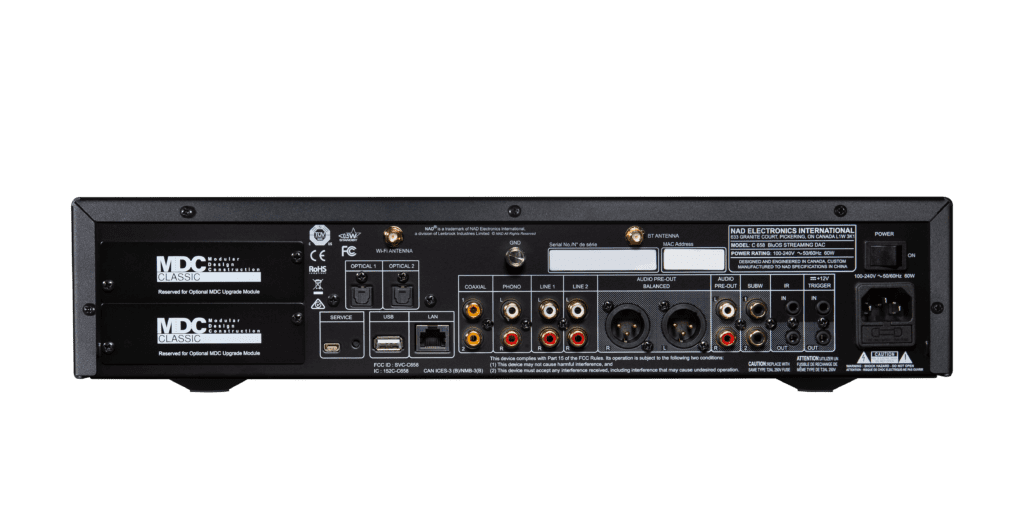
NAD’s new C658 streaming DAC packs a huge number of advanced technologies and capabilities into an affordable package. The C658 is a BluOs-enabled streamer that incorporates a DAC with MQA decoding, support for about a dozen music-streaming services, network connectivity, a full suite of preamplifier functions, a moving-magnet phonostage, two subwoofer outputs with configurable crossover, and Dirac Live DSP room correction. You can add inputs now and in the future, thanks to NAD’s Modular Design Construction architecture. The C658 even has a Bluetooth aptX HD receiver/transmitter so that you can listen to music through your wireless headphones. The price? $1649. 

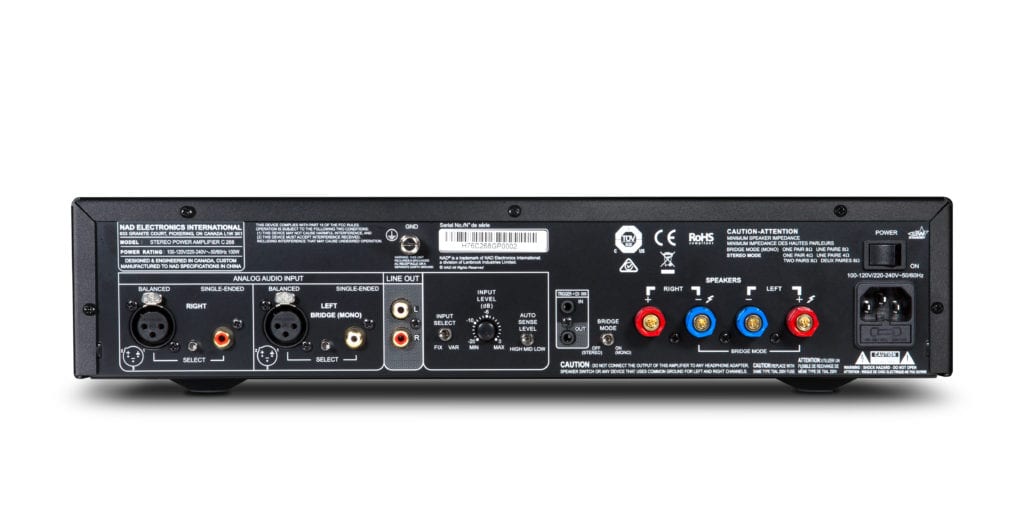
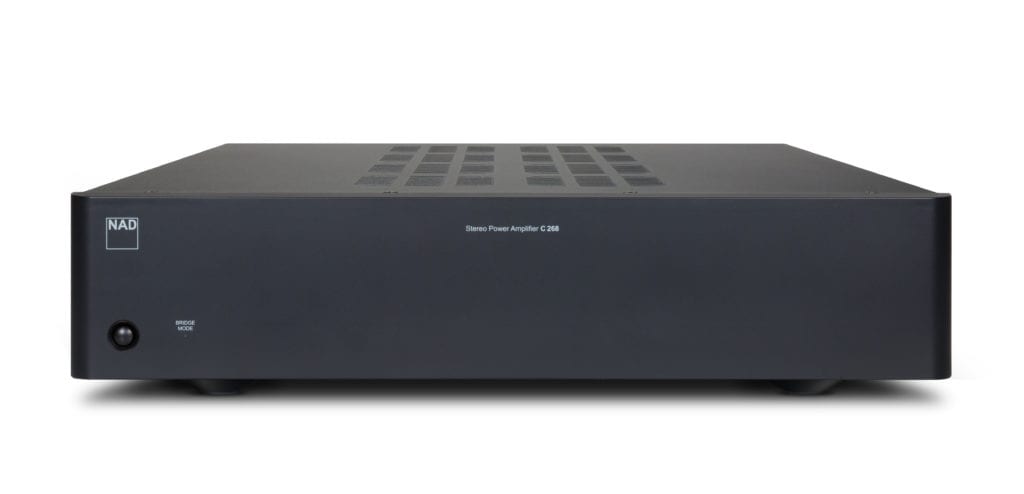
A logical partner for the C658 is NAD’s brand-new, $1999 C298 stereo power amplifier. It, too, is packed with features, including balanced and single-ended inputs, variable gain, line outputs for daisy-chaining multiple amplifiers, a bridging function for monaural operation, an auto-on feature when signal is detected, and remote control. The C298 is one of the first amplifiers to feature a new circuit, called Eigentakt, that is a significant advance in Class D amplification. The Eigentakt output-stage module, created by a new Danish company called Purifi, has extraordinary specifications, including vanishingly low distortion or noise. The design effort was led by Bruno Putzeys, one of the brightest thinkers in switching-amplifier design (Putzeys created the Hypex Ncore Class D module that is the basis for dozens of high-end amplifiers. I describe this new switching-amplifier module, which you are likely to see in many upcoming high-end products, in a sidebar.) 

The C298 is the third NAD amplifier based on the Eigentakt module. The previous iterations are the Masters M33 and M28, each priced at $4999. The C298 is the company’s first attempt to bring the technology to a much lower price point, largely by eschewing the fancy casework of the Masters Series. The C298 is rated at 185Wpc into 8 ohms and 340Wpc into 4 ohms, with a dynamic power rating of 260W into 8 ohms, 490W into 4 ohms, and 570W into 2 ohms. When bridged to operate as a monoblock, the C298 can output a staggering 1000W into 8 ohms.
The C658 network streaming DAC can accept a wide range of inputs (see Specs & Pricing), but will probably be used primarily via its integral support for music-streaming services, and be controlled through the BluOS app. (A full-function remote control is also included with the C658.) BluOS is a wireless digital ecosystem for connecting and controlling a variety of products, including whole-house wireless-audio distribution.        BluOS is a multi-room wireless platform developed by Lenbrook International, and is a sister brand to NAD. BluOS offers a full suite of compatible products for any application. After downloading the app (iOS or Android), you select the BluOS device to stream to, choose music from a streaming service, and enjoy. I logged in to my Tidal and Qobuz accounts, which gave me access to all the music I wanted. You can also connect to any network-attached drives and play music stored on them. Music management is handled through the BluOS app. The C658 shows up as a Roon endpoint (the  C658 was recently Roon certified). BluOS recently made a deal with the Neil Young Archives to provide BluOS users full and free access to the iconic musician’s catalog, all in high resolution. BluOS is compatible with PCM up to 192kHz/24-bit, but lacks DSD support. The optional USB input module will accept DSD up to DSD512, but converts it to PCM at 192/24. The module also accepts USB 2 audio from a computer. Finally, the BluOS app offers a range of free Internet radio services in addition to the paid streaming platforms.

The C658 also allows you to name inputs, set auto-standby time, disable inputs, select between fixed and variable output levels (fixed is the “theater-bypass” mode), trim the gain on each input, engage or bypass the tone (bass and treble) controls, and adjust the display brightness. On the technology side, it’s built around the ESS Sabre 32-bit DAC. The volume control operates in the digital domain, except when the C658 is in the analog-bypass mode.

The C658 is the first NAD Classic Series two-channel product to incorporate Dirac Live. Dirac Live is a DSP room- and speaker-correction system that measures the frequency response and time signature of the sound at the listening position. From this measurement data, Dirac calculates a series of filters that flatten the frequency response and assure correct phase response at the listening seat. Those filters are then downloaded into the C658, which processes the audio signal before the C658’s digital-to-analog conversion stage. In essence, the system “pre-distorts” the audio signal in a way that is the inverse of the distortion created by your speakers and room. That is, Dirac Live modifies the signal driving your loudspeakers so that the final result at your ears is flat in frequency, with most of the sound energy in the room arriving at your ears in phase. Dirac Live doesn’t just look at amplitude information, but also at the room’s time signature. It distinguishes between deleterious reflections, such as floor and ceiling bounce, and later-occurring and lower-amplitude reflections that sound like natural reverberation. 

The version of Dirac Live included with the C658 corrects frequencies up to 500Hz. For the full-frequency-range version, you must pay $99 for the software upgrade. A future software upgrade will provide extensive control over the C658’s subwoofer-output signals. Specifically, it will include a bass-management function as well as clever tricks, such as causing one subwoofer’s output to cancel a standing wave created by the other subwoofer. That feature is like having an active room-resonance-cancelling device built right into the C658 (provided that you have two subs). The C658 hardware, including the two subwoofer outputs, can accommodate this new feature when it becomes available.

Because Dirac Live operates in the digital domain, analog signals at the C658’s input are digitized, processed, and converted back to analog at 192kHz/24-bit. Fortunately, you can bypass the digital conversion on specified analog inputs so that the C658 operates as a pure analog preamplifier. Those bypassed inputs, however, cannot be processed with Dirac Live, and the DSP subwoofer crossover won’t be accessible. (See the sidebar for more about setting up and running Dirac Live.)

Overall, the C658 was fairly easy to operate considering its extensive features and capabilities. I quickly became accustomed to the BluOS app. In typical NAD tradition, the two products’ casework is utilitarian rather than lavish; NAD spends the parts-budget on those components that affect the sound quality. If you prefer a more upscale chassis, NAD offers the Master Series of components.

Listening

I auditioned the C658 and C298 separately in my reference system before using them as a pair. This put each product under the microscope of reference-quality sources, electronics, cables, and the Wilson Chronosonic XVX loudspeakers. For a more real-world situation, I paired the two NAD components with a speaker of commensurate price, the Focal Chora 826, a floorstanding three-way that sells for $2200-per-pair (review upcoming in the April issue). The complete system, without cables, was $5848. I ran balanced interconnects between the two NAD components.

I connected the C658 to my network via an Ethernet cable. NAD also sent to me the Bluesound Pulse 2i, an all-in-one tabletop system ($699) that connects to the BluOS network wirelessly (as I used it) or via an Ethernet port. NAD wanted me to experience how products like the Pulse 2i allow BluOS to function as a whole-house wireless audio system. I wasn’t expecting to receive the Pulse 2i, but discovered that it was a great way to have music outside the listening room. There’s the joke that the audiophile’s way of realizing whole-house audio is to open the listening room door and turn up the volume. I must confess to taking that approach myself. But the ability to place the Pulse 2i in the kitchen, for example, and have full wireless access to high-resolution streaming music controlled by my iPad was compelling.

Starting with the C298, the amplifier had more than enough power to drive the Wilson Chronosonic XVX to any listening level without strain. Even on music with very wide dynamic range (John Williams at the Movies on Reference Recordings) the C298 had plenty of pluck. Peaks were reproduced effortlessly; the bottom end stayed tight and defined at high playback levels; and the soundstage didn’t collapse during the loudest and most complex passages. NAD has long been a proponent of amplification with lots of dynamic headroom, which could be defined as the difference between the amplifier’s continuous power rating on the spec sheet and the clipping point on musical peaks. This approach makes sense; music is dynamic and much of its expressiveness is contained within those dynamic contrasts, and not on steady-state tones. It’s worth noting that the Eigentakt Class D output module is rated at 400W, but NAD specifies the C298’s output power at 185Wpc into 8 ohms. Clearly, there’s a generous amount of headroom.

As with other Class D amplifiers I’ve auditioned, the C298’s bass reproduction was outstanding. This amplifier goes deep, has a nice sense of heft and weight through the midbass, and has terrific dynamic punch on instruments such as kickdrum. An acid-test of bottom-end impact is the track “Octopia” from drummer Simon Philips’ album Protocol II (Qobuz 96/24). In addition to first-rate performances by the entire band (including great guitar work by Andy Timmons), this album showcases Philips’ phenomenal talent, recorded with spectacular drum sound. His huge kit includes many low-tuned toms that put the C298 to the test. The C298 did justice to this album, sounding like an unflappable powerhouse and reproducing the kit with effortless dynamics and impact. 

But it wasn’t just all sledgehammer impact; the C298 also revealed dynamic subtleties and nuance. Throughout the listening, I noticed that the C298 had an unusually satisfying ability to convey music’s rhythmic flow and forward propulsion, from the funky grooves on bassist Brian Bromberg’s Thicker than Water (Tidal MQA) to Ray Brown’s hard-swinging acoustic bass on Soular Energy. This could be the result of the C298’s extremely low output-impedance, which translates to the amplifier having an iron-fisted grip over the loudspeakers’ woofers—either the Wilson’s 12.5″ and 10.5″ drivers or the pair of 6.5″ woofers in the Focal speakers.

The midrange had a nice presence on Norah Jones’ voice on her album Day Breaks (Tidal MQA). Her vocal had good tonality, too, with just a touch of added sibilance. The upper-midrange to lower-treble was a bit forward in perspective, but only a bit. This character brought cymbals and the upper harmonics of instruments to the fore, imparting a lively quality to the sound. Significantly, the C298 lacked the “chalky” haze over the mids and treble that I’ve heard from other switching amplifiers. Instrumental timbre was fairly natural, with excellent resolution of inner textural detail. The C298 was also remarkably adept at revealing subtle instrumental lines. It was easy to hear low-level instruments in the mix or at the back of the hall. The C298’s soundstaging was outstanding—big, open, spacious, and detailed, with precise image placement. If you think of amplifiers in this price as sounding flat, congealed, and a little grainy (compared to reference amplifiers), you’ll be in for a pleasant surprise with the C298.

Dropping the C298 into the middle of a system with $800k worth of source components, electronics, cables, and loudspeakers revealed just what a spectacular bargain this amplifier is. Although not the last word in timbral liquidity, the C298 does just about everything else at a level far above what its price would suggest. It was supremely musical and engaging, particularly the wonderful sense of rhythmic drive and ability to convey dynamic shadings and expression. I have not auditioned many Class D amplifiers, but can confidently say that the C298 is the best switching amplifier I’ve heard.

The C658, in this same system but feeding my reference amplifiers, revealed a good-sounding DAC at this price level. The overall tonal balance was neutral, but with a slight treble emphasis, heard as a bit of additional sibilance on voices. The top end also had a touch of sheen overlying instrumental timbre, and a slight layer of grain. This tended to affect recordings that are inherently bright, rather than blanketing all music. It’s by no means a deal-breaker, but I’ve heard smoother-sounding DACs. 

I was particularly impressed by the C658’s resolution through the midrange; the NAD revealed subtleties of texture and dynamics that are commendable for its price. The bottom end was well defined, and favored articulation over weight, making it easy to follow bass lines. Importantly, the C658 didn’t compress images in the soundstage into two-dimensional representations; rather, image outlines had some tangible space and air around them. The C658 had a good ability to present instruments and voices within a soundstage that was wide and well defined. Dynamics were similarly impressive, with the C658 having the ability to convey subtle nuances of dynamic expression such as gently struck cymbals. 

To get a better feel for the C658’s DAC section performance, I compared it to the AudioQuest DragonFly Red, a $199 overachiever. Although the two products couldn’t be more different in function and capabilities (the DragonFly is a USB stick with no features other than MQA decoding), the AudioQuest, nonetheless, provides a benchmark for what is possible at an entry-level price. The NAD’s bass was a little lighter in weight but more detailed than that of the DragonFly, which was a bit loose and billowy. With the NAD it was easier to follow bass lines, and the overall tonal balance sounded more natural, with the bass better integrated into the rest of the music. The C658 had a much wider and deeper soundstage, with greater spread and separation of instruments in the hall or in the multichannel mix. I also heard greater midrange resolution from the NAD, which better revealed subtle details about how instruments make sounds. The acoustic guitar accompaniment on Norah Jones’ “Come Away With Me” sounded more natural and realistic through the NAD. Overall, the C658 was significantly better sounding than the DragonFly Red. It may not seem fair to compare a $199 USB stick to a $1649 full-featured product; nevertheless, the comparison puts the C658’s DAC performance into perspective. Although you can find better-sounding DACs at the C658’s price, they won’t have the NAD’s extensive capabilities—full preamplifier functions, phonostage, subwoofer outputs with configurable crossover, streaming under BluOS control, and, most significantly, Dirac Live DSP room correction. 

Next, I moved on from the Wilson Chronosonics and listened to the C658 and C298 driving the Focal Chora 826 for some time before engaging Dirac Live room correction. (See the sidebar on setting up and running Dirac Live.) Starting with the stock version that corrects up to 500Hz, I could see in the measured response two peaks of excessive energy in the range from about 80Hz to 180Hz, with two dips below 80Hz. The target curve showed a smoother response after correction, with the gently rising bass of the NAD target curve. In the listening seat, engaging Dirac resulted in more low bass and less midbass bloat. The Focal Chora 826 almost sounded almost like a different speaker in the low end, with greater depth and extension. Kickdrum had more impact, with seemingly much steeper and faster transient attack, coupled with quicker decay. The musical effect was greater punctuation of the rhythm. With the midbass bloat removed, it was much easier to hear nuances in bass playing; pitches were more clearly articulated; and, most significantly, I could more easily hear the starts and stops of each note. With Dirac, individual notes were more distinct in pitch and dynamics. This was true across a wide range of music, from Ray Brown’s acoustic bass on the previously mentioned Soular Energy to Brian Bromberg on Thicker than Water. The overall tonal balance was somewhat lighter and leaner, but this leaning out of the midbass was entirely salubrious; the sound still had plenty of weight and authority, but was cleaner, tighter, and more intelligible.

That impression was with the Dirac version that comes free with the C658, which corrects up to 500Hz. Below this frequency is where room modes are most problematic, and this version of Dirac results in a remarkable transformation of the bass and low bass.

I then switched to the full-frequency-range version, a $99 upgrade, and again measured the system and loaded the new filters from my PC into the C658. I’ve generally believed that it’s best not to try to correct higher frequencies with DSP, for several reasons. First, it’s easy to dramatically change the sound of your speakers (which you presumably like) and get “lost in the woods” trying to find the right tonal balance. It’s easier to do more harm than good. Second, correcting higher frequencies is much more technically challenging that correcting lower frequencies. In my previous experience, it’s best to use DSP to fix the bass and leave the rest of the spectrum alone. 

But that wasn’t the case with Dirac Live. The bass improvements just described were all there, but the effect on the midrange and treble was equally remarkable. Using the NAD target curve (the frequency response the correction system aims for), Dirac didn’t fundamentally change the Focal Chora 826’s smooth and flat tonal balance. Instead, engaging full-range Dirac produced a startling improvements in image specificity, in clarity, in the ability to hear individual instruments through the mix, and in transient response. Sounds started and stopped faster, with less overhang. I also heard a smoother upper-midrange and treble, with less hash. The sound was overall more refined. The impression of individual instruments within a soundstage was heightened.

The full-frequency version of Dirac Live is the most impressive DSP correction system I’ve heard. It is well worth the $99 upgrade. In fact, it made the $2200-per-pair Focal speakers sound like more expensive models.

I next tried Dirac Live with the Wilson Chronosonic XVX, a speaker with much greater bass extension than the Focal. The Wilsons are perfectly positioned in my built-from-scratch listening room, which has good dimensional ratios for evenly distributing room modes. Even with these advantages, rooms will still create peaks and dips in frequency response, caused by the interaction of direct and reflected waves, and between different reflected waves. Two waves combine constructively to produce a peak of energy at certain frequencies, or destructively to create a dip at certain frequencies. Those frequencies are determined by the room’s dimensions. After measuring the system and loading the correction filters for the Wilsons into the C658, I compared with no correction. I did hear an improvement in the bass, but it was an order of magnitude less than with the Focals. The bottom end was a bit more muscular and defined, with slightly better transient performance. 

After lots of swapping individual components in and out of the reference system, and experimenting with Dirac, I finally settled in for some music listening to the system as it was intended; the NAD pair driving the Focal Chora 826 with Dirac properly calibrated. I have to say that the performance of this $5848 system was outstanding, particularly in the bass. The bottom end was quick, articulate, punchy, and had outstanding resolution of pitch and dynamic shading. It was truly a full-range system with a terrific bottom end, a quality that’s very difficult to achieve without spending a lot more money. 

Conclusion

The C658 and C298 can serve as the heart of a capable and powerful music system. The C658 streaming DAC is loaded with all the features needed in today’s digital streaming world, has expandable inputs to accommodate future interfaces, and the BluOS app provides easy and intuitive control over a music library. The C658 can also serve as the heart of a whole-house wireless system. The C298 amplifier is a powerhouse that will drive virtually any loudspeaker. It also has qualities that are consistent with much more expensive amplifiers, including superb soundstaging, clarity of instrumental line, and good resolution of timbre. Bass and dynamics are spectacular, with excellent rendering of pitch and clarity of bass lines. The overall sound is slightly forward in perspective through the midrange and treble, a character that suggests attention to system matching. I can see the C298 delivering terrific performance when paired with much more expensive components. It’s that good.

I would have recommended this pair without Dirac Live, but this DSP speaker- and room-correction system vaults the performance to a new level, without the sonic compromises I’ve heard from some other DSP systems. The improvement in bass extension, clarity, and dynamics is astounding. The full-frequency version of Dirac brings newfound image specificity along with far more lifelike reproduction of transients.

Considered alone or as a duo, the C658 and C298 deliver exceptional performance and value.

Specs & Pricing

C658
Digital inputs: USB, 2x coaxial, 2x TosLink, Gigabit Ethernet RJ45, Wi-Fi 5 (802.11 ac/n), Bluetooth aptX HD (two-way); Apple AirPlay2, HDMI on optional MDC board
Analog inputs: Line in x2 (unbalanced), phono (mm, >80mV overload margin)
Analog outputs: Balanced on XLR jacks, single-ended on RCA jacks, subwoofer output x2
Other input/outputs: IR in/out, 12V trigger in/out, service USB
Formats supported: MP3, AAC, WMA, OGG, WMA-L, ALAC, OPUS, MQA, FLAC, WAV, AIFF; converted DSD supported only via BluOS desktop app
Dimensions: 17 1/8″ x 3 15/16″ x 16″
Weight: 22.3 lbs.
Price: $1649

C298
Output power: 185Wpc into 8 ohms, 340Wpc into 4 ohms
IHF dynamic output power: 260Wpc into 8 ohms, 490Wpc into 4 ohms, 570Wpc into 2 ohms
Mono IHF dynamic power: 1000W into 8 ohms, 1100W into 4 ohms
Inputs: Balanced on XLR jacks, single-ended on RCA jacks
THD: 0.005% at 1W-185W
SN ratio: >98dB (A-weighed, 1W output into 8 ohms)
Input impedance: 56k ohms single-ended or balanced
Dimensions: 17 1/8″ x 4¾” x 15 3/8″
Weight: 24.7 lbs.
Price: $1999

NAD ELECTRONICS
633 Granite Court
Pickering Ontario
L1W 3K1 Canada
nadelectronics.com

The post NAD C658 Streaming DAC and C298 Power Amplifier appeared first on The Absolute Sound.

Neue NAD-Endstufen M28 und C298

Rechtzeitig zum bevorstehenden HiFi-Herbst 2020 erweitert der kanadische Audio-Spezialist NAD sein Portfolio um die überaus leistungsstarke 7-Kanal-Endstufe NAD M28 und den Stereo-Endverstärker NAD C298. Die M28 gehört zu NADs „Masters“ genannten High End-Segment und ersetzt mit ihren sieben, laut Herstellerangaben, extrem verzerrungsarmen, jeweils 340 Watt Dauerleistung (an 4 Ω) mobilisierenden HybridDigital Purifi Eigentakt Verstärkern das bisherige Endstufen-Flaggschiff M27. Für Impulse stellt der Powerblock sogar kurzzeitig eine Leistung von bis zu 700 Watt (ein Kanal an 4 Ω) bereit.

Die exklusive Kombination des NAD eigenen HybridDigital-Konzepts mit der vom dänischen Unternehmen Purifi entwickelten Eigentakt-Technologie soll absolut verzerrungs- und rauschfrei arbeiten und wurde vor kurzem erstmals beim Streaming-Vollverstärker M33 vorgestellt. Die sowohl mit konventionellen Cinch- als auch professionellen symmetrischen XLR-Eingängen ausgestattete M28 ist der perfekte Partner für die ebenfalls siebenkanaligen A/V-Vorverstärker NAD M17 und M17 V2 und kommt noch im September 2020 zu einem UVP von um 5.500 Euro auf den Markt.

Mit zwei überaus leistungsfähigen Stereo-Kanälen geht die ebenfalls brandneue Endstufe NAD C298 ans Werk. Auch dieser Powerblock arbeitet mit der neuen innovativen Purifi Eigentakt-Technologie. Die mit in der Empfindlichkeit regelbaren Cinch- und XLR-Eingängen sowie einem Vorverstärker-Ausgang ausgestattete Endstufe verfügt über eine Dauerausgangsleistung von 2 x 340 Watt und eine Impulsleistung von 2 x 490 Watt (jeweils an 4 Ω). Bei Bedarf lässt sich die C298 in Brückenschaltung betreiben und mobilisiert dann sogar eine Leistung von 620 bzw. 1.000 Watt (Dauer/Impuls an 8 Ω). Der perfekte Spielpartner für den Streaming-Vorverstärker NAD C658 ist ab Ende September zu einem UVP von um 2.000 Euro im Fachhandel erhältlich.

Weitere Infos, Händler und Tests zur Marke NAD

NAD C 298 Power Amplifier with Purifi Eigentakt™

PICKERING, ONTARIO, CANADA – Today NAD Electronics introduced a real game changer. A massively powerful and predictably fantastic sounding stereo amplifier that uses Purifi Eigentakt amplification. A new day has dawned, and NAD rises early with a seriously high-value amplifier. Press Release Enclosed NAD Intros C 298 Power Amplifier With Purifi Eigentakt Amplification Powerful Two-Channel Model Establishes New Standard For High Performance Audio NAD Electronics, a leading manufacturer of premium home audio and video products, announced another high- performance amplifier that uses Purifi Eigentakt amplification technology. The C 298 is a two-channel powerhouse that is a perfect partner to high quality preamplifiers or in any application where additional channels of audiophile amplification are desired. This new NAD classic amp boasts 185 Watts per channel into 8 Ohms and can be bridged to 620W X 1 into 8 Ohms to create a huge Monoblock. The C 298 ($1,999 U.S. MSRP) will be shipping in October 2020. Traditional with all NAD components, the C 298 represents exceptional value offering performance, features and technology unmatched by other amplifiers in its class. The new NAD basic amplifier is a compelling upgrade for virtually any advanced HiFi system and its robust power with upgrade flexibility […]

NAD Now Shipping MASTERS Series M33 BluOS Streaming DAC Amplifier

PICKERING, ONTARIO, CANADA (PTA) — NAD Electronics is now shipping their MASTERS series M33 BluOS Streaming DAC Amplifier with the new power and features. Most exciting is the new Purifi Eigentakt Hybrid Digital amplifier modules used in the new M33. Purifi if you are unaware, is a new company based in Denmark that specializes in digital amplification, and stands at the leading edge of the technology. Someone you are probably aware of is Bruno Putzeys, who is the company’s Co-Founder, and inventor of the UcD (Philips) module, probably still the most widely used class-D amplifier for upmarket audio products. He is also the inventor of Ncore (Hypex), which is generally considered the first class-D amplifier to successfully compete with class-A on audio performance. Bruno developed high performance A/D and D/A converter designs for Grimm and Mola-Mola. He is also co-founder for Kii Audio, and himself holds 8 patents and multiple patent disclosures. Bruno co-founded Purifi with Lars Risbo, and Peter Lyngdorf. NAD NOW SHIPPING MASTERS M33 BluOS STREAMING DAC AMPLIFIER Flagship Model Builds On Brand’s Remarkable Success with Advanced Features, Cutting-Edge Technology and High Power NAD Electronics, the highly regarded manufacturer of high-performance audio/video components, announced it is now shipping […]