Tag Archives: NXEARS OPERA

NXEars Opera

NXEars is one of many newcomers in the personal audio space, but it comes with a lot of back-story and all of it is good. The brand was founded in California and builds in China; its founder was one of the brains behind NuForce and a former Knowles engineer, which gives the company a unique insight into what a pair of IEMs will be used with, and the construction of drivers used in most earphones, custom and universal in-ears.

NXEars may be comparatively new, but its three-strong range has already caught the attention of the personal audio cognoscenti and the Sonata, Basso and the flagship three-way, eight-driver Opera we’re testing here. Two distinct technologies unique to the brand have been noticed in a very contended world.
NXEars Opera

All three IEMs use NXEar’s unique Aperiodic Ground Loading (AGL) system, which manages to retain the core of a good IEM (shutting out the world outside) while reducing the pressure build-up that comes from pushing a mostly rigid structure into your ear. AGL restores the balance of natural pressure that occurs in the ear canal. In addition, the Opera uses NXEars’ own ‘Linear Phase Crossover’ system that corrects the irregular phasing that is an unfortunate function of multi-driver setups; even the eight Knowles balanced armature drivers, tuned and used in the Opera.

All eight drive units would occupy the same physical space in an ideal world, but this is impossible. Those different driver positions and a range of bandwidths from each driver means phase issues, even frequency cancellations. These problems go away by adding time and phase alignment to the crossover.

Opera storage

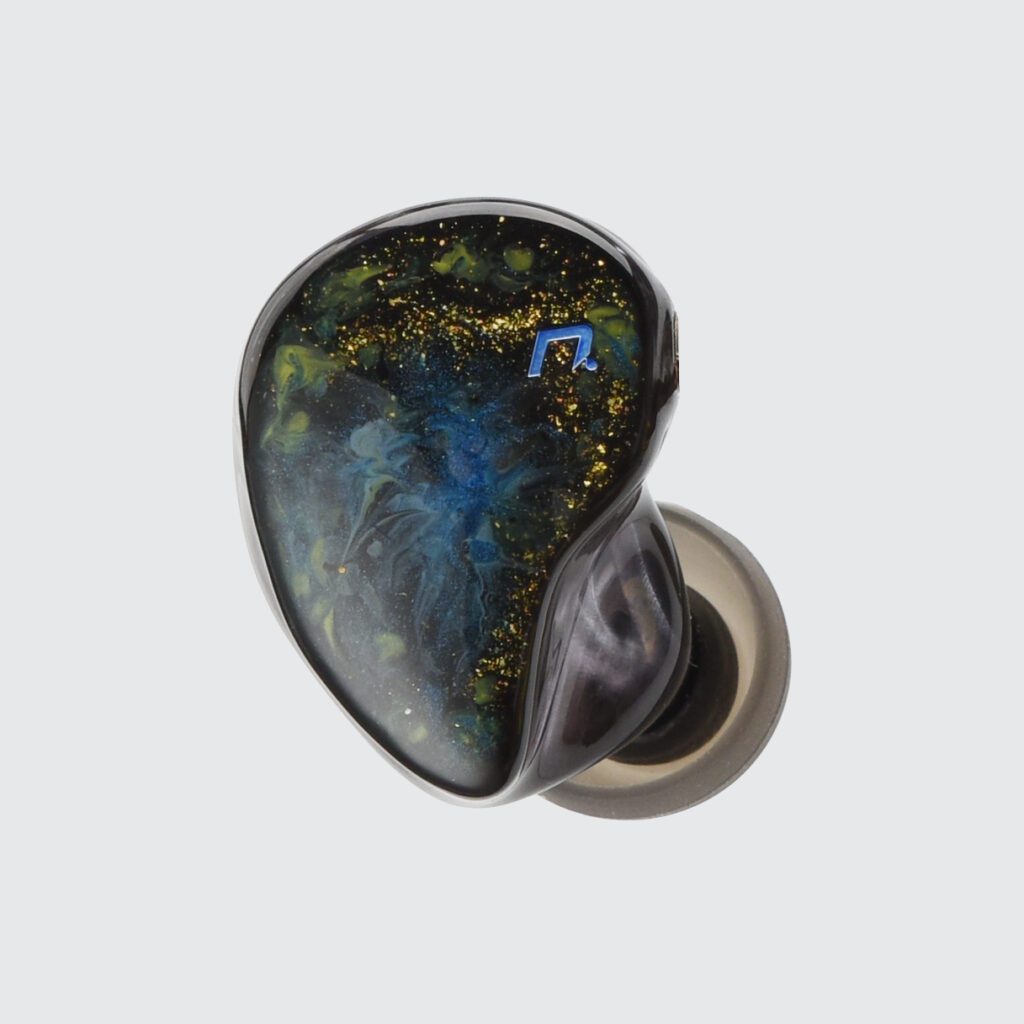
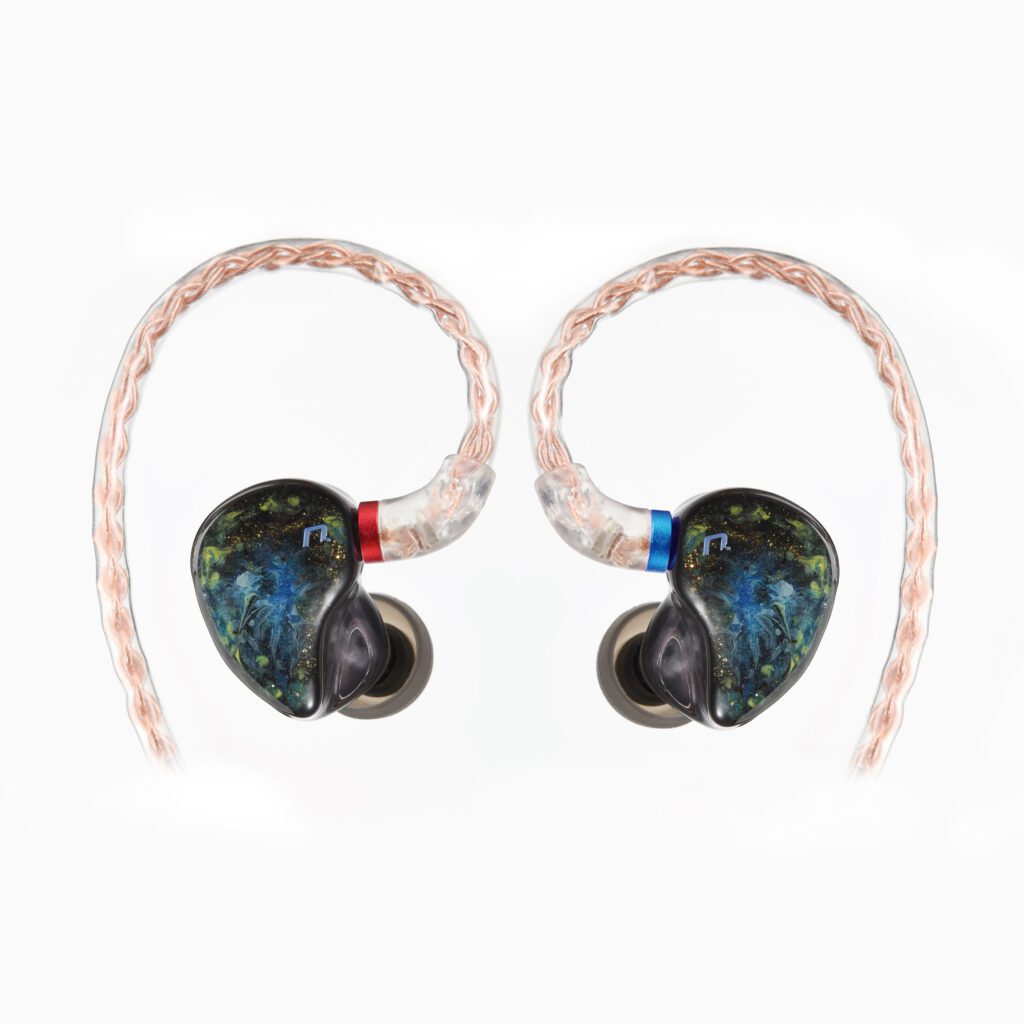
Opera comes in a black storage case in a nice white box with an NXEars on the outside. Inside are the Operas themselves, with a good Mono-crystal 6N copper, eight-conductor braided 3.5mm cable, four pairs of silicone and two pairs of foam ear tips, some clips, a smaller pocketable case, a cleaning tool and some documentation case candy. The 3D-printed earpieces are made of semi-transparent dark blue with a distinctive Stardust Blue design on the outer facing.

Each model’s outer facing is unique, and the logo is etched into this front face. The small logo is ‘subtle’, to the point of almost complete invisibility. As with most Custom and Universal-Fit IEMs, the Opera ‘screws’ into your ear, making a complete seal, then the cable has a curved strain relief that hooks over the top of your ear.
NXEars Opera

The Opera IEM has a standard MMCX connector and nozzle length to allow aftermarket cables and ear-tips. While the cable is good enough not to need an upgrade (although upgrades do improve the performance), this is a good plan because the choice of ear-tip is vital. As the AGL system relieves pressure build-up in the ear canal, the performance of the Opera is strongly contingent on making a good seal with the ear-tip itself.

However, unless they are a dreadful fit for your ears, I would recommend using the medium silicone tips fitted as supplied for the first 50 hours of listening to let the Opera’s drivers loosen up, then find the best fit knowing the Opera’s tonal balance is as good as it’s ever going to get.

Single driver over balanced armatures

Of late, I’ve found myself more drawn to single-driver IEMs rather than models with multiple balanced armatures. This is because many such models trade ‘long-term listening’ for ‘short-term excitement’; multiple drivers often sound exciting initially but ultimately wearing. The Opera is a delightful exception; the sound is detailed but not aggressively so, with a more natural and traditional loudspeaker-like presentation in all the ways that count (as in ‘refinement’ rather than ‘box coloration’ of course). It has the insight and drive of good IEMs but without the overtly exuberant or hyper-energetic sound commonly associated with the breed. There’s rich, chocolatey darkness to the sound that is more beguiling than muddy, which is truly excellent.

That richness extends down into the midrange, with a valve-like warmth and naturalness to the sound. Perhaps more significantly, there’s a seamless coherence to the sound across the frequency range that gives the Opera a sort of analogue-like openness and musical integrity often lost on multi-way IEMs. This, coupled with a surprisingly large and delateralised (perceived to be way outside of the listener’s head) soundstage, make the Operas a model of refinement in the true high-end audio sense.

It’s not all rosy, however. Or perhaps the point is it is a little too rosy at times. While I like the Opera very much for not making a bright, forward, and uneven presentation, by the same token, this can work against the Opera when playing more laid-back music, especially older, slightly rolled-off treble sounds. This can end up sounding too soft and saccharine sounding at times. But this is a trade-off I’d happily make compared to the sharp stinging treble of many IEMs.

Where the Opera shows itself to be a true star, though is in the lower regions. Bass is at once fast and warm and quite ‘meaty’ sounding. But perhaps what attracts me to the NXEars Opera sound is the way it doesn’t dissect the music in the way many IEMs can. It’s still an extremely analytical sound and gives you excellent insight into what’s going on with the music played, however, and instead focuses on the whole musical presentation. That suggests a more mature, sophisticated musical ear behind the voicing of the Opera and highlights how its tuning has paid off.

The pressure’s off

Finally, a word on that AGL system that reduces pressure in the ear canal, and that word is ‘wow!’. It works and delivers effortless long-term listening without that uncomfortable ‘underwater’ pressure build-up.

The NXEars Operas are at once easy to drive, easy to wear, and easy to listen to. They need a long run-in, and you must use the right ear-tips to get the most out of them, but it’s worth the effort if you crave refinement!

TECHNICAL SPECIFICATIONS

  • Type: Balanced-armature, universal-fit in-ears
  • Impedance: 18 ohms
  • Sensitivity: 100dB
  • Price: $799

Manufacturer:

NXEars

URL: nxears.com

Back to Reviews

The post NXEars Opera appeared first on Hi-Fi+.

Soft Ears RSV Review – Mastering Versatility

Pros –

Flawless gloss finish, Comfortable and well-isolating design, Quality stock cable, Highly refined and versatile tuning, Excellent dynamics for a BA design, Jack of all trades master of many, Easy to drive

Cons –

Treble extension and sub-bass definition could be improved, Soundstage depth just above average in-class

Verdict –

The RSV is one of the most well-rounded and instantly likeable earphones I’ve tested, representing an excellent value proposition even at its elevated price tag.


Introduction –

Soft Ears are the luxury division of the now widely renowned Moondrop, seeking to offer a more refined experience at more premium price tiers. Their product portfolio is more focused and mostly high-end focused. This starts at their all-out co-flagships, the 10x BA driver RS10 reference monitor and their Tribrid Cerberus. Alternatively, the Turii offers a high-end single-DD configuration that has become more popularised in recent years. The RSV is their cheapest model if not a cheap earphone in isolation. The team spent 1 year honing it to perfection, aiming to offer a scaled back version of the RS10 experience with the same technologies and engineering on a simplified and easier to drive 5-BA platform. Compared to the flat out reference RS10, the RSV has been slightly reworked to provide a heavier emphasis on dynamics. Its engaging yet immaculately clean sound, ease of driving and more accessible price point makes it a great choice for audio enthusiasts.

The RSV comes in at $729.99 USD. You can read all about it and treat yourself to a unit here.

Disclaimer –

I would like to thank the team at Soft Ears very much for their quick communication and for providing me with the RSV, RS10 and Cerberus for the purpose of review. All words are my own and there is no monetary incentive for a positive review. I paid a slightly reduced cost for the earphones in return for honest evaluation and will attempt to be as objective as possible.

Contents –

Specifications –

  • Drivers: 5x BA
  • Crossover: 6-Component, 3-way
  • Sensitivity: 125dB @ 1kHz
  • Impedance: 8 Ohms
  • Frequency Response: 5Hz – 40kHz
  • Socket: 0.78mm, 2-pin

Behind the Design –

Tuned Acoustics & Crossovers

The combination of electronic crossover and passive filters has enabled Soft Ears to achieve their desired note presentation in addition to their ideal frequency response. Using a 3rd order LRC filter for bass, impedance + low-pass for the midrange and film capacitors for the high-end, the company was able to achieve both whilst maintaining almost linear phase. This is aided by the 3D-printed shell and internal acoustics, leading to maximised extension, resolution and sharper imaging.

VDSF Tuning

Moondrop pioneered the VDSF tuning curve which is a combination of the diffuse field neutral and Harman Curves which have become industry standards as of late. Every model lies on a spectrum between both. The Moondrop sound has become hugely popular with users and critics alike due to its combination of timbral accuracy, balance and improved listenability over time compared to the vanilla Harman and DF Neutral curves. The RSV represents one of the most refined takes on it yet.

Unboxing –

The RSV has the most exclusive unboxing of the Soft Ears line-up with a large magnetic box that folds open to reveal the leather carrying case and accessories within a separate box. The case contains the earphones and cable. Each earpiece comes protected within a fabric pouch that prevent scratches during shipping. The accessories include 3 pairs of silicone tips in addition to 3 pairs of memory foam tips that offer a warmer, softer sound. In addition, a cleaning tool is provided alongside a metal Soft Ears card. Of note, the tips have an especially large bore size which can limit aftermarket pairings. The stock tips also have a seat promoting a more homogenous fit depth, likely in order to provide a more consistent sound between listeners. As there was such a heavy emphasis on tonality on this earphone, I decided to stick with the stock ear tips, of course, experiment for your preference if this is not to your liking.

Design –

As a huge car fanatic, the RSV invoked some primal instinct in me. From the sleek, smooth yet symmetrical styling to the gold foil inlay atop carbon fibre faceplates, the RSV advertises its sporty, high-performance nature. I am a huge fan of the combination of texture and simple yet flawlessly finished 3D printed piano black that oozes quality even in the absence of metal and its associated density in the hand. With its solid 3D-printed design, the RSV feels far more substantial than your average acrylic monitor. If I had one complaint, perhaps the nozzle could have a small ridge to help tips stay attached as those with wet wax may find themselves having to clean them frequently.   

Up top are 2-pin 0.78mm recessed connectors compatible with a wide range of aftermarket options. The stock cable leaves little to be desired, with a smooth matte jacket and very sturdy yet minimally cumbersome construction. The wires are a little springy though it is supple enough to coil without issue and microphonic noise isn’t exacerbated either. The pre-moulded ear guides are comfortable and the connectors complete the aesthetic with their clean matte black finish. Altogether a well-considered package, perhaps a modular or balanced termination could have been employed. Arguably, their use of the widely adopted 3.5mm standard is in line with the company’s intentions that this monitor should be enjoyed from almost any source.

Fit & Isolation –

This is a medium-sized earphone and its fit will be reminiscent to anyone familiar with faux-custom style monitors. It sits comfortably in the outer ear and its rounded design is devoid of features that may cause hotspot formation over time. It protrudes slightly, meaning they won’t be suitable for sleeping on, but the RSV isn’t especially bulky either. For my ears, they were comfortable for hours on end and I achieved a strong, consistent seal. Due to its fully sealed design and well-shaped body, the RSV is very stable and forms a great seal with its slightly deeper fit. Those sensitive to wearing pressure will have a similar experience here to other sealed in-ears that said. In addition, wind noise isn’t an issue and isolation is strong, great for commute and even travel, especially with foam tips installed. This also means the earphones don’t require huge bass emphasis to sound great in louder listening environments.

Next Page: Sound Breakdown & Source Pairings

The post Soft Ears RSV Review – Mastering Versatility first appeared on The Headphone List.