Tag Archives: Others

Universal Audio Dream ’65 Reverb Amplifier – A Real-World Review

You can create clean, crunchy and overdriven amp tones from the front-panel controls of the Universal Audio Dream ’65 Reverb Amplifier pedal.
MIX VERDICT: Universal Audio Dream ’65 Reverb Amplifier
THE TAKEAWAY: “No matter your workflow, you will surely be impressed with the authentic guitar amp sound and playing experience.”
COMPANY: Universal Audio • www.uaudio.com
PRICE: $399
PROS:
• Authentic touch and feel.
CONS:
• Amp knobs and switches can only be edited in accompanying app.

The Dream ’65 Reverb Amplifier is one of three amp-emulating pedals in Universal Audio’s UAFX effects line, its two siblings being the Ruby ’63 Top Boost Amplifier (based on a Vox AC30) and Woodrow ’55 Instrument Amplifier (based on a “tweed” Fender Deluxe). As the name hints, the new pedal is based on a ’65 Fender Deluxe Reverb.

The three pedals have many similar features, but each has a unique sound and control set. This review is specific to the Dream ’65 Reverb Amplifier. Although it offers many handy features for live use, I’ll concentrate here on its utility in the studio.

The Dream ’65 Reverb Amp is housed in a heavy-duty metal chassis. It runs on a 9V DC power supply, which is not included. It should run fine on a pedalboard’s 9V power supply.

The I/O features two 1/4-inch inputs and two outputs, so you can connect mono or stereo sources. Controls include Volume, Reverb, Output, Bass, Treble and Boost. The latter two also function as the Speed and Intensity for the gorgeous-sounding Vibrato effect.

The Volume knob governs input gain while the Output functions as a master volume. The higher the gain, the more overdrive. You can use the Boost knob to push the saturation further and change the overdrive characteristics depending on which of the three Amp Mod settings you choose.

The Reverb accurately re-creates the sound of an amp’s spring reverb. The Speaker switch lets you choose between emulations of different speaker cabinet configurations (each of which was modeled through a different mic). If you’re using the pedal connected to an actual guitar amp, you can turn off the cabinet simulation.

Universal Audio Sphere DLX, LX Modeling Mics Launch

You’ll get the most out of the Dream ’65 Reverb pedal if you register it on the UAD site and download the free UAFX control app (iOS and Android). You can use the pedal without the app, but it won’t have all its functionality.

The app communicates with the pedal over Bluetooth, and when open and paired, you get several benefits, including three additional speaker cabinet emulations. It also provides access to banks of Factory and Artist presets, along with a User category for saving your settings. I was disappointed to discover that you can’t edit any of the amp knobs and switches from the app, only from the pedal itself.

With the pedal connected to my audio interface, I found it easy to quickly dial in settings—both clean and overdriven—that sounded like they were from a well-miked vintage Deluxe Reverb. The touch and feel when playing guitar through the pedal are amazingly authentic—more so than with any amp modeling plug-in I’ve used.

Another advantage to recording direct through the Dream ’65 pedal is that you don’t have to worry about the volume from an actual guitar amp. Use it for late-night sessions or to avoid bleed when tracking a band in a single room. Because the pedal is creating the amp simulation, you can monitor with zero latency.

If you prefer recording dry DI guitar parts to keep your sound options open for the mix, you could always reamp them through the Dream ’65 pedal later, although you’ll need a separate reamp box to do so.

No matter your workflow, you will surely be impressed with the authentic guitar amp sound and playing experience that the Dream ’65 Reverb Amplifier pedal provides. It’s a potent new option for recording electric guitar.
FarPlay 1.05 Remote Musical Collaboration App – A Product of the Week Review

FarPlay 1.05
FarPlay 1.05

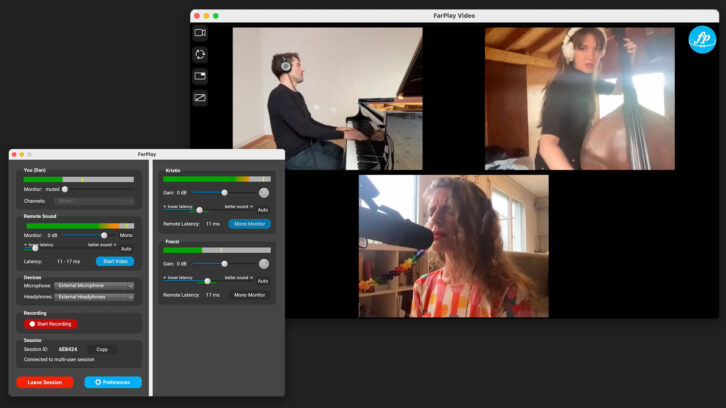
If you want to collaborate online with other musicians and have the option of recording your performances or jams, the FarPlay application offers an elegant solution. Created by renowned jazz pianist Dan Tepfer and developer Anton Runov, the software provides a low-cost, high-quality solution for online musical collaboration.

You can use FarPlay for online rehearsing, music lessons, live webcasts (in conjunction with Open Broadcaster Software) and more. There’s no hard limit on the number of participants in a FarPlay session. According to the developers, it depends on the processing power of the computers involved and their internet connections. They’ve successfully tested the software with as many as nine participants in a session, and say that FarPlay can achieve latencies below 10ms, depending on the distance between participants. A 10 ms delay is equivalent to playing in the same room with somebody standing 10 feet away from you.

I had a chance to demo FarPlay with Tepfer. I was playing electric guitar in my studio, and he was playing piano in his studio. We jammed at several different tempos, and it felt like we were playing in the same room. Our studios were about 50 miles apart, but FarPlay can work over hundreds or even thousands of miles.

How did FarPlay succeed where other online-collaboration software has failed—or at least requires additional, dedicated hardware to reduce latency to comfortable levels? One reason is that it connects participants through a peer-to-peer architecture with no server in the middle. In addition, it uses uncompressed audio, dramatically reducing latency because it doesn’t have to go through compression or decompression, which, in this context, is time-consuming.

The software is simple but offers users a lot of control. Each participant can create their own monitor mix, using level controls for themselves and everyone else logged on. In addition, each user can adjust their buffer size, which lets everyone involved dial in the best combination of low latency and audio quality.

PSPaudioware PSP 285 — Product of the Week

You can also turn on a low-latency video feed so you can see the others in your session (because of the nature of video data transfer, the video you see during a session won’t be totally in sync, although it’s “low-latency,” according to FarPlay).

Pressing the Recording button on the software creates separate, perfectly synched, uncompressed tracks for each participant, which you can mix later. The software features both a monitor output and a broadcast output. The latter provides a feed of the multitrack session audio using a separate, much larger buffer, that delivers artifact-free audio that you can use for live webcasts.

FarPlay runs natively at 48 kHz, and version 1.05, which was just released, can convert 44.1 kHz (or any other sample rate) audio on the fly without additional latency or any pitch issues. The application runs on Mac, Windows and Linux computers and requires no special hardware. It works with your existing audio interface. You can even use your computer’s built-in audio (although FarPlay says the built-in mics on MacBooks made after 2015 add about 30 ms of latency and suggest an external interface or even a set of wired Apple EarPods). All participants must have wired headphones of some type.

The developers highly recommend using a computer physically connected to the Internet through Ethernet. The website states, “the faster your connection, the better your results will be…FarPlay has been successfully tested with upload speeds as low as 8 Mbps.” You can use FarPlay on a computer with a Wi-Fi connection, but according to the developers, you’re likely to experience more latency than with a Wired connection.

You can use FarPlay for free, albeit with some limitations. You can only have one other participant and sessions are limited to 45 minutes each. If you want access to advanced features such as unlimited session time, multiple participants, multitrack recording and the broadcast output, you can get the Premium subscription for $7.99 per month. (FarPlay also offers a slightly less featured $5.99/month subscription).

McIntosh announces MB20 Bluetooth Transceiver

Stream to a McIntosh of Any Era.

Binghamton, NY – May 20, 2021 – McIntosh, the global leader in prestigious home entertainment and ultimate-quality audio for over 70 years, is proud to introduce the MB20 Bluetooth Transceiver.

The MB20 Bluetooth Transceiver is an easy and simple solution to add McIntosh quality Bluetooth® streaming capabilities to virtually any McIntosh (or non-McIntosh) home audio system of any era. It can quickly turn a vintage McIntosh system that you’ve treasured for decades, or a family heirloom system that you’ve inherited, into a modern home music system capable of playing the digital music stored on your phone, in your cloud accounts, or from your preferred streaming services. It is a small (its footprint not much bigger than a smartphone), stand-alone, complete Bluetooth streaming solution.

As a transmitter/receiver, the MB20 has been designed to provide a superior Bluetooth connection to audio equipment that lacks Bluetooth connectivity. As such, it has been engineered as a Class 1 Bluetooth device. Class 1 devices can typically operate at a range of up to 150 feet (45.7 meters) (footnote 1) in ideal conditions with limited obstructions. As a Receiver, the MB20 employs an extremely sensitive receiver for better reception, even from Class 2 devices, with the maximum range determined by the capabilities of both actively paired devices. An external antenna helps maximize its range for better performance. As a Transmitter, it has a range 10x greater than that of a typical Class 2 Bluetooth device.

The compact MB20 comes with a variety of analog and digital inputs and outputs to connect it to your home audio system – most notably amongst them being balanced inputs and outputs, making it one of the only Bluetooth transmitter receivers to offer these superior audio connections that help deliver top quality audio performance. For connecting it to your system via analog cables, it includes one stereo set of both balanced and unbalanced inputs, along with a stereo set of balanced and unbalanced outputs. For digitally connecting it to your system, such as for use with an outboard Digital-to-Analog Convertor (DAC), it has one each of both coaxial and optical inputs and outputs.(footnote 2)

The MB20 uses Bluetooth 5.0 with support for both the high bitrate Advanced Audio Coding (AAC) standard as well as Qualcomm® aptX™ HD for hi res audio playback. It also features Qualcomm aptX Low Latency for improved audio transmission speed to deliver sound in sync with applicable visual media. When used as a Receiver, the MB20 uses a high-performance 32-bit DAC with 192kHz internal processing for optimum sound quality; when used in combination with a separate outboard DAC, the MB20’s digital output is fixed at 96kHz to be compatible with most third-party DACs in order to maximize performance and maintain audio signal integrity. When in Transmitter mode, it uses an equally capable high-performance Analog-to-Digital Convertor (ADC) with 110dB Signal-to-Noise Ratio (SNR).

As a transceiver, the MB20 can function as either a Bluetooth Receiver or Transmitter (but not both at the same time). Simply set the switch on the back panel to the proper setting for the desired Receiver or Transmitter usage.

Usage examples:

  1. In Receiver mode, you can stream to the MB20 via Bluetooth from any compatible device with Bluetooth streaming capabilities; this audio can then be played through your McIntosh system regardless of when your amplifier or preamplifier was made.
  2. When in Transmitter mode, you can stream from the MB20 to any device capable of receiving Bluetooth streamed audio. In this setup, you could stream the music stored on physical media, such as CDs or vinyl records, to your wireless Bluetooth headphones or wireless Bluetooth speakers.
  3. If you have more than one audio system in your home that are within range of each other1 then a third option is to add an MB20 to each system and set one to Transmitter mode and the other(s) to Receiver mode. Then you could stream music stored on a physical medium, such as from a CD player or turntable, from one system to the other system(s) in your home. Or if you have the need for a high-performance audio link from one part of your house to another but running cables is not possible, then two MB20s wirelessly connected in this manner could create a full wireless encode/decode bridge.

It comes in a black, custom aluminum chassis with a black glass top panel, letting it fit right in with any McIntosh system. The MB20 will also work with any non-McIntosh home audio system that has the proper inputs and outputs. It includes a wall mount charger with adapters for some of the most common outlets used around the world.(footnote 3)

Footnotes:

1. The MB20 is a Bluetooth Class 1 device. Actual range of Bluetooth Class 1 technology may be affected by physical obstacles
as well as the performance of devices with which the MB20 is intended to connect, particularly Class 2 devices.
2. The MB20 cannot be used as a stand-alone Digital-to-Analog Convertor (DAC).
3. Includes a wall mount charger with a Type A (120V 60Hz) plug for use in the United States; adapters for use with Type F
(220 – 240V 50 – 60Hz or “Schuko”) and Type I (220 – 240V 50Hz). As defined by the International Electrotechnical
Commission.

Pricing and Availability

Orders for the MB20 can now be placed with Authorized McIntosh dealers with shipping expected to begin in May 2021 to the United States and Canada, and to the rest of the world shortly thereafter.

Suggested retail price (VAT, shipping and any customs duties related to current standards of individual countries are excluded): $500 USD.

About McIntosh

Founded in 1949, McIntosh Laboratory, Inc. is known for offering distinguished quality audio products, superior customer service and the ultimate experience in music and film. All McIntosh products are handcrafted at the Binghamton, NY factory by over 150 employees with a passion for music and the McIntosh heritage. McIntosh continues to define the ultimate home entertainment experience for discriminating consumers around the world, with the iconic “McIntosh Blue” Watt Meters globally recognized as a symbol of quality audio. Since its inception, McIntosh has been powering some of the most important moments in music history and pop culture. From President Lyndon Johnson’s inauguration speech to Woodstock to the famous Grateful Dead “Wall of Sound,” McIntosh has not only witnessed history, it has shaped it. With McIntosh, customers have the ability to create their own premium audio experience – and truly live their music. Visit www.mcintoshlabs.com to learn more.

The post McIntosh announces MB20 Bluetooth Transceiver appeared first on Dagogo.

MOON products now feature Apple Airplay 2

The following is a press release from Simaudio.

MOON is delighted to announce that its performance audio streaming products* are even more connected as they now feature Apple AirPlay 2. The new integrated streaming module effortlessly allows Apple users to play music from any iOS device and to change music with Siri voice control. AirPlay 2 also adds multi-room playback to MOON’s premium selection of connectivity options.

The MiND2 streaming module and intuitive MiND app have ensured that MOON has long been the master of music control. The addition of AirPlay 2 further increases the range of connectivity options and will delight Apple lovers as the built-in controls on their device allow them to easily access their music. MOON owners can use Siri voice control to play their selected tracks.

AirPlay 2 offers complete control and lets the listener enjoy their favourite music or podcast throughout the home and in perfect sync. Different songs can be played in different rooms – music can be streamed in one room and a podcast can be played in another. With AirPlay 2 friends can add their own music to the mix. And all listeners can use Siri and say the song, say the room and then enjoy the performance.

Existing MOON owners who want to add AirPlay 2 can contact their local dealer to arrange to have the new module installed.

Etienne Gautier, MOON’s export sales manager, said: ‘We are pleased to partner with Apple and to have AirPlay 2 integrated in our streaming products. Our premium connectivity solutions have always been at the heart of what we do and now AirPlay 2 gives our customers a truly complete range of options.’

*MOON products featuring Apple AirPlay 2
● ACE – all-in-one music system
● MiND 2 network player
● 280D – streaming DAC
● 390 – network player/preamplifier
● 680D – streaming DAC
● 780D v2 – streaming DAC


The post MOON products now feature Apple Airplay 2 appeared first on Dagogo.

Aurender N100SC caching music server and streamer Review

There are days when I need to refresh my listening habits and switch to the analog system headed by the Clearaudio Master Innovation turntable and the Top Wing Suzaku coreless cartridge, before playing music on the SACD player again, vice versa. Prior to receiving the Aurender, hard-disk and Tidal music listening meant connecting a USB hard-disk to my Apple MacBook Pro and having the Audirvana streaming platform for Tidal, while the Oppo UDP-205 would function as renderer for the 2014 Esoteric K-03. A Combak Harmonix coaxial digital cable and a Light Harmonic Lightspeed USB cable would link the Oppo to the Esoteric alternately. Came 2020 and the leaps and bounds advancements in hard-disk music playback technology in the preceding years seemed to have subsided. I thought the technology might’ve reached maturity into which for me to dip my toes.

Aurender is one of a few companies specializing in high resolution hard-disk and streaming playback, and I was sent the N100SC, an N-series half-width dandy server/streamer in a tastefully designed industrial-grade aluminum enclosure. Though half-width, it is 14 inches deep with all connectors in the rear. Appropriate placement is warranted. There are thirteen current models in the company’s server/streamer product lineup. The entry-level N variants begins with the USB output-only N100H at $2,700 that comes with a 2TB hard-disk nonetheless, the $3,500 N100C equipped with both USB and Coaxial digital outputs and a 4TB hard-disk, and the $3,300 N100SC with the same outputs and optional hard-disk, such as the subject of this review which is equipped with a user-installed 2 TB hard-disk. Obviously, Dagogo readers who are 100% streamers don’t need the optional hard-disk, and conversely for those among us with a humongous collection, there’s the recently released Samsung 870 WVO 8TB SSD!

There are also the $8,000 N10-4TB and $8,500 N10-8TB server/streamers with a USB 2.0 port that utilizes a OCXO-based precision clock to produce up to DSD128 in resolution via DSD-over-PCM, and then the RCA Coaxial, BNC, Toslink and AES/EBU outputs to deliver up to 24 Bit 192KHz of resolution.

Per John-Paul Lizars, Director of Sales and Marketing, “We take great care to minimize the jitter and noise [on the N10 and higher models] by using two high-precision OCXO (oscillators). Each one handles a different sampling frequency range (multiples of 44.1KHz and 48KHz). And to minimize AC power noise we pay special attention to grounding and the use of ultra low-noise regulators.

We always suggest customers try both the USB and coax to determine which works better with their DAC, keeping in mind that the coax has a 192 KHz sampling rate limit, while USB is good out to native DSD.”

The Coaxial digital output on the N100SC is a converted signal from the USB output and does not feature the precision of the OCXO clock.

Moving up the hierarchy are the “A”, “ACS”, “X” and the flaghship “W” series.

The “A” series begins with the $3,900 A100, an MQA DAC featuring the Asahi Kasei AK4490 32 Bit 384KHz chipset, RCA analog outputs, volume control and a 2TB hard-drive. The $5,500 A10 adds dual-mono DAC operation and a 4TB hard-drive. The $18,000 A30 uses two AK4497 in dual mono configuration with dual mono linear power supplies, outputs up to 32 Bit 768KHz through its USB, up to 24 Bit 192KHz through its RCA SPDIF, BNC SPDIF and the two Toslink outputs, complete with an OCXO-based precision clock, one dedicated transformer for the Intel N4200 Quad Core CPU, another for the field programmable gate array and the clock, a third one for the three headphone outputs, and two more for the DAC, plus a Teac CD-ROM Drive, Super Capacitor Based Internal UPS for safe shutdown, double-isolated Gigabit Ethernet, a 10TB hard-disk, etc.

Aurender A30

There are also three models in the ACS series, namely the $3,500 compact ACS100 which comes complete with the server/streamer functionality with a CD ripper and optional hard-disk, the $6,000 full-chassis ACS10-16TB which adds a 16TB hard-disk, and the $7,500 ACS10-24TB, adding a 24TB hard-disk.

Atop all models is the digital output-only $22,000 W20SE, an upgraded version of the W20: “New Flagship Caching Music Server and Streamer / MQA Core-Decoder / 4TB SSD Storage with 1TB SSD Caching / Battery Operated Power Supply for Audio / Full-Linear Power Supply for CPU / Double-Isolated LAN and Audio USB Port / Dual-AES/EBU up to 24-Bit 384KHz, Coaxial, BNC and Optical Outputs / Word Clock Input.” For readers using a separate DAC and demanding a flagship server and streamer, the W20SE is it. Otherwise, the A30 with analog output is the ultimate Aurender playback machine.

Primary auditioning of the N100SC took place in conjunction with the new $23,000 Esoteric K-01XD SACD player and the $19,000 Bricasti Design M21 DSD DAC, although the Aurender also saw action with the $150,000 Audio Note Fifth Element/Fifth Force 24bit/96KHz DAC and the $8,500 Audio Research DAC 9 Tube (review forthcoming). Operating the Aurender involved downloading the company’s app onto my iPad Mini, which would control the choice of accessing the internal hard-disk directly for playback, or to connect up to two external USB hard-disks, or to access the Tidal streaming platform via Ethernet. Digital cable was the Light Harmonics Lightspeed USB.

The Aurender was connected to my home network via an Ethernet connection through a pair of Zyxel Powerline adaptors, one near the Xfinity router in the other room that transmits and another one in the same room as the Aurender for the receiving end. During the review period, the transmitting module malfunctioned and derailed the auditioning process; good thing Zyxel sent me a replacement two days later. Price to pay for Ethernet until the day comes when a new standard would allow wireless connection all the way.

The post Aurender N100SC caching music server and streamer Review appeared first on Dagogo.

Rotel launches RSP-1576MKII and RAP-1580MKII Surround Processors

The following is a press release from Rotel

ROTEL INTRODUCES HOME THEATER PRODUCTS SUPPORTING DIRAC ROOM CORRECTION

TOKYO, JAPAN (September 8, 2020) – The RSP-1576MKII and RAP-1580MKII join the Rotel family of home theater components, including license for best-in-class Dirac room correction technology ensuring accurate room calibration and system configuration for installations of any size. Built on six decades of audio design experience, these models continue to deliver on the promise of acoustic performance and exceptional value synonymous with Rotel.

The RSP-1576MKII is designed as a multi-channel preamplifier, leveraging audio performance engineered utilizing Rotel’s proprietary Balanced Design Concept built on an in-house manufactured toroidal transformer, with low distortion – noise rejection circuit layout and acoustic tuning of all critical audio circuits. The Rotel RAP-1580MKII is user-friendly, powerful, flexible, and refined. It is a state-of-the-art single chassis audio and video component that outperforms most separates. In stereo or surround sound, this is a serious audio component.

Control system integration of both the RSP-1576MKII and RAP-1580MKII is made easy with RS232 and IP Ethernet controls including software updates, three assignable independent 12V trigger outputs, wired IR input/ output, and available custom rack mount kit. The units will be available through authorized Rotel dealers beginning September 2020, further product details can be found listed below.

PRODUCT PRICING:

·       RSP-1576MKII (available September 2020): $3,499 USD

·       RAP-1580MKII (available October 2020): $4,999 USD

RSP-1576MKII SURROUND SOUND FEATURES AND CAPABILITIES:

·       Supports theaters up to 7.1.4 channels of Dolby Atmos and DTS:X audio formats using the latest Texas Instruments quad-core DSP.

·       Surround processor utilizes an array of 6 audiophile grade Wolfson DACs and is fully licensed for DIRAC Live Full room correction software and includes a measurement microphone

o   Dirac Live Full enables 20Hz – 20kHz automatic frequency and time domain adjustments ensuring optimal performance in any size theater.

·       Features 7 HDMI 4K HDR video inputs and 2 HDMI 4K HDR video outputs

o   The video processing is complimented with an array of audio inputs including XLR, PC-USB (24b/192k), optical (3), coaxial (3), RCA analog (3), iPod USB, apt-X Bluetooth, 7.1 multichannel input and for classic vinyl lovers there is even an Moving Magnet Phono Stage input.

·       Available in both Silver and Black colors.

Rotel RSP-1576MKII


RAP-1580MKII AMPLIFIED SURROUND PROCESSOR FEATURES AND CAPABILITIES:

·       Includes 7 channels of Class AB amplification delivering 100 Watts per channel into 8 ohm loads, all channels driven and 200 Watts of power in 4 ohm loads 2 channel driven utilizing an oversized Rotel factory built toroidal transformer and high efficiency slit foil capacitors.

·       The latest Texas Instruments quad-core DSP and array of 6 Wolfson 24bit 192kHz audiophile grade DACs ensures the audio meets the highest of acoustic standards worthy of Rotel.

·       The DSP and DACs are supported with critically tuned sonic components delivering clean, accurate and precise audio to the array of amplifier output devices ensuring effortless energy and tremendous depth to the sound stage.

·       Includes support and license for Dirac Live LE acoustic room correction technology including adjustments in the most difficult frequency region from 20Hz to 500Hz.

o   Utilizing the included calibration microphone the Dirac software measures and calculates the DSP coefficients for a totally unique, pristine listening experience.

·       A full set of source inputs are available including optical, coaxial, analog, XLR, iPod USB, PC-USB (24/192), apt-X Bluetooth for high quality wireless streaming and a Moving Magnet Phono Stage for classic vinyl fans.

·       The 8 HDMI inputs include 7 on the back and 1 on the front with 3 supporting HDMI 4K/HDR pass-through and both HDMI outputs supporting 4K/HDR.

·       Available in both Silver and Black colors.

Rotel RAP-1580MKII

ABOUT ROTEL

Rotel audio products are known worldwide for their quality, reliability, value, and, above all, exceptional sound reproduction. Since 1961, Rotel has utilized the resources of its formidable international design team and has manufactured its products in its own sophisticated production facilities. Rotel proudly offers a complete range of electronics that have consistently received critical acclaim and coveted industry awards. With substantial investment in new technologies and manufacturing, Rotel is prepared to meet the challenges of an evolving specialty electronics marketplace.

The post Rotel launches RSP-1576MKII and RAP-1580MKII Surround Processors appeared first on Dagogo.

Pro-Ject Audio Jukebox E Bluetooth integrated turntable system Review

After reviewing the ultra-high-end Clearaudio Master Innovation turntable system, a curious product came to my attention: a $499 turntable, albeit made by another large corporation, Pro-Ject Audio.

Austria-based turntable manufacturer Pro-Ject Audio has twelve series of turntables, which range from the $400 Hard Rock Café Primary turntable in the Artist Series to the $14,000 Signature 12 in the Signature Series. Some of the Series have as many as fifteen models, such as the aforementioned Artist Series, in which the highest priced model is the The Beatles’ White Album 2Xperience SB turntable at $1,800. Jukebox E, the subject of this review, is not the lowest priced model in the entire lineup. There is the lone Elemental turntable in the Elemental series for $229, and a Primary E for $225 in the Primary Series. It is interesting to see the multitude of affordable turntables, or as Pro-Ject puts it, record players, being offered at such low price points.

Of all Pro-Ject turntables, the Jukebox Series stands out as the only Bluetooth-enabled models —and they come equipped with an integrated amplifier. The Jukebox E, in particular, is capable of 50 watts of output into 8 ohms, features a silicon belt for damping, a low vibration synchronous motor and DC power supply, an 8.6-inch aluminum tonearm with sapphire bearings, and an entry-level Ortofon OM5e moving-magnet cartridge premounted. Round the back, jacks include Line Out, Phono Out, Line In and two pairs of five-way speaker binding posts. Decoupling feet and dustcover complete the package.

Pro-Ject even devised a remote control unit for POWER, MUTE, LOUDNESS, BASS+, BASS -, TRE+, and TRE-. Further features on the remote include TURNTABLE, LINE IN, VOLUME+ and VOLUME-. A BLUETOOTH button on the remote accesses the Bluetooth functionality when connecting to a Bluetooth player, such as those in smart phones. Under the front to the left are two rocker power switches. The first switch turns on the motor and thus the Jukebox E can be used as a pure turntable. The second switch turns on the onboard Bluetooth and amplification electronics. An LED display on the top panel of the turntable provides status. It doesn’t come with a record puck for hold down, and the motor is not powerful enough to pull along using the ones I have. Nonetheless, it is utterly incredible and mindboggling to have all this for a meager $499.

I placed the Jukebox E in a system consisted of the $399 Audioengine HPD6 bookshelf speakers on $50 Atlantic stands. I used Audio Note UK AN-SPx 27-strand silver speaker cables with banana connectors from the Jukebox E’s speaker terminals directly into the back of the speakers. Note that the company also offers the $299 Speaker Box 5, available in high gloss piano black, white or red, a supposedly ideal companion to the Jukebox E. Vinyl playback on its own was acceptable with good instrument placement although the gain was a bit low. Using its Line Out and routing the signal to an integrated amplifier, such as the $2,899 Wyred 4 Sound STI-1000 v2 class D stereo integrated amplifier, changed the narrative completely. Now the sound became eminently easy on the ears, and criteria such as tonal separation, dynamic contrast and spatiality emerged and were enjoyable.

Utilizing the LOUDNESS feature added overall presence to the music while increasing the gain, although I preferred using the BASS function instead to add weight to the presentation through the small speakers without also impacting the midrange and top-end. There were considerable limitations to the Jukebox E’s sound but picking it apart based on review criteria for a high-end turntable would be missing the point. The Jukebox E was created so that more people can have the joy of music, and not exactly to be used as reference.

The Pro-Ject Jukebox E’s Bluetooth playback is via its own speaker terminals and not possible through the Line Out function, which only outputs the cartridge signal and nothing else. Nonetheless, being able to play my favorite tunes from my iPhone 11 was a good dose of casual fun. And there were sufficient spatial cues to be enjoyed.

Bearing in mind that the volume control functionality only works via the speaker terminals, there is more fun to be had. I put an Oppo BDP-105D Blu-ray player’s RCA analog outputs into the Line-in RCA jacks of the Jukebox E and it was unreal. There was the expected big sound of SACDs, such as the soundtrack to Star Trek: Nemesis and the Esoteric remastered and reissued Grieg Peer Gynt excerpts, coming even from the HDP6. Again, adjusting the volume and having the BASS and MUTE functions available via remote control just added to the value of the package.

The Pro-Ject Jukebox E makes for a nice traditional turntable+tonearm+cartridge package for $499, highly competitive against similar offerings by similar-sized corporate manufacturers. Throw in a Bluetooth receiver, add a Line-In function, increase its value further by equipping the turntable with a 50 wpc amplifier, then add all sorts of tone controls, and finally make all functions controllable via a remote — that’s the Pro-Ject Jukebox E Bluetooth.

For the savvy-minded, Pro-Ject offers a complete Juke Box E HiFi Set that comes with the Jukebox E and the Ortofon OM 5E cartridge, Speaker Box 5, a spool of speaker cables with banana plugs and the Damp It rubber damping feet for use underneath the speakers. All for $999. Kudos to the marketing efforts that make audio affordable and fun.

Ladies and gentlemen, questions?


Copy editor: Dan Rubin


Review system:

Audio Reference Technology Power Distributor

Acoustic Sciences Corporation TubeTraps
Audio Note UK AN-SPx speaker cables

Oppo BDP-105D Blu-ray/SACD player
Wyred 4 Sound STI-1000 v2 class D stereo integrated amplifier

Audioengine HDP6 bookshelf speakers


The post Pro-Ject Audio Jukebox E Bluetooth integrated turntable system Review appeared first on Dagogo.