Sennheiser/Neumann and Sony have joined Mix Nashville; famous mastering engineer Michael Romanowski will host listening periods on the occasion for Sennheiser/Neumann.
Nashville, TN (May 3, 2023)—Sennheiser/Neumann and Sony, two of the main firms creating instruments for immersive audio manufacturing, have signed up as sponsors for , taking up the studio amenities at Black River Entertainment.
Immersive is the way forward for audio, and creating, mixing, preserving and adapting music to spatial audio codecs will likely be essential as immersive music continues to make inroads into the patron market. With that in thoughts, Mix Nashville: Immersive Music Production is bringing collectively leaders within the area, from high mixers and engineers to cutting-edge firms creating the audio gear that brings spatial audio to life.
Sennheiser/Neumann will create a 7.1.4 playback system inside the dwell room of Front Stage Studio and current curated listening periods led by famous mastering engineer Michael Romanowski.
Meanwhile, Sony will showcase its revolutionary headphone applied sciences and creation instruments simply exterior the power’s new Sony 360RA combine room (with a Genelec monitor system).
“We’re thrilled to have these two main firms be part of us in Nashville,” mentioned Tom Kenny, co-editor of Mix. “Both have been instrumental in advancing the immersive codecs, from each the content material creation and playback sides—and if the latest NAMM Show is any indication, each will likely be drawing huge crowds on Music Row come May 20.”
Full programming and exhibition particulars to be introduced shortly. for probably the most up-to-date info.
Mix Nashville: Immersive Music Production is produced together with Host Partners Curb Studios, Belmont University and Blackbird Studio. During the day, Host Partner Curb Studios, together with Quonset Hut, Starstruck Studios, and Front Stage/Back Stage Studios, will function a collection of knowledgeable panels, venture profiles, expertise exhibitions and demonstrations, interviews with high engineers and producers, immersive listening periods, and way more. At evening, the occasion strikes to the close by Berry Hill neighborhood for a celebration at world-renowned Blackbird Studio, together with a Studio Crawl that includes immersive music Listening Sessions at quite a few close by studios.
Insbesondere der Subbassbereich soll beim HD 660S2 für besondere Emotionalität sorgen. Zugleich gab es laut Sennheiser einen akustischen Feinschliff mit optimierter Luftstromleitung um den Wandler und eine leichtere Schwingspule, was die dynamische Wirkung und Impulsivität der Musikwiedergabe noch besser zur Entfaltung bringen soll. Die Wandlersicke wurde ebenfalls überarbeitet, was die Resonanzfrequenz von 110 auf 70 Hertz gesenkt haben soll.
Insbesondere die Präzision und Detailtreue in den untersten Frequenzen sei im Vergleich zum Vorgänger verbessert worden. Der in Deutschland entwickelte und im Sennheiserwerk im irischen Tullamore hergestellte Kopfhörer hat eine Impedanz von 300 Ohm, Ohrpolster und Kopfbügel sind weich gepolstert. Geliefert wird der HD 660S2 mit 2 verschiedenen Kabeln sowie einem Adapter für 3,5mm Miniklinke.
Der Kopfhörer ist ab sofort im Handel für um 600€ erhältlich.
Als Teil der IE-Serie an In-Ears soll der neue IE 200 von Sennheiser ebenfalls hochwertigen Klang mit einem kompakten Design verbinden. Die neuen In-Ear-Kopfhörer arbeiten mit 7-Millimeter-Treibern sowie der “TrueResponse”-Technologie von Sennheiser und sollen unter anderem besonders Verzerrungsarm sein und natürlich klingen. Zudem soll über die “Dual-Tuning-Funktion”, bei der die Ohrstöpsel in unterschiedlichen Positionen angebracht werden können, eine Anpassung des Klangs ermöglicht werden.
Laut Sennheiser soll der IE 200 für ein komfortables und angenehmes Tragegefühl gestaltet worden sein; zusätzlich kommen die Hörer inklusive Schaumstoff- und Silikon-Aufsätzen in verschiedenen Größen, welche auch Umgebungsgeräusche filtern sollen. Neben einem 3,5-mm-Klinkenstecker bieten die Kabel der IE 200 auch MMCX-Anschlüsse.
Die neuen In-Ear-Kopfhörer IE 200 von Sennheiser sollen ab dem 31. Januar erhältlich sein, zu einem Preis von zirka 150€. Laut Sennheiser soll der IE 200 zudem bereits ab dem 17. Januar vorbestellbar sein.
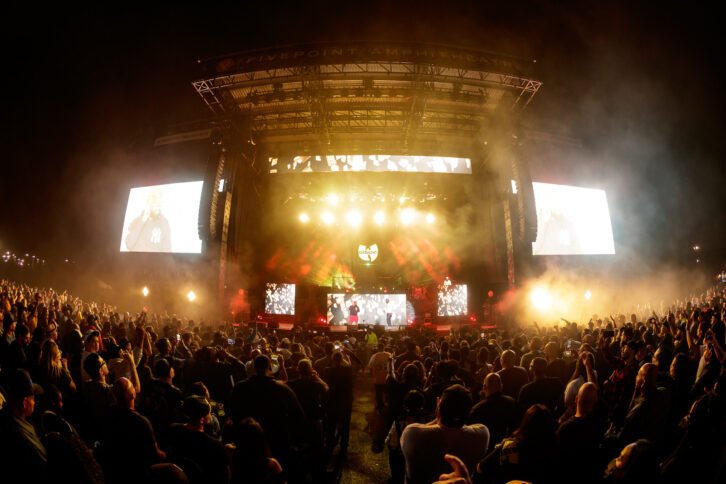
Wu-Tang Clan tears it up at FivePoint Amphitheatre in Irvine, Calif. on the New York State of Mind tour. PHOTO: Shea Flynn
Wu-Tang Clan, Nas and Busta Rhymes are hip-hop royalty for a reason. All three broke out in the early Nineties, capturing the mood of the era with their dexterous lines and creativity that pushed the genre far beyond its party-hardy beginnings. Thirty years later, each act has become a legend to be reckoned with, able to draw on a catalog of platinum-selling hits as they command the stage. So when it was announced that all three would get together for this fall’s 25-date New York State of Mind tour, it’s fair to say that minds started melting.
True to form, the artists did it their own way, too. Instead of serving up individual sets between intermissions, the tour created a non-stop, tag-team format that used collaborations to transition between acts, resulting in an epic, three-hour-long show every night. The massive Wu crew started off the evening, eventually bringing on Nas for his own set that gave way to Busta Rhymes until Nas returned, followed by Wu-Tang’s closing throwdown. While that gave each act time to take a break over the course of the concert, there was no rest for FOH engineer Peter Dottin or monitor man Justin Tolar, who each mixed the show from beginning to end.
Pausing before another marathon three-hour concert began were (clockwise from left): Nick Abaghababian, sound crew; Dean “Cruise” Glenn, Wu-Tang Clan studio engineer; Ralph Mastrangelo, CEO, PK Alliance; Peter Dottin, FOH engineer; and Chad Fuller, production manager.
It was a change of plan for Dottin, who originally came aboard to mix Nas but quickly saw his role expand. “I think part of my advantage was the fact that I have been touring with Nas, so I already have ‘a sound,’” he said. “I already know the music—a lot of times I know what phrases he’s going to pause on, so I can even set up my delays—so I’m very entwined into what he has going on. Everybody on the tour liked what they were hearing from my side of things and thought that to get some balance so that everybody more or less would be sounding equal, that it might be better to have me do everything.”
It was the first of many changes that took place throughout the tour, but whereas some productions go through endless alterations due to turbulence or politics, the New York State of Mind tour was perpetually striving to improve the show throughout the entire run. That meant Wu-Tang Clan supplemented its DJ with a drummer for a few shows, switched to a guest violinist for some more shows, and eventually opted to perform with both guest musicians. “Based on where we may be going to, it’s like certain flavors that they want to bring for that city, so they’ve been changing things up a little bit here and there,” Dottin explained.
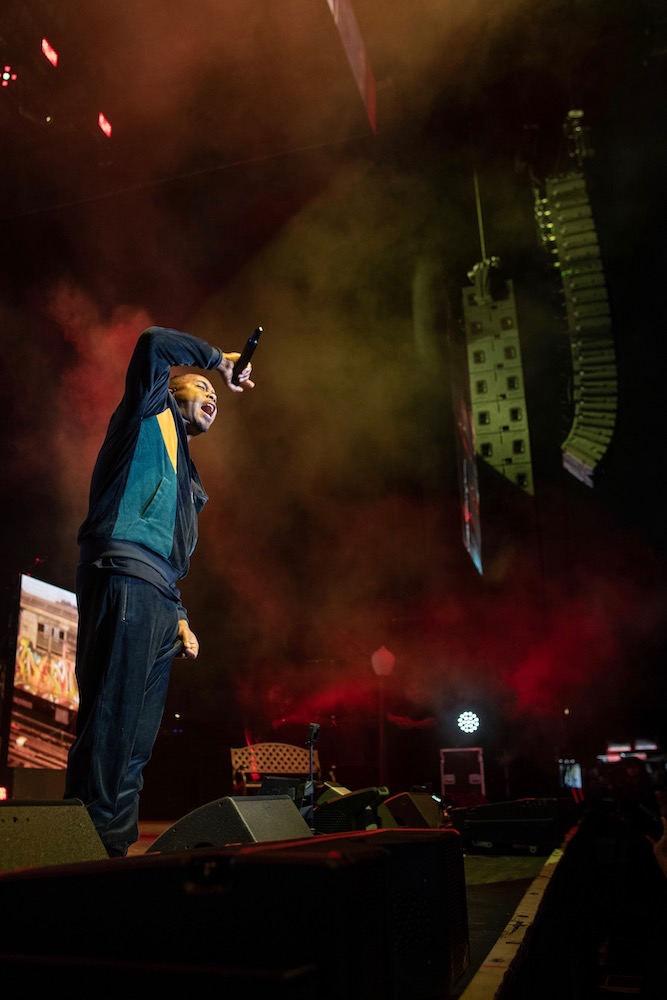
Nas flowed into a Sennheiser SKM 6000 digital wireless nightly. PHOTO: Shea Flynn
While hip-hop shows typically center around DJ tracks and vocals, Dottin oversaw more than 50 inputs on his Avid S6L-32D console at the FOH position. In addition to dealing with live drums and strings, he had his hands full ensuring vocal clarity, as well as providing musical continuity between tracks.
“As far as Nas and Wu-Tang are concerned, both parties have a mix of their more modern tracks and a lot of older tracks—tracks that are so old that the quality requires a little bit of attention,” said Dottin. “You might have one track where the bass is good and round—the kind of modern bass you’re looking for where it’s slamming and nice—and then you have another track where it’s sounding kind of muddy and cloudy. Most of these tracks are dry instrumentals, so where the vocalists are concerned, I had to create a bunch of snapshots in order to have the show flowing more consistently every single night. It was a very, very tedious process, because I probably have over 120 snapshots.”
Fortunately, Dottin got some help from Wu-Tang Clan producer/leader himself, RZA, who made a point of visiting FOH virtually every day during soundcheck. Production manager Chad Fuller recalled, “He’d say, ‘Hey, Petey, how you doing? I want to listen to these tracks and hear what they sound like because I need to know if we need to go back in the studio to fix them—or see what we can make them sound like, so that what I’m looking for translates to the audience.’ Both Petey and I, we have a lot of respect for RZA, so we would let him do that, then we would save those snapshots and replicate that on a daily basis. That would also tell us what he’s looking for; he knows exactly what he wants, we take the principles that he’s looking for, and then we magnify and amplify it.”
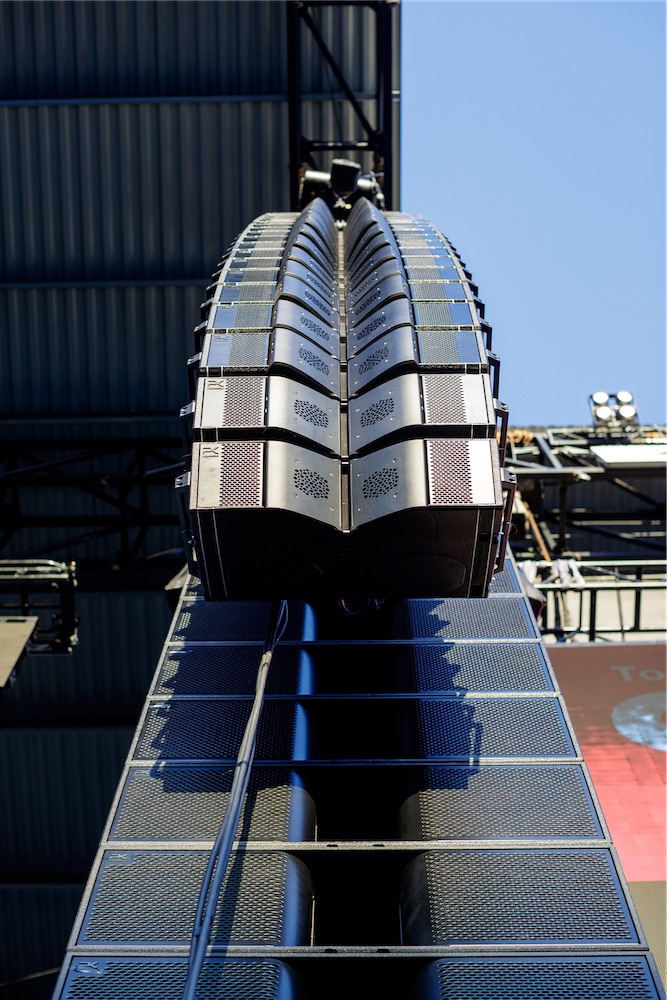
The tour’s tapered line array was built around PK Sound Trinity T10 elements backed by T218 subwoofers.
The method of amplifying was another case of the tour doing things its own way, as Fuller, who spec’d all the gear on the production, chose to take Canadian loudspeaker manufacturer PK Sound’s new Trinity robotic line array on one of its first major U.S. tours. That made the New York State of Mind trek an opportunity for PK to gather engineering data and put the line array to the test. Already familiar with the burgeoning Trinity system, having mixed Snoop Dogg on it in Canada, Fuller opted for the tour to carry T10 elements and T218 subwoofers.
The “robotics” aspect of the speakers allows users to hang an array straight, and then configure and mechanically adjust the array’s directivity remotely from 60 to 120 degrees, both symmetrically and asymmetrically, using industrial linear actuators.
“It gives you total control once it’s in the air and in position to be able to shape and contour to the room,” said Fuller. “If you don’t like how sound’s hitting that wall over there, with any other P.A., you’d have to pull it down, change it and take it back up. With PK, you’re like, ‘from what I’m seeing in the software, we need to move that in a little bit with those three boxes right there. Another example would be on the vertical plane—maybe our calculations weren’t 100 percent accurate and it’s washing the stage a little bit. Okay, let’s back off the bottom three boxes a degree apiece and see if that clears it up. What does the simulation software say? Sure enough, you move it back three, four degrees, and you don’t have those problems anymore.”
Preventing wash on the stage was crucial, as there were often 10 or more open vocal mics at any given moment, with Wu-Tang Clan using 20 channels of Shure Axient Digital Wireless, while Nas had two Sennheiser SKM 6000 digital mics outfitted with MM 445 capsules. Rounding out the tour’s wireless demands, there were also 20 channels devoted to Shure PSM 1000 in-ear monitors. The wireless rig was bolstered by the presence of PWS combiners and antennas, taking sound to and from Monitorworld, where Tolar oversaw a DiGiCo SD5 console. Not everyone opted for IEMs, however, resulting in 18 L-Acoustics 115XT HiQ wedges strewn around the stage, supplemented by two SB28 subwoofers and two ARCIIs per side for side fills, all powered by L-Acoustics LA12X amplifiers.
The tour wrapped up in October at the Hollywood Bowl, having earned critical acclaim at virtually every stop. Along the way, the nightly marathon mixing sessions kept Dottin and Tolar on their toes as they improved the show, built snapshot after snapshot, and occasionally made things up as they went along. “Probably 80-85% of the show is the same every night,” said Dottin, who added with a laugh, “They went leftfield on me a couple of times, introducing new songs that weren’t even snapshotted. To me, that is what live is about: Your job as the live engineer is basically to make it happen now—as it happens!”