Tag Archives: wireless microphone

Shure’s New GLX-D+ Wireless System Adds Guitars to the Mix

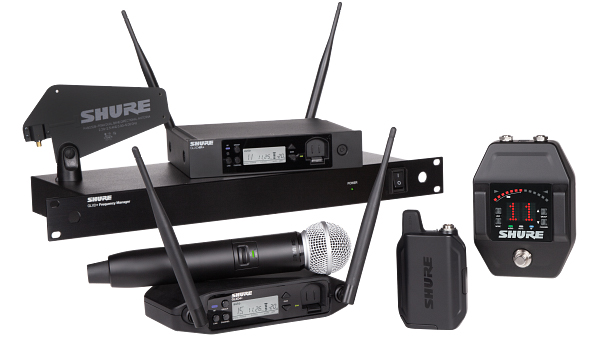
Shure GLX-D+ Dual Band Wireless System.

Chicago, IL (March 1, 2023)—Shure has been a significant participant within the wi-fi microphone marketplace for a long time, and the GLX-D+ Dual Band sequence introduced immediately follows in that custom—however with a twist: The sequence’ receivers embrace the everyday rack-mount and tabletop fashions, but additionally embrace Shure’s first guitar pedal receiver.

Aimed at guitarists and bassists who need to go wi-fi, the GLXD6+ Digital Wireless Guitar Pedal integrates proper right into a pedalboard and may be powered from typical 9V DC cords. The pedal receiver has a tuner built-in, and sports activities a ¼” enter in order that customers can nonetheless plug in after they need to. For gamers who alternate between a number of guitars throughout a present, the receiver can hyperlink to 2 or extra transmitters, dashing up on-stage transitions between devices.

As may be anticipated from a sequence that features a guitar pedal receiver, the GLX-D+ Dual Band sequence is basically aimed toward musicians, homes of worship and others who want wi-fi mics however don’t have the time, aptitude, want or finances for in-depth choices like Shure’s flagship Axient Digital sequence.

Nonetheless, there’s different causes to look into the brand new line. The GLX-D+ dual-band wi-fi expertise updates the sequence’ earlier era by doubling obtainable bandwidth, working each in 2.4GHz and 5.8GHz. The receivers robotically scan for and choose the cleanest obtainable frequencies, serving to customers keep away from interference and dropouts.

Greats Turn to Shure at Grammy Awards

Also up to date from earlier fashions, the GLX-D+ Dual Band’s rechargeable battery provides as much as 12 hours of runtime, with a fast cost functionality offering 1.5 hours of use from a 15-minute cost if want be. The lithium-Ion SB904 battery may be charged straight on the tabletop and half-rack receivers or via a USB-C connector on the transmitter.

GLX-D+ methods can be found with three handheld wi-fi microphone choices, together with SM58, BETA 58A, and BETA 87A. GLX-D+ Dual Band Wireless offers RF efficiency, antenna distribution, and automated frequency administration for as much as 11 half-rack methods in typical environments (16 underneath optimum circumstances). Separately obtainable Frequency Manager (GLXD+FM) and directional antenna equipment are required.

The GLX-D+ Dual Band Wireless Systems will probably be obtainable later this month on the firm’s web site and at choose retailers, beginning at US $499.

Shure Petitions FCC for Dedicated Wireless Mic Channel

FCCChicago, IL (February 4, 2021)—In recent years, RF audio pros have faced increasing difficulties as the amount of usable spectrum available to wireless microphones has steadily vanished—first in 2010 as the FCC bumped pro audio out of the 700 MHz band (roughly 698-806 MHz) requisitioning that range for the use of public safety, and then again in 2017, as it auctioned off most of the 600 MHz service band (617-652 MHz and 663-698 MHz). While the FCC some conciliatory stabs at ensuring space for wireless audio gear were made at the time, those rulings recently fell by the wayside, and now wireless mic manufacturer Shure has petitioned the FCC to reverse its recent decision and ensure that at least one “vacant” 6 MHz UHF channel is designated in each market for wireless microphone use.

The petition comes just weeks after longtime FCC Chairman Ajit Pai stepped down on January 20 as President Biden was inaugurated (Jessica Rosenworcel has since been appointed acting FCC chair). Pai’s occasionally contentious stint atop the FCC began in 2012; among the last events taking place under his stewardship, in early December, 2020, the FCC terminated the “Vacant Channels” rulemaking that was opened during the 600 MHz incentive auction and declined to authorize a dedicated UHF TV channel for wireless microphone use. Shure disagrees with the FCC conclusions and rationale for terminating the proceeding and has asked the Commission to reverse the decision.

Shure’s petition argues the wireless microphone community needs clear spectrum now more than ever, as the 600 MHz band has been reallocated to mobile phone use and the DTV repack has moved many TV stations into the 500 MHz spectrum. At the same time, broadcast, performance and sporting productions continue to demand more channels of wireless microphones than ever before.

According to Shure, the “alternative” frequencies identified by the FCC in 2017 for wireless microphone use at 900 MHz, 1.4 GHz, and 7 GHz fall short of addressing the needs of wireless microphone users, as they are less flexible than UHF frequencies. Because these bands are occupied by licensed users in other industries, access to these bands for wireless microphone use is conditioned on sharing requests, which can be lengthy and ultimately denied.

The company noted that ensuring the presence of at least one dedicated channel in a market is important to meet demand for wireless microphone use, and that channel would also be important for applications that include intercom, IFB and others.

“The amount of available UHF spectrum for wireless microphone use continues to shrink,” said Ahren Hartman, vice president, Corporate Quality, Shure. “With the loss of 700 MHz, 600 MHz, and the DTV repack into 500 MHz, we are at an all-time low for access to UHF spectrum. However, the need for open and clear wireless microphone spectrum is higher than ever before.”

The petition marks one of Shure’s first forays back into lobbying following the unexpected death last October of longtime Shure executive Mark Brunner, VP of Global Corporate & Government Relations. Brunner previously led the company’s lobbying efforts in Washington D.C. to promote industry interests in wireless device regulation, frequency spectrum allocation and more.

Shure • www.shure.com