Tag Archives: wireless system

Shure’s New GLX-D+ Wireless System Adds Guitars to the Mix

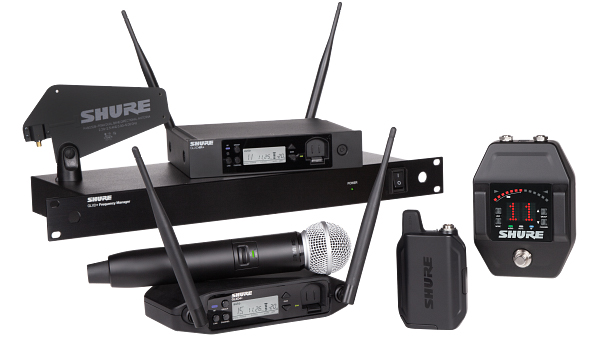
Shure GLX-D+ Dual Band Wireless System.

Chicago, IL (March 1, 2023)—Shure has been a significant participant within the wi-fi microphone marketplace for a long time, and the GLX-D+ Dual Band sequence introduced immediately follows in that custom—however with a twist: The sequence’ receivers embrace the everyday rack-mount and tabletop fashions, but additionally embrace Shure’s first guitar pedal receiver.

Aimed at guitarists and bassists who need to go wi-fi, the GLXD6+ Digital Wireless Guitar Pedal integrates proper right into a pedalboard and may be powered from typical 9V DC cords. The pedal receiver has a tuner built-in, and sports activities a ¼” enter in order that customers can nonetheless plug in after they need to. For gamers who alternate between a number of guitars throughout a present, the receiver can hyperlink to 2 or extra transmitters, dashing up on-stage transitions between devices.

As may be anticipated from a sequence that features a guitar pedal receiver, the GLX-D+ Dual Band sequence is basically aimed toward musicians, homes of worship and others who want wi-fi mics however don’t have the time, aptitude, want or finances for in-depth choices like Shure’s flagship Axient Digital sequence.

Nonetheless, there’s different causes to look into the brand new line. The GLX-D+ dual-band wi-fi expertise updates the sequence’ earlier era by doubling obtainable bandwidth, working each in 2.4GHz and 5.8GHz. The receivers robotically scan for and choose the cleanest obtainable frequencies, serving to customers keep away from interference and dropouts.

Greats Turn to Shure at Grammy Awards

Also up to date from earlier fashions, the GLX-D+ Dual Band’s rechargeable battery provides as much as 12 hours of runtime, with a fast cost functionality offering 1.5 hours of use from a 15-minute cost if want be. The lithium-Ion SB904 battery may be charged straight on the tabletop and half-rack receivers or via a USB-C connector on the transmitter.

GLX-D+ methods can be found with three handheld wi-fi microphone choices, together with SM58, BETA 58A, and BETA 87A. GLX-D+ Dual Band Wireless offers RF efficiency, antenna distribution, and automated frequency administration for as much as 11 half-rack methods in typical environments (16 underneath optimum circumstances). Separately obtainable Frequency Manager (GLXD+FM) and directional antenna equipment are required.

The GLX-D+ Dual Band Wireless Systems will probably be obtainable later this month on the firm’s web site and at choose retailers, beginning at US $499.

Post-Pandemic Wireless System Care: The Show Must Go ‘On’

As live events start to come back, it’s crucial to get wireless audio gear back in working order long before you need it.
As live events start to come back, it’s crucial to get every wireless system back in working order long before you need it.

When COVID-19 cases spiked last March, most people figured that we were looking at a limited shutdown—perhaps a few months. This happened just as sound companies and rental houses were preparing for the summer concert season. The global lockdown was extremely trying for everyone, and the pro audio community felt its share of the impact in 2020.

Jim MacGregor
Jim MacGregor is senior manager, Global Pro Audio Marketing at Shure. Matt Mrozinski

The past year has been a pretty rough time for the music industry, especially in live events. No tours, no venues, no festivals—for a full year. Now, with vaccines being distributed, live events are being tentatively planned, venues are slowly being reopened, and equipment in storage is being readied for normal use.

For most equipment, standard downtime procedures apply: Pull out that gear, dust it off, set it up, and make sure it’s sounding good and ready for action. Check your cables, lubricate wheels and hinges, tighten screws and bolts.

But while most sound companies and rental houses have solid procedures for off-season storage and reboot, one year is a long time, especially for batteries. Most of today’s wireless systems—microphones, in-ears, and intercoms—are designed for constant usage via lithium ion rechargeable batteries. The problem? No company plans for its gear to spend a full year offline.

Here’s a key fact: Even when not plugged in or powered up, all battery cells remain electrically active. That means a small, steady loss of power over time that, potentially, can affect performance. While in theory, everything should be fine, you’ll want to confirm that everything is working properly before your wireless system is back in service. So, just as you will need fresh frequency scans for your wireless systems, it’s equally important to make sure their batteries are performing properly.

Companies to Watch 2021

Many a wireless system today features advanced lithium ion rechargeable batteries. These are marvels of engineering, highly resistant to memory effects and degradation. Assuming they were stored at room temperature range, it’s unlikely there will be any issue. Still, storing batteries for a full year was never part of the plan. Fortunately, the engineers at Shure have been studying the situation.

If your battery charger offers a Storage Mode, use it! This feature charges the batteries to a slightly depleted state, optimal for long-term storage. Several Shure chargers offer this feature. For example, the AXT900 charger can put the batteries in storage mode. This puts the voltage of the battery at a mid-range point (3.8 volts), which is best for the battery.

Also, keep the battery from getting too hot or too cold. Lithium ion batteries can lose health when stored in cold or hot areas. For best performance, store the batteries in normal room temperatures.

If you haven’t used your rechargeable batteries in a while, don’t wait; do the following now: Put your lithium ion batteries through several power cycles—at least two—before being returned to routine service. This serves to physically demonstrate the run time while simultaneously stabilizing the electrochemical properties of the batteries. Please review your owner’s manual and documentation and follow all other safety recommendations for handling lithium ion batteries. If your battery fails to charge after the power cycles, contact the manufacturer for further guidelines.

We’re all excited at the prospect of the live events industry working again. At the same time, we urge everyone to be patient, stay safe, and follow appropriate protocols.

Shure • www.shure.com