Tag Archives: Floorstanding Loudspeaker

PMC fact fenestria

Most loudspeakers have characteristics that tell you that you are listening to a loudspeaker. Even with your eyes closed, it’s not too difficult to discern that there isn’t a grand piano in the room but instead a pair of loudspeakers attempting to reproduce the sound of that instrument. This, it would seem, is due in no small part to the noise introduced by vibration from the cabinet. A wooden loudspeaker is a bit like a musical instrument; most of the sound comes from the drivers but a high proportion emanates from vibrations in the box itself. At certain frequencies, the proportion changes and the panels contribute more. Designers have used a wide variety of techniques to combat the cabinet’s contribution because it muddies and colours the sound, smearing the notes produced by the lowest distortion drivers. A large proportion of loudspeakers in the high-end use mass and there have been some notable successes with this idea. However, PMC has taken a more sophisticated approach to minimising vibration in its fact fenestria flagship, one that has not been seen elsewhere and yet is extremely effective.

PMC fact fenestria

The panels that flank this tall, elegant loudspeaker might look like they are there for aesthetic reasons but in fact they provide a means to negate noise coming from the sides of the cabinet. The four panels act as tuned mass dampers, which is a technology that is hard to understand without visuals but is regularly employed on top of tall buildings to negate the effect of earthquakes and strong winds. Put a flexibly mounted weight on top of a skyscraper and it will move in the opposite direction of any movement in the building and counteract that movement. In the fact fenestria, each panel is mounted on 12 pins, which are mounted in rubber and foam to allow a small amount of movement; this cancels vibrations coming from the side walls of the two bass cabinets. PMC established the best places to put these pins by measuring movement in the sidewalls with accelerometers; an old but precise way of detecting small movements.

Ollie’s Army

PMC’s engineering team – led by Ollie Thomas – did not stop there in the quest to eliminate vibration. Virtually every element on the fact fenestria is isolated from the rest in order to stop vibration travelling through the cabinet, distorting the output of the drivers and undermining performance. This is most apparent in the so‑called nest, the machined aluminium element that supports the mid and treble drivers in the centre. Neither driver is fixed directly to the metalwork but has an anti-vibration mounting to stop energy getting in or out. The whole nest itself is floating on silicone mounts top and bottom, further reducing the likelihood of energy in the bass cabinets getting to the drivers.

PMC fact fenestria tweeter

This is a tall loudspeaker, more than five foot high, and moving its 80kg bulk any distance would be difficult if it were not assembled on site. A pair of fact fenestrias arrive in ten boxes and each speaker is made up of eight parts starting with the plinth. This substantial MDF base houses an equally substantial fourth-order crossover where component placement and orientation has been optimised for minimum interference between them. They are high quality components too, naturally.

Six silver-plated custom terminals are provided on the back of the plinth but these are supplied with jumpers so tri-wiring is not essential. Either side of this block are adjusters for high and low frequency output, which allow cuts or boosts at either extreme in order to help with integration into different rooms. The plinth has inserts for four chunky, machined stainless spikes of the ‘not to be messed with’ variety that are supplied along with the tools and fixings used to construct the speakers. The isolation starts where the lower bass cabinet fixes to the plinth in order to protect the crossover from vibration. This part is bolted on and the electrical connection is made by six-pin connectors built into either part. The same connections are made when you install the nest and the result is no cables on the back of the box, which is a nice touch.

Locking nest

The second bass cabinet locks into the first, then the nest slots in between them and is fixed above and below. Then comes the fun bit of finding the best spot relative to the wall; I used hard plastic furniture cups under the spikes to slide them around and found that a gap of around 50cm to the rear gave the best tonal balance.

PMC fact fenestria bass unit

Most of the drive units on the fenestria were created specifically for this project but the most radical is the bass driver. This is based on an existing chassis but has far greater excursion than previous models and thus needed to be very light and extremely stiff. Ollie chose a sandwich of carbon fibre skins with a Rohacell foam core for this purpose and is even thinner than the flat drivers seen on some of PMC’s pro models. The midrange is based on the company’s 75mm dome but here they have bored a hole through the pole-piece so that rearward pressure is released into the bullet-shaped chamber that you can see behind this driver; a move that reduces distortion that little bit more. The tweeter is a ring radiator type with a 19mm central dome in a 36mm surround, it takes over from the mid at a high 3.8kHz and like the midrange has an isolating mount.

PMC fact fenestria midrange

The nature of the nest means that both mid and treble are on an open baffle. This means that sensitivity is reduced but dispersion is very good and there is no woodwork that can vibrate along with their output. The bass system has PMC’s preferred transmission line loading with Laminair fins at the line vents to kill any turbulence; there are of course two of these lines on the fenestria and this means that the system drives the room much like a line array. It makes for the most effortless and articulate bass I have had the pleasure of hearing at home, and it is uncannily good at finding low frequency content in all sorts of music; frequently on tracks that didn’t seem to have any real bass on at all. This despite using fairly substantial loudspeakers as a reference for many years. The other characteristic of the bass and in fact the whole loudspeaker is the ease with which it delivers whatever is in the recording. This was something that everyone who came to hear them noticed without prompting.

Power is everything

They do like power, however. I started out using a Bryston 4B3 power amplifier which is good for 300 Watts (8 Ohms) but managed to get hold of a pair of 7B3 monoblocks (600W) for some of the listening and that proved to be a fine combination. Although this speaker isn’t particularly ‘deaf’ at 86dB sensitivity, it really stretches out with this much power behind it. With the 4B3 things were pretty special however, especially when vinyl was brought into the equation. I put an old and well played copy of Astral Weeks on the Rega Planar 10; this is one of the best albums ever made but it’s not the most refined of recordings… or at least most speakers don’t give that impression. With the fenestria the usual coarseness and forwardness of the vocal seemed to be missing and Van, while clearly pushing things into the red, sounded sublime. It was also interesting to note how precisely the various instruments were placed in the soundstage; the jazz arrangements mean that they often blur into one another but here it was easy to pick each one out. On the much more contemporary Dark Days Exit, Felix Laband uses vinyl crackle to emulate an analogue sound and this adds atmosphere and texture to his collages of synthesised and sampled sounds. I love the crunch of the bass line on ‘Crooked Breath’ and here it goes down much further and in more articulate fashion than usual.

King Crimson’s ‘Easy Money’ is a superb track that I’ve heard many a time, yet never has the way that the image suddenly expands at around the halfway point been made so clear; these speakers are clearly more sensitive to every nuance of the signal than most. And by ‘most’ I mean nearly all of them; you might get this degree of finesse with some high sensitivity designs but such speakers can’t match the bandwidth nor the tonal evenness on offer here. Even mono recordings sound lifelike in their hands; Muddy Waters’ Folk Singer has ferocious dynamics but rarely does the man appear in the room so comprehensively as he does with these PMCs. An early Sonny Rollins album on Blue Note (A Night At The Village Vanguard) is also mono and you can hear this in the lack of scale (a mono switch would help here) but the tone of his sax is incredible and made me re-evaluate him as an artist.

PMC fact fenestria

I don’t play music at particularly high levels as a rule because most speakers/rooms start to become uncomfortable when you do; the reflections and distortions of the speakers themselves are made more obvious by volume. But this didn’t happen with the fenestrias; with a good recording there is a strong inclination to turn it up because the usual sense of loudness does not appear. Instead you get more music, more engaging, inspiring and fully immersive music at that. This indicates that PMC have created a loudspeaker with incredibly low distortion, one that does more justice to the signal than the vast majority. And that makes for highly addictive listening, especially with a live recording of John Martyn playing ‘Head and Heart’ at Glastonbury in 1986 (BBC Radio 1 Live in Concert) where you get a real sense of being transported to the event and standing in the (least muddy) sweetspot in front of the desk. On Jon Hopkins’ ‘Deep In The Glowing Heart’ the depth and clarity of the bass is a real luxury, one you can almost bathe in, while the drums and bass of Arab Strap’s ‘Packs of Three’ is explicit in its raw realism. The shockwave that Massive Attack produce on ‘Angel’ is truly palpable, those guys probably weren’t audiophiles in the traditional sense but they sure knew how to capture all the key facets of the sound they were making.

Precision and nimbleness

The fenestria tell you all about everything that they play; the open baffle of the nest gives them a small speaker precision and nimbleness, while the speed and lack of cabinet vibration in the bass system matches this in the lower registers. This is a phenomenal loudspeaker system of that there is no doubt but more than that is the way it leaves no trace of character on the music being reproduced. I could not hear coloration or distortion of any kind and that’s very rare, what I could hear were new characteristics in virtually everything that got played, and a lot of music passed through the system in the few weeks that these speakers were in the room. Aretha Franklin’s ‘I Never Loved A Man (The Way I Love You)’ is a killer track and the sheer power of her voice pushes the microphone very hard, only the tape compression stops things getting too much. Its emotional power is what hits you the hardest and while the Bryston 7B3 are not the most touchy feely amps around, they let this through loud and clear.

The PMC fact fenestria is a remarkable achievement for any loudspeaker company let alone a relatively small independent one. It conclusively proves that the transmission line or even the advanced transmission line (ATL) is a very serious contender for the best way to load a loudspeaker and makes one wonder why so few designers use it. This is an expensive loudspeaker for sure and it needs good quality and quantity of power for best results but it’s not extreme by high end standards, you will find several dozen more expensive designs at the High End show. But few of them can compete with the sheer transparency to the signal that the fact fenestrias offer, it will be a long time before I come to terms with real world loudspeakers when they are gone.

TECHNICAL SPECIFICATIONS

  • Type: Three-way, six-driver, floorstanding speaker with PMC ATL (Advanced Transmission Line) enclosure
  • Driver complement: One 19mm SONOMEX soft dome, ferro‑fluid cooled tweeter with 36mm surround; one PMC 75mm soft dome, rear chambered midrange driver; four PMC 6.5inch transverse‑weave, carbon‑fibre, multicellular-core piston driver
  • Crossover frequencies: 380Hz, 3.8kHz
  • Frequency response: 23Hz–25kHz
  • Impedance: 4 Ohms
  • Sensitivity: 86dB/W/m
  • Dimensions (H×W×D):
    1700 × 370 × 623mm including terminals
  • Weight: 80kg/each
  • Finishes: White Silk, Rich Walnut, Tiger Ebony
  • Price: Tested at £56,995/pair

Manufacturer: The Professional Monitor Company

Tel: +44 (0)1767 686300

URL: pmc-speakers.com

Back to Reviews

The post PMC fact fenestria appeared first on Hi-Fi+.

Vivid Audio Kaya S12

The big brain behind Vivid Audio and the Kaya S12 – Lawrence’ Dic’ Dickie – once shared an anecdote with me some years back. When Vivid Audio first launched its distinctive, unique-looking loudspeakers at a hi-fi show, the first reaction from the first member of the public to walk into the room was, “Oh no, not again!” Presumably, he comes from a long line of people who had seen it all before, tutting at everything from the wheel (“It’s just a square with the edges knocked off!”) to the Apollo space program (“We’ve had fireworks for years… what’s the big deal?”).

However, one of Vivid Audio’s real-world issues is that people like the idea of genuinely distinctive-looking loudspeakers and buy boring boxes ‘to play it safe’. The Kaya line is partly a way of addressing the need to make a loudspeaker cabinet that doesn’t ‘play it safe’ for sound (and sonic) reasons while creating a more universally acceptable design. As a result, the Kaya S12 stand-mount loudspeaker is the smallest and most domestically chummy of the whole range.

Organic Shape

There’s something very organic to the shape of the Vivid Audio Kaya S12, especially on its dedicated three-point stand. That 12-litre RIMcast polyurethane resin cabinet looks less like a loudspeaker and more like a flower or a large seedpod. This design is so clever because three-footed speakers have traditionally either looked like truncated Ikea living room lighting systems or something out of The War of the Worlds but with fewer death rays. Giving those three legs a gentle concave makes them look like the speaker grows out of them.

Vivid Audio Kaya S12 floorstanding loudspeaker

The injection-moulded enclosure shape of the Kaya S12 is not just there to creep out fans of The Invasion of the Body Snatchers. The front baffle gives the tweeter a gentle horn-loading, and the overall shape creates the ideal rear chamber size for both treble and mid-bass units, aided by the tapered tube reflex first used in Vivid Audio’s behemoth Giya G1. The design also reduces internal cabinet resonance from the outset, making it an ideal platform for the drive units to do their stuff unimpeded by the box itself.

Unlike most loudspeaker ‘builders’, Vivid Audio is one of the few who make their drive units. In the case of the Kaya S12, the company uses the same 26mm D26 Tapered Tube-loaded carbon-reinforced catenary dome tweeter throughout the line. In contrast, the long-throw 100mm C100L alloy dome/cone driver is explicitly designed for the Kaya S12. Of course, the cabinet making virtually no impact on the loudspeaker’s sound means more of the heavy sonic lifting is on the character of the drive units. If they have a ‘character’, it will be thrown into sharp highlight because the cabinet leaves few places to hide.

Everything under scrutiny

Every aspect of what goes into making a drive unit comes under Dic’s scrutiny. Those long-standing ‘well, we’ve always done it that way’ facets of loudspeaker driver engineering are stress-tested and – if found wanting – he seeks a better way of doing things. For example, the internal architecture of the enclosure features a unique tapered absorber that surrounds the rear of the mid-bass driver. Absorbent material fills the radial slots formed by the deep ribs in this absorber; each absorbs a different frequency and prevents interference with the action of the cone. TL;DR version; the enclosure is deader than Elvis.

This scrutiny even looks to the slightest changes; Vivid Audio uses flat wire instead of conventionally drawn round wire for winding voice coils. It means the loudspeakers’ sound doesn’t require hundreds of hours or run in and doesn’t take an hour or so of playing to ‘come on song’ in a listening session. Of course, it also benefits a loudspeaker at its incursion extremes, meaning you can bass play louder for longer too!

However, don’t take its ease of running in to mean the loudspeaker is a pushover; it demands careful installation and partnership. The Kaya S12 needs a little ‘breathing space’ between it and the rear wall, but not so much that it leaves the listener in a small room using the speakers as headphones.

Head vs Heart

In most loudspeakers, there seems to be a ‘head vs heart’ trade-off; you either get a loudspeaker that sounds remarkably detailed and analytical, with outstanding imagery and shimmering ‘micro-dynamics’ or one that is consummately musical, entertaining and rhythmically ‘in the pocket’. The Vivid Audio Kaya S12 is not like most loudspeakers. It blends rhythmic drive and energy with the transparency that makes you think of electrostatic loudspeakers. That applies universally; from ‘To Be Loved’ from Adele’s therapy session album 30[Columbia/Melted Stone], through the lo-fi brilliance of The Clash’s ‘White Riot’ [The Clash, CBS], to Arvo Pärt’s chillingly atmospheric ‘Speigel im Speigel’ [Alina, Spivakov et al., ECM]. In every case, the musical insight comes from the detail and the underlying depth of performance. You get that elusive combination of insight into the recording and that sense of a musical performance.

However, the big thing from this little speaker is the relative absence of distortion. It’s a paradox that while we strive to reduce distortion in electronics, loudspeakers frequently have more significant deviations from accuracy. However, when you hear one of those rare loudspeakers like the Kaya S12 that doesn’t have the same degree of distortion found in other speakers, you hear music as even more of a cohesive whole than usual. It’s beguiling in the extreme.

This transparency is not easy to pin down, as it’s a bit of a group effort on the part of the Kaya S12. The quieting effect of that cabinet and the absorber did not introduce sing-along sessions to hold back the drive units. It’s the drive units themselves. It’s even the stand, which seems capable of doing its job while adding or subtracting nothing. Put all those elements together, and you have a sound just so damn lifelike that you want to hear more.


Vivid Audio Kaya S12

My days of guitar wrangling are largely behind me, but a well-turned Telecaster can still make me think of playing again. Amateur musicians listening to masters of that instrument will play music on the Kaya S12 like a masterclass because the clean and detailed loudspeaker gets you in the spaces between the notes. Playing ‘Soft Winds’ from Ed Bickert’s Out of the Past CD [Sackville] is a perfect example; it can sound like drab dinner jazz, but the playing is masterful. Here, Bickert’s masterful ‘grips’ (impossible jazz chords) almost seem attainable and understandable, and there is so little between you and the late Canadian jazzer. It’s like being in a session with the guy.

Do (more) than one thing well

We’ve often had snippets of this before, often on loudspeakers that do one thing well at the expense of the whole. I remember hearing a loudspeaker playing Dylan’s harmonica like it was in the room but making almost every other instrument sound like Dylan’s harmonica. Here, you get that stunning ‘unencumbered by artifice’ presentation, but it cuts across all instruments. Again, I could rattle off a list of recordings ­– both commonly used ones like Joyce DiDonato and Trentemøller and more ‘for personal use’ albums like Grinderman and Heavy are the Head – but it applies universally. The Kaya S12 is like having less loudspeaker and more studio or concert hall in your room.

No, it’s not the only product that delivers that degree of musical insight, but it’s one of the few that can get even close to the degree of detail and precision you get from top-end audio trailblazers at a fraction of the price and size.

It’s hard to avoid discussing the size of the loudspeaker because the Vivid Audio Kaya S12 highlights the difference between regular humans and homo audiophilius. Asked to sit in front of what we consider ‘reasonable’ sized loudspeakers, ordinary people are intimidated by the physical dimensions of the big boxes in front of them. The Kaya S12 doesn’t have the same physical presence, so rank-and-file humans look at them in terms of their aesthetics… and often find them a pleasing shape. Meanwhile, audiophiles look at a loudspeaker like the Kaya S12, proclaim it ‘too dinky’, then are astonished at the scale of the sound it produces… and find it a pleasing shape sounds like a win-win to me.

The size of the loudspeaker is both its greatest strength and its lone weakness. Being so ‘dinky’, the Kaya S12 acts almost as a ‘point source’, meaning its stereo and detail reproduction are outstanding. Stereo soundstaging is staggeringly good as the loudspeaker effectively removes itself from the room, leaving the instruments each occupying their place within a three-dimensional space. Even if that is the impression of dimensionality created by delay and panning, you feel enveloped in a sound-field that is physically and emotionally ‘there’ in the room with you. This spatial excellence has a degree of detail and precision that is almost impossible to replicate at anything close to the Kaya S12’s price and size.

Plumbing the depths?

The lone weakness described above is bass depth. The Kaya S12 does a remarkable job at plumbing the depths given the constraints of size and drive-unit acreage, and it rolls off cleanly, so you get the impression of those deep bass notes even if you don’t get quite the same gut-punching intensity. Although it gets surprisingly close irrespective of room size. In a small room, however (which, let’s face it, is where the Kaya S12 will likely spend its days), this clean roll-off is almost ideal as it doesn’t trigger standing wave resonances where the room ‘joins in’ with the music. The nearly preternatural bass speed and effortless, bouncy, infectious sense of rhythm baked into the Kaya S12 make partnering it with a subwoofer very difficult. A good sub will anchor the sound in space, but the Kaya S12 speed will take that ‘anchor’ concept and take it to mean ‘holding everything back’.

Discussing a subwoofer almost misses the Vivid Audio Kaya S12’s point. More than just a ‘good’ loudspeaker, the Kaya S12 is also an ‘important’ one. It’s important because it reflects the increasing understanding that ‘metropolitan’ listeners exist and do more than listen on headphones. It’s a source of some personal frustration that high-enders with a profound love of music but who live in large cities with small rooms are left out in the cold by most audio. The ‘oh well, compromises must be made’ stance is as wrong as ‘let’s shoe-horn a vast system into a small room’. The Kaya S12 is a legitimately high-end loudspeaker for such rooms. That it isn’t a full-range design is an advantage in spaces so small that anything below 60Hz has its in-wall accompaniment. But the uncompromised performance, from that taut bass to the upper limits of hearing, makes it something special. That Vivid audio no-distortion, super clear, and, it has to be said, ‘vivid’ sound is in full effect here, scaled down – but not shrunken – to work in a broader range of rooms than you’d expect.

‘Impressed’ doesn’t even describe my feelings toward the Vivid Audio Kaya S12. The Kaya S12 takes the ‘loudspeaker for small rooms’ concept to new heights. Its combination of stereo focus, detail and clean bass makes the Kaya S12 a cerebral performer; the tremendous sense of musical performance and excellent beat give it some heart, too. While it might not be the first choice for dub reggae or church organ fanatics, I’d happily trade bass weight for bass precision, especially as trying to get both in the same box requires a more significant investment in loudspeakers in a larger room. Those of us living in The Big City – where space is at a considerable premium – have just got a new champion to fight our corner.

TECHNICAL SPECIFICATIONS

  • Type: Reflex-loaded two-way stand‑mount loudspeaker
  • Drive units: Tweeter – 26mm alloy dome with tapered tube loading, Mid/bass – 100mm long throw alloy cone
  • Nominal frequency response: -6dB 45–25,000 Hz
  • Nominal impedance: 8 Ohms
  • Crossover frequency: 3kHz
  • Connectors: single wire binding posts
  • Sensitivity: 87dB 1w/1m
  • Finishes: gloss piano black, gloss Pearl white, custom colours, matte Oyster grey
  • Dimensions H×W×D: 480 × 237 × 254mm
  • Weight: 6kg
  • Price: from £6,000 (stand £1,500)

Manufacturer: Vivid Audio

URL: vividaudio.com

Tel: +44(0)7515 127049

Back to Reviews

The post Vivid Audio Kaya S12 appeared first on Hi-Fi+.

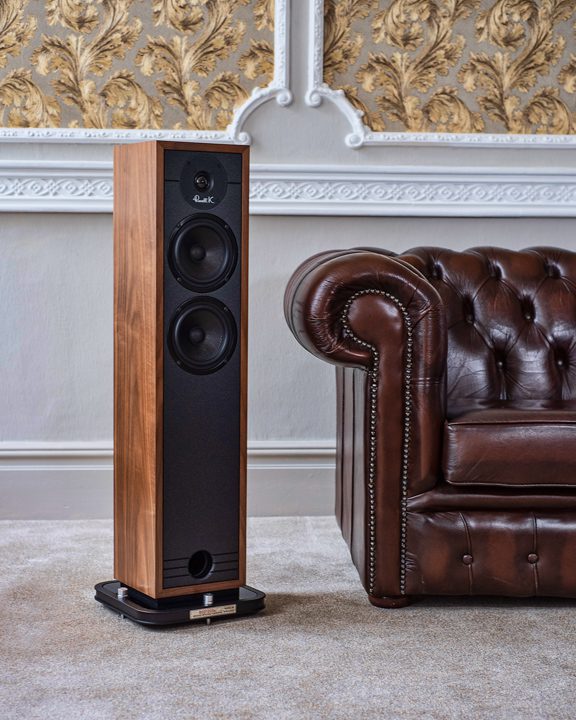
Russell K. RED 120Se

These loudspeakers got me doing something I sometimes forget to do. When I start with a new review product, I calibrate by listening to a handful of familiar tracks. But it’s easy to focus on those tracks and forget about the music on the rest of the album. On at least two occasions during the work-up for this review, I found myself listening to the entire CD rather than just the track I’d put it on for. If you compare your loudspeakers on a cost-per-unit-volume basis, I may need to help you reassess because the Russell K. RED 120Se’s aren’t priced like your typical thirty-something litre offering; but that’s OK because they don’t perform like one, either. These loudspeakers have continually reminded me I have a great music collection with some astonishing performances captured in it. Not every speaker that has graced these rooms has managed that.

Russell K. RED 120 Se

There’s no shortage of well-regarded, smallish floorstanding loudspeakers at comfortably under a metre tall and maybe 20cm wide. It’s a nice size for a domestically acceptable product that promises decent all-round performance without dominating a modest-sized living space. I expect many are sold to their owners for precisely that reason. That probably explains why the majority are also keenly priced; £3,000 will buy you a very respectable, well-reviewed product from any one of a number of makers, and they’ll doubtless do an excellent job for a lot of people. So why might you, dear reader, be interested in a speaker of this size that costs twice as much as those?

Unconventional approach

Let’s assume then that, like many people, this is a size of loudspeaker that ticks a lot of boxes for you. But you’ve been there, done that, and now require more. Moving on, you may have assumed, will require moving on to something bigger.

The Russell K. approach to loudspeaker design is a little different. And it’s why you might want to read on if you’ve got this far. Manufacturers can keep development costs down by keeping to familiar recipes; conversely, being a bit different can be costly. Neither the cabinets, nor the drivers, nor yet the crossovers here are what you would call entirely conventional, but this isn’t the sort of wilfully idiosyncratic design that screams ‘owned by a single bloke’ either.

Russell K. cabinets are undamped. Tradition has it that you’ve got to damp your cabinets, or they’ll resonate and sing along. However, designer Russell Kauffman maintains that while damping may prevent cabinets from resonating along with the music, it also stores energy, releases it out of time, smearing transients and timing cues, and generally messing up the bass in particular. His solution is to manage the cabinet resonance by careful bracing and attention to detail on the internal structure of the loudspeaker so that if the cabinets do join in, they do so manageably, notably in time with the music, and crucially, they stop when the signal stops.

Russell K. RED 120 Se

It seems to work; music I’ve thought of as complex, or dense, has revealed itself more lucidly. Take ‘Fiesta’ on the Chick Corea and Gary Burton duets album The New Crystal Silence [Concord]: you hear more deeply into the tonal differences between piano and vibraphone; the instruments remain distinct, separate and easier to discern in the busiest, most complex, or most dynamic passages. The notes start and finish when they should, and if you hear them, all the better for it. These are revealed as better, more exciting instruments, and the musicians are also clearly having a lot more fun.

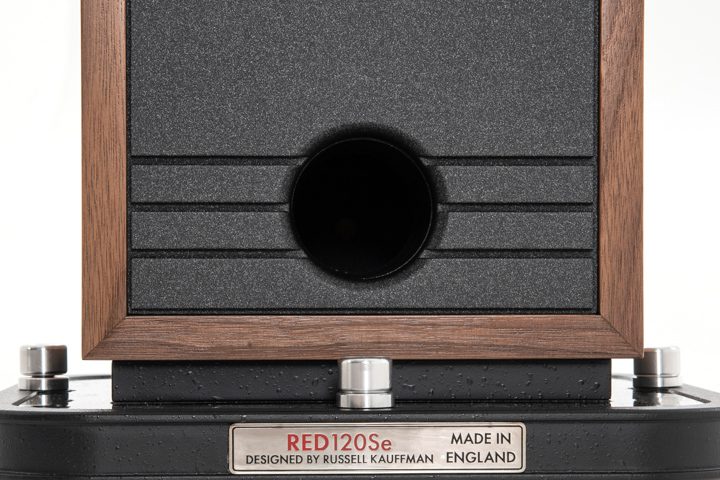
Russell also uses these internal bracing shelves to manage the drivers’ loading and airflow within the cabinet. The bracing subdivides the cabinet into zones for each driver and is perforated by carefully sized and positioned apertures that impede airflow beyond a given frequency. Each driver sits within its division of the cabinet, and thanks to the way the bracing acts as a form of acoustic impedance, the bass cabinet can behave more like a sealed box; midrange energy stays mainly in the region of the midrange driver and only the lower frequencies use the whole of the larger chamber. The bass reflex system uses an internal port to tune the output, this vents into a small cavity which effectively contains any port resonances within the box, and thence it exits into the room by a small, forward-facing port. The port system has been tuned to a positively subterranean 21Hz. Because little to no midrange energy finds its way into the chamber vented by the port, there is no appreciable chuffing or other ‘noises off’ to distract the listener.

Upgraded drivers and crossovers

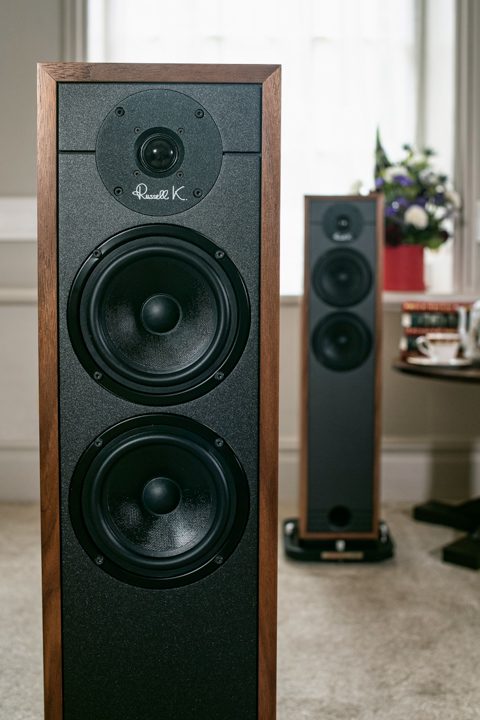
Compared to the regular RED 120, the Se edition comes with upgraded tweeters and reworked crossovers. The tweeter used in the RED 120 is a 25mm soft dome with a ferrite magnet system, a copper-clad aluminium voice coil with a copper Faraday ring, a second magnet, and a metal face plate feature in the Se version. Two 5” bass units deal the lower frequencies with impregnated paper cones of curved, optimised acoustic profile. The motor uses a high-power ferrite magnet, a 25mm voice coil over an aluminium former, and a Faraday ring. The paired bass drivers are connected in a two-and-a-half-way configuration, the upper driver handling bass and midrange, while the lower one handles only lower bass with a crossover which starts to roll off above 80Hz.

Russell chooses his drivers by auditioning them ‘raw’. No enclosure, no baffle, no crossover, no test tones, just a driver connected to an amplifier via its lead-out wires. Doing this highlights how many decent quality drivers, even from respected brands, exhibit audible compression and distortion. By contrast, Russell’s drivers for his loudspeakers are cleaner and more dynamic, and the Se versions are audibly improved over the stock design.

This process allows some scope for originality on the crossovers. A modified 12 dB per octave slope rolls off both tweeter and bass/mid, with only one coil in the bass path and one capacitor in the treble signal path. Tweeter attenuation is via a Zobel network with deliberately misaligned component values as opposed to the conventional L-pad resistor set-up. This avoids having resistors in the signal path, and the component values have been adjusted by ear, using speech and music. The -Se variant crosses over at a relatively low 1800Hz (the RED 120 crosses over at 2200Hz) because this is a better match with the upgraded tweeter, and there’s an additional small capacitor in parallel, which gives the crossover a faster rise time. Low bass uses an enclosed field iron core inductor for improved power handling and low energy leakage. This Se variant has a second, similar inductor in the return path, effectively creating a balanced circuit. This is said to improve bass tunefulness.

Does it work?

It would be fair to say that the RED 120Se loudspeakers concede a little to the larger RED 150 in terms of scale and weight. I used the RED 150s happily in my room for a few years, and the ‘120s are a smaller box with smaller drivers, after all. But it’s very quickly evident that the (£700 more expensive) RED 120Se is the better loudspeaker. The difference is most noticeable in large-scale orchestral music, which trades a little of the sheer size for a lot of the purpose and musicianship. Arvo Pärt, Symphony No. 4 [ECM], the second movement features some deep, dark notes from strings and bass drum, and while there’s no significant shortage of impact here, what really impresses are the instrumental textures, the contrast between xylophone and strings, or violin/violas and cello/bass. The RED 120Ses show you how the composer creates and maintains tension and the way the conductor achieves that through the performance; other speakers which go deeper have been known to gloss over this sort of thing, concentrating instead on giving you an impressive hit of bass, somewhat divorced from its musical context. Freddy Kempf, Prokofiev, Piano Concerto No. 2 [BIS, SACD] shows his exemplary articulation and tone and a real insight into the interpretation through his phrasing.

Russell K. RED 120 Se

The RED 120Ses exert very good control of the different musical forces. The music remains lucid even in the busiest, most energetic passages, in a way reminiscent of a live, unamplified performance. When called upon, they will play very loud indeed without losing their composure, but they don’t do this by being buttoned-up; the music remains expressive and eloquent, the excellent sense of spatial detail intact, so the way the different orchestral forces have been set to work with each other, or with a soloist, is quickly and clearly perceived. Maybe there’s something to this notion of choosing the cleanest, most uncoloured drivers from the outset.

Scale, or proportion?

One takeaway is that bass, scale and depth are all very well but not sufficient. And perhaps more than that, what’s really important is a sense of proportion. Take ‘Log’, a piece for six pianos by Graham Fitkin [Decca]. Now six pianos in an average domestic listening room are about as appropriate as a symphony orchestra and chorus, so there needs to be some accommodation here. Me? I’ll happily trade some size and heft for an image that maintains the proportions. I want to appreciate the component elements’ relative masses, sizes and power, so I can hear deep into the performance. The RED 120Ses help me follow an individual pianist’s contribution, appreciate the timbral differences, the contributions of acoustic and electric instruments, and sense the way the centre of mass of the music shifts around in the soundscape as individual pianos take their lead. I am won over by the performance, not run over by shock and awe.

So, talking about overwhelming performances, Hugh Masekela’s ‘Stimela’ from Hope [Analogue Productions, SACD] has often hinted at colours and textures. Masekela’s vocal verges on uncanny, the voice and percussion working so tightly together for emphasis, and the evocative timbres of sax and trumpet just take this already compelling track to another level of immersiveness. It’s such a warhorse – I defy anybody to go to a hi-fi show and not hear it at least once – it’s quite easy to become inured to the power of its message through over-familiarity. The RED 120Se’s made it fresh again.

Russell K. RED 120 Se

They are also very good at telling you what’s going on in the rest of your system. Change what the CD player sits on, and you hear the effect. Change what the speakers rest on, and you hear that too. Most of this review was conducted with the spikes resting on AcouPlex discs, which brought out the subtleties of phrasing in ways that made regular metal spike cups, coins, or floor protectors sound unconvincingly uncommunicative. A little attention to placement, support and isolation will pay dividends here.

So many audio touchpoints and benchmarks are hit with precision by the RED 120Se: I have talked quite a lot about timbre and colour; we also have articulation, pitch and tunefulness – Renaud Garcia-Fons’ bass is an exemplar: tight, tuneful and full of texture on ‘Berimbass’ from Arcoluz [Enja], so those claims as to improvements to the bass via the crossover tweaks ring true. And perhaps implicit in the speakers’ ability to hear deep into the mix is a facility with imaging – Patricia Barber’s quartet on Café Blue [Premonition Records, SACD] has real presence and form; and last, but arguably most important of all, we have timing – the quartet is absolutely ‘on it’ with an almost telepathic cohesiveness. These modestly-sized speakers have redefined what I expect from this size of cabinet and driver complement. That £6,000 asking price doesn’t feel like a stretch at all.

Technical specifications

  • Type 2½ -way floorstanding, reflex-loaded loudspeaker with internal porting, and forward-facing reflex port. Braced, thin‑walled cabinet with no internal damping
  • Driver complement 1× 25mm soft dome tweeter; 2× 5” impregnated paper cone bass/bass-mid drivers with optimised acoustic profile
  • Power handling nominal 120W programme
  • Crossover frequency 80Hz and 1.8kHz
  • Crossover type Single-wired, phase optimised; tweeter via zobel network with misaligned component values, 12dB per octave slope; Low bass 6dB per octave via enclosed field iron core inductors
  • Frequency response (in-room, usable) 25Hz–22kHz
  • Impedance 4–8 Ohms nominal, 5 Ohms minimum at 50Hz and 300Hz (4 Ohms minimum at 20kHz)
  • Sensitivity 86dB for 1 Watt at 1 Metre
  • Dimensions (H×W×D) (including plinth) 910 × 200 × 190mm
  • Weight Approx. 18 Kg each
  • Finishes Real wood veneers Oak with white baffle;
    Walnut with black baffle; Black Oak with black baffle
  • Price £5,950/pair

Manufacturer

Russell K. Ltd, Dunstable, Bedfordshire, UK

Tel: +44(0)1582 477355

Homepage – https://www.russell-k.com

Product – https://www.russell-k.com/red-120se/

Dealers – https://www.russell-k.com/russell-k-dealers/

Back to Reviews

The post Russell K. RED 120Se appeared first on Hi-Fi+.

Burmester BC150 floorstanding loudspeaker

Burmester invited us to visit Berlin when launching the new BC150 floorstanding loudspeaker  – you can read an earlier version and exclusive preview that formed the basis of this review here. This new speaker design is an impressive statement; not only in terms of its physical presence and its £97,500 price tag, but in the sheer amount of research and development engineering that went into the project.

Just a look around the specification sheet shows why the BC150 is notable. Each BC150 weighs in at a shade under 200kg, a figure achieved by using a combination of aluminium, MDF, and steel (where appropriate) for a cabinet. This trio of materials combine (aided by some carefully chosen visco-elastic materials) making a cabinet that maximises the benefits of all three materials while minimising their own respective downsides. An aluminium frame with MDF housings and steel plates, carefully bonded together is a rare and uniquely successful approach in making a cabinet as non-intrusive and non-interactive as possible.

Each component or subsystem in the BC150 is given the same uncompromising, obsessive-compulsive approach to design and engineering. Alongside the two AMT folded ribbon tweeters (one front firing; a second, smaller and rear-mounted for adjusting spatial properties in room), the midrange is heavily modified to Burmester’s exacting specifications. That last sentence needs exploring; usually ‘heavily modified’ means “can you put our name on the front of the basket?” not “can you change the dust-cap for a phase plug, can we make that phase plug oval, and can we revise the doping materials on the paper of the cone, please? Thanks!”. In fact, when it comes to the side-firing bass unit, the company making the driver liked Burmester’s changes so much, they retrofitted many of them (such as beefing up the magnet) into its own designs.

The crossover too, shows just how seriously Burmester is taking things with the BC150. The board is large, populated with the highest grade components (many of which are ‘potted’… more on that later) and then sits on its own suspension system within its own chamber inside the loudspeaker. Short of playing the loudspeaker during an earthquake, nothing’s going to trouble that crossover. Furthermore, because it’s going to have to handle some high power, everything is built to last. Perhaps the adjustment for the rear-firing tweeter highlights this best; rather than a simple potentiometer mounted in the rear of the speaker, Burmester went the extra mile and built its own stepped attenuator. No one else does this!

Those aforementioned potted capacitors are a part of Burmester going the extra mile once more, in that the BC150 is one of the few passive loudspeakers to achieve UL certification. This means every aspect of the loudspeaker needs to be tested for fire safety, and usually applies to electronic components. Granted, if you are sufficiently infernoed to be concerned about the potential for loudspeaker terminals or internal capacitors in a crossover network to either catch fire or release toxic fumes, it’s probably already a bit late, but the fact Burmester even considered going the distance on this is impressive in its own right.

One of the things you should get from all this is that the engineers in Burmester are driven by passion, and it’s a passion that is shared by the people who end up buying the loudspeakers and enjoying them. OK, few engineers are unmotivated by their own projects, but to create a project like this, you need engineers who will spend hours on end talking about the design of the BC150’s feet, and how many iterations they went through to create the right dial-in adjustable foot sitting on its own bearings. They’ll even tell you about the creation of the tool used to adjust that foot with the kind of bright-eyed enthusiasm you might use to describe your child’s first day at school.

The post Burmester BC150 floorstanding loudspeaker appeared first on Hi-Fi+.

NAD M10/PSB Alpha T20/Bluesound Pulse Mini 2i multiroom system

As with the majority of brave new worlds, establishing a wireless multiroom audio system initially required quite serious compromises. Though there were minor compromises to be accommodated where ergonomics and operability were concerned, the most significant compromises centred around sound quality – and consequently multiroom audio was deemed a non-starter by anyone who fancied themselves an audiophile.

Happily, the simple convenience and arousing modernity of wireless multiroom audio proved an irresistible lure to many a consumer – and as result the wireless multiroom audio sector can confidently be characterised as ‘oversubscribed’. Any number of electronics brands, from the venerable to the no-profile, from the long-established hi-fi stalwarts to vendors of beard-trimmers and toothbrushes, are ready to help you into the brave new(ish) world of simple, straightforward wireless multiroom audio. And it’s true: some of them deliver extremely acceptable sound while they’re doing it.

Bluesound was far from first out of the blocks with its range of wireless multiroom audio products. But it understood both the lure and the shortcomings of the already-ubiquitous Sonos streaming system – rock-solid stability, ease of use and entirely humdrum sound – and with its own extensive range of products attempted to replicate the Sonos strengths while addressing its weaknesses. The Bluesound ecosystem remains the only one able to support uncompressed 24bit/192kHz digital audio files on every player in a wireless system – and that’s true even if you’re running 64 players on the same network. Which is extremely good news for boutique hoteliers if no one else.

Bluesound uses a bespoke operating system called BluOS to control its products. And, as Bluesound is a part of Canada’s Lenbrook International (a wholly owned subsidiary of the Lenbook Group), other Lenbrook-owned companies like NAD Electronics (as well as an increasing number of non-Lenbrook brands like DALI) can be grouped, administered and otherwise controlled using BluOS too.

The importance of the user interface where wireless multiroom audio is concerned can’t really be overstated. It needs to be stable, logical, ergonomically impeccable and easy to operate – and, as anyone who’s ever used a control app from a company without the necessary development resources knows, that’s not especially easy to achieve. One of the reasons ‘Sonos’ is well on its way to becoming a generic term in wireless multiroom audio is because of its absolutely flawless, completely reliable and stunningly straightforward user interface. So while Bluesound products have the audio capability to make them a pretty compelling option, if BluOS doesn’t measure up then Bluesound’s sonic prowess becomes an irrelevance.

Building a modest wireless multiroom system using Lenbrook International brands couldn’t be more straightforward. And I use the word ‘modest’ only to describe the extensiveness of the set-up – there’s nothing modest about the way the system assembled here performs.

The post NAD M10/PSB Alpha T20/Bluesound Pulse Mini 2i multiroom system appeared first on Hi-Fi+.

Magico M6 floorstanding loudspeakers

Even by Magico’s own big-boned approach to high-end audio, the M6 sets a high bar. While there is an M9 flagship that eclipses even this model, the M6 is by most reckoning a loudspeaker of the highest standard, and a cost-no-object interpretation of what goes into making a floorstanding loudspeaker.

Magico’s M6 is ostensibly a three-way, five driver design in a 1cm thick six-sided carbon fibre monocoque, which is made yet more rigid by thick aerospace-grade aluminium front and rear baffles, top plate and inner baffle, all tensioned with aluminium rods. The drivers feature a diamond-coated beryllium dome (in the tweeter) and graphene in the midrange and bass units. If that sounds familiar, it’s not too dissimilar from Magico’s 2014 limited run ‘thank you’ M-Project loudspeaker. The M-Project, built to celebrate Magico’s ten years as a speaker maker and sold to its most loyal followers, both set a high performance bar for subsequent Magico loudspeakers to achieve, but also was a launch-pad, instigating design concepts and criteria that the company has used to this day. The M6 is very much a child of the M-Project.

One of the first big outcomes of the M-Project was a radical change to the way big-hitter Magicos looked, but for reasons that were predicated on sonics as much as aesthetics. The slab-sided black aluminium monolith was gone, and the aluminium matrix frame that helped define projects like the Q-series (which still exists in the shape of the Q7 and Q Sub) was replaced by the aforementioned carbon monocoque. Perhaps the best way of looking at this sea-change is it requires a shift in analogies; the previous matrix frame worked best with the inevitable motoring analogy (reminding you of the space-frames of classic 1960s F1 racing cars) where the designs that came from the M-Project require higher-tolerance aerospace analogies (think the monocoque build of a modern F35 fighters)  One of the results of this was a loudspeaker that was both more domestically acceptable and integrated in room better than before. Better performance from the enclosure was the outcome; a better-looking enclosure was the happy by-product.

As opposed to the normal statement piece loudspeakers at this level, where the sheer size of the loudspeaker physically dominates the room, the Magico M6 is positively understated. It’s still a big loudspeaker, both in size and weight, but the M6 still looks like a floorstanding loudspeaker and not an exercise in mechanical engineering or, as in the case of the M9, a house Dalek. However, let’s not back away from the fact a loudspeaker that stands 143cm tall, weighs in at 177kg, and is finished in contrasting shades of anodised matt black aluminium and a shinier – but still black – sculpted carbon fibre monocoque still cuts an imposing figure in a listening room. But it’s a ‘loudspeaker, but bigger’ rather than ‘an exploded diagram of what makes up a loudspeaker’ and that will make the M6 a more attractive prospect in many high-end listening rooms.

The post Magico M6 floorstanding loudspeakers appeared first on Hi-Fi+.

Mellow Acoustics announces the New FrontRo Pro

From the Mellow Acoustics press release: 

Farnham October 2021:  Following two very favourable press reviews of the Frontro speakers by Hifi+ and Hi Fi Pig, Mellow Acoustics has been assessing its remarkable hybrid electrostatic speaker with regard to pleasing those enthusiasts who expressed a requirement for more bass response to suit their musical choices.

“While the Frontro has been acclaimed for its wonderful reproduction abilities by many people whose choice is for classical or jazz music primarily, we have listened to those who have found the bass too light for their tastes.” Said designer, Tim Mellow, “In response we have re-analysed the bass setup and made two main alterations.”

The changes include the woofer being upgraded from 5.25 inch to a 6.5 inch unit with even greater excursion. In addition, the crossover has been lowered from 600 Hz to 400 Hz for more transparent midrange from the electrostatic unit. The revised units will be known as the FrontRo Pro edition.

Listeners have already remarked that this already superb speaker has been transformed! Rock and Drum & Bass is now pumped out at highly satisfactory levels without compromising the speaker’s ability to delicately reproduce live vocals and sparkling acoustics guitar sounds.

Mellow Acoustics is currently making a pair of the new speakers available for press reviews or for demonstration at dealerships in the UK.

FrontRo is the only electrostatic loudspeaker designed and built in UK. It has the broadest directivity pattern for spacious room-filling sound and pin-point imaging

It is a uniquely compact electrostatic loudspeaker, suitable for even quite small rooms. The sound is produced by a light gossamer film in free space. It is the closest thing to moving air directly with no cones, domes, heavy coils or boxes to mar the sound.

The FrontRo is a hybrid electrostatic design with a circular electrostatic unit, about the size of a vinyl LP, above a conventional dynamic woofer in a pyramid-shaped box. The FrontRo is the only British-built electrostatic loudspeaker with a design that proudly boasts its British heritage, built by hand in England.


About Mellow Acoustics


Mellow Acoustics was founded in 2011 by Tim Mellow who felt that hi-fi design had become too complicated and focused on technical specifications, whilst losing sight of what really mattered – the integrity of the sound.


Tim Mellow is an electronics and acoustics engineer with 30 years of experience working at several companies including 12 years at Nokia. His OTL tube amplifier design published in 2010 issue of AudioXpress has proved a popular DIY project. Tim is also the co-author of an updated version of Leo Beranek’s classic 1954 book ‘Acoustics’ and has published 11 papers in the Journal of the Acoustical Society of America. Tim presented a paper on his Oscillating Sphere Concept, to the 144th Convention of the Audio Engineering Society in Milan 2018, which he developed while designing FrontRo.

Manufacturer: Mellow Acoustics

URL: frontro.co.uk

Back to News

The post Mellow Acoustics announces the New FrontRo Pro appeared first on Hi-Fi+.