Tag Archives: Streaming DAC

Vermeer Audio Model THREE D

Here, we had been enthused concerning the Vermeer Audio Model TWO. But the Model TWO is a heavy hitter; not everybody wants that form of firepower of their methods. Perhaps you might have a smaller system with out the necessity for analogue inputs. Maybe all you want is a streamer or DAC. And you need this stuff with out compromising high quality. Say ‘bonjour’ to the Vermeer Audio Model THREE D streaming DAC!

The Vermeer apple doesn’t fall removed from the tree. Much of what went into the Model TWO trickled right down to the Model THREE D. This additionally means the Model THREE D pulls in an awesome deal from the late, lamented Audio Aero LaFontaine. I’d like to say this conclusion got here from painstaking listening, evaluating circuits and background analysis. But I can’t; Vermeer Audio makes this clear by itself website. “The Model THREE D is totally based mostly on the Model TWO and the parts which have made this uncompromising unit a hit.”

Lighter case

Like Model TWO, it helps 32bit, 384kHZ PCM audio and DSD128 by way of its USB and LAN connections. The Vermeer Audio Model THREE D goes as much as 24bit, 192kHz and DSD64 on S/PDIF and AES/EBU. The large variations between the 2 are eradicating analogue inputs and utilizing a far lighter case.
Vermeer Audio Model THREE

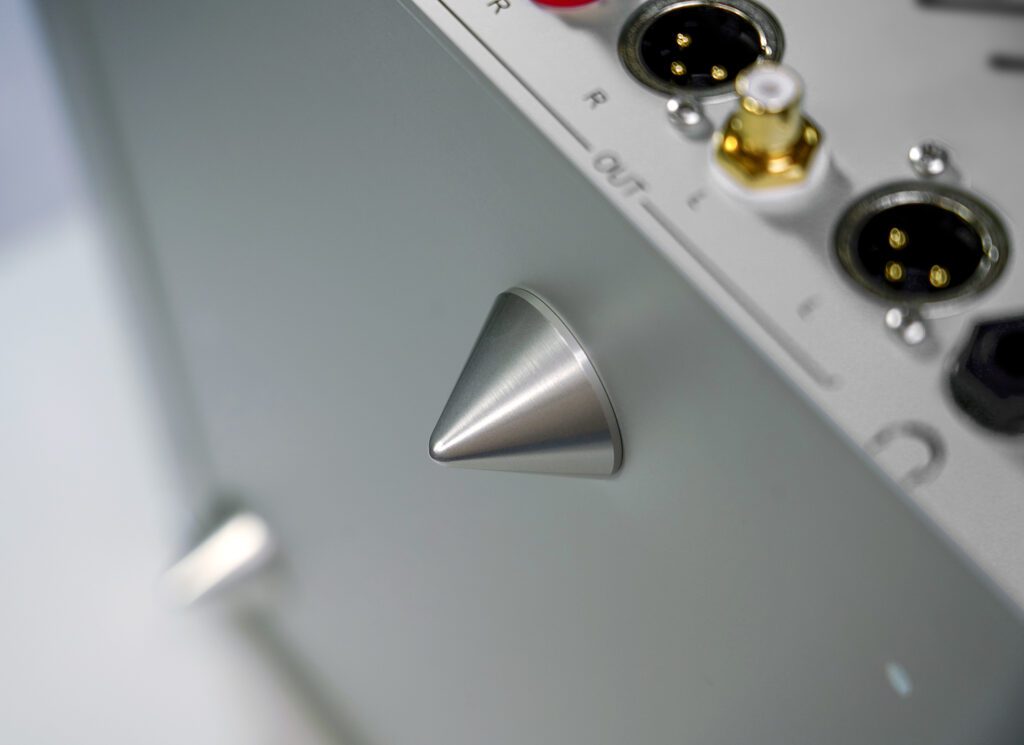
Let’s not underplay that ‘lighter case’, nevertheless. It doesn’t imply the DAC is light-weight or that its trio of armour-piercing cones don’t add as much as highly effective construct high quality in and of itself. However, not like Model TWO, something shy of ‘battleship construct’ is discovered wanting. The distinction is you may carry the Model THREE D out of its field with out visiting an osteopath.

Having no analogue inputs advantages the Vermeer Audio Model THREE D because it permits full Leedh integration. Leedh processing is an revolutionary all-digital quantity management. It happened as a result of digital audio nonetheless suffers from quantity controls that degrade the sound sign by modifying its form.

Circular logic?

A digital quantity management’s downside sounds round however is misplaced info brought on by itself. That misplaced info is expounded to modifying the amplitude of a digital datastream, often called ‘truncation’ and even ‘bit chopping’. How this truncation seems to the listener is a drop in low amplitude sign, making the sound seem ‘flat’ and ‘missing heat’; among the baseline normal criticisms of ‘digital audio’ typically stated by analogue music lovers.

What if a few of these limitations of digital audio had been purely capabilities of attempting to make a no-noise digital quantity management? This would go some approach to clarify the peculiar facet of high-end audio that whereas good digital gamers typically have digital quantity controls, many audiophiles nonetheless desire passing the sign by way of an analogue preamplifier. This intrinsically provides noise however is made as a result of pragmatic determination that it merely sounds higher.

Vermeer Audio Model THREE

Leedh makes an attempt to deal with this well-documented downside by making a quantity algorithm to minimise the variety of further bits in a datastream to cut back truncation loss. This is an awfully intelligent – and very advanced – means of modifying the amplitude with out altering the waveform utilized by among the brightest stars within the digital heavens, reminiscent of Lumin, Métronome, Soulution… and Vermeer.

Hushed tones

So, why is it Vermeer Audio isn’t spoken of with the identical hushed tones folks apply when discussing the very best of these different Leedh sign-ups? If you advised a fellow audio traveller you owned a type of different three names, you’d get a nod of recognition and respect to your discerning alternative. Do the identical with Vermeer Audio, and you’ll in all probability get a ‘who?’ Partly, it’s for all the suitable causes; even in an trade with a popularity for a bespoke construct, Vermeer Audio’s merchandise are resolutely hand-made. The firm is sufficiently small to make sure one engineer can observe a product from inception to ultimate sign-off, testing and aligning exactly alongside the best way. Where different corporations of Vermeer’s dimension normally have one or two folks in advertising and marketing and gross sales, it’s all about constructing the very best they’ll.

In that means, Vermeer Audio operates like Henry Poole & Co. This small Savile Row tailor is famously understated (it doesn’t even have its personal label to stitch into its clothes), but invented the dinner swimsuit and had Winston Churchill, Napoleon III, and lists quite a few Kings, Queens, Emperors and Princes as purchasers. Personally, I’d take timeless craftsmanship and understatement over flashy and trashy!

Of course, simply as a tailor is simply pretty much as good as its final sew, so Vermeer Audio depends on the standard of its two merchandise, and the Model THREE D is greater than ok. However, there are a few operational ‘quirks’ such because the rear-mounted headphone socket. From an aesthetic perspective, I approve because it makes the entrance panel’s strains look clear and uncluttered, however from a logistical place, having to succeed in across the again of the Model THREE D – particularly if it isn’t on the highest shelf of your system – isn’t the most suitable choice.

Decisions, Decisions

I’m cautious of going over outdated floor right here, however a lot of what applies to the Vermeer Audio Model TWO applies to the efficiency of the Model THREE D. It makes use of the identical high quality boards, substantial PCB tracks and high-grade parts. I didn’t have each merchandise at hand, so counting on a long-standing aural reminiscence of essentially comparable merchandise is troublesome. Still, I believe the variations in efficiency are comparatively slight. Model TWO largely provides weight and line inputs… and makes an even bigger gap within the financial institution steadiness. This is an excellent achievement for Model THREE D as a result of Model TWO was a stellar digital replay system, and this will get inside “a midge’s minim” or “a gnat’s crotchet” (thanks, Humph, and the I’m Sorry I Haven’t A Clue staff) of the Big Boy’s efficiency. In specific, Model THREE D retains that ‘drawing you in’ property that pulls you nearer to the music, just about no matter file sort or musical style. I discovered myself listening to a variety of listening pleasures and having fun with and understanding them completely.

Mentioning ‘Clue’ above was for a purpose; it’s a deep pool of a long time of foolish, freely out there and readily streamable half-hour slices of fried gold through BBC Sounds, and I discovered myself chuckling alongside to some traditional early night stupidity (singing the lyrics of ‘A Whiter Shade of Pale’ to the tune of ‘The Muppet Show’) and double entendre (“Samantha has to nip out now as she’s received a brand new job working within the sound archive because the supervisor. It’s her first day, so apparently she’s going to present a speech within the again room and hand jobs out within the workplace”). Toward the top of his life, former host Humphrey Lyttleton’s voice grew to become just a little vague. Model THREE D helps deliver out sufficient vocal high quality to hear joyously. You really feel as in case you are a part of the viewers and much more celebration to the jokes.

Vermeer Audio Model THREE

I learn by way of the Model TWO assessment and did the identical factor; I hung out discussing a BBC broadcast. There’s a great purpose for this and one which I didn’t essentially discover the primary time round. The Vermeer simply stayed on on a regular basis. You play Model THREE D at each alternative. It accompanies your digital music and makes a really fluid, participating and engaging sound. This digital replay system is on the complete aspect somewhat than stark, with an easy rhythm and loads of element. Still, finally none of these issues is as vital as simply what number of hours you log with the Model THREE D. And this listening in the course of the demise (pronounced ‘dem-EEZ’ as an alternative of ‘de-MIZE’) of the Crown, the place all issues British went maudlin.

Good instances dangerous instances!

There’s solely a lot of that one can take, and periodically one’s pipes want a great cleanout. Nothing appeared extra applicable than taking part in the entire first eponymous Led Zeppelin [Atlantic] album from one finish to the opposite, beginning with ‘Good Times Bad Times’… and it sounded prefer it was the primary time I had ever heard it. Wow!

THREE D by identify, THREE D by nature. The Vermeer Model THREE D produces an especially holographic soundstage. If that had been all, it could in all probability be sufficient, however because it follows carefully within the footsteps trodden by its larger brother, at a fraction of the fee and one-third the burden, it’s a tough factor to not love.

Technical specs

  • Digital inputs Asynchronous USB, AES/EBU (XLR), S/PDIF (optical and BNC coaxial)
  • Analogue outputs Single-ended RCA, Balanced XLR
  • Digital precision to 32bit, 384kHz PCM (utilizing Vermeer Audio resampling module), DSD 64/2.8Mhz
  • Output Voltage 2, 3 or 4Vrms in mounted output mode. Up to 7Vrms in variable output mode
  • Output Impedance 100Ω
  • Signal-to-noise ratio 129dB
  • THD < 0.1%
  • Dimensions (W×H×D) 450 × 130 × 440mm
  • Weight 9kg
  • Price £13,995

Manufacturer

Vermeer Audio

vermeeraudio.com

Manufacturer

The Audiophile Club

theac.co.uk

+44 (0) 20 8882 2822

Back to Reviews

The submit Vermeer Audio Model THREE D appeared first on Hi-Fi+.

Vermeer Audio Model THREE D

Here, we have been enthused concerning the Vermeer Audio Model TWO. But the Model TWO is a heavy hitter; not everybody wants that sort of firepower of their programs. Perhaps you have got a smaller system with out the necessity for analogue inputs. Maybe all you want is a streamer or DAC. And you need these items with out compromising high quality. Say ‘bonjour’ to the Vermeer Audio Model THREE D streaming DAC!

The Vermeer apple doesn’t fall removed from the tree. Much of what went into the Model TWO trickled all the way down to the Model THREE D. This additionally means the Model THREE D pulls in an awesome deal from the late, lamented Audio Aero LaFontaine. I’d like to say this conclusion got here from painstaking listening, evaluating circuits and background analysis. But I can’t; Vermeer Audio makes this clear by itself website. “The Model THREE D is totally primarily based on the Model TWO and the elements which have made this uncompromising unit successful.”

Lighter case

Like Model TWO, it helps 32bit, 384kHZ PCM audio and DSD128 via its USB and LAN connections. The Vermeer Audio Model THREE D goes as much as 24bit, 192kHz and DSD64 on S/PDIF and AES/EBU. The large variations between the 2 are eradicating analogue inputs and utilizing a far lighter case.

Vermeer Audio Model THREE

Let’s not underplay that ‘lighter case’, nevertheless. It doesn’t imply the DAC is light-weight or that its trio of armour-piercing cones don’t add as much as highly effective construct high quality in and of itself. However, not like Model TWO, something shy of ‘battleship construct’ is discovered wanting. The distinction is you’ll be able to raise the Model THREE D out of its field with out visiting an osteopath.

Having no analogue inputs advantages the Vermeer Audio Model THREE D because it permits full Leedh integration. Leedh processing is an progressive all-digital quantity management. It took place as a result of digital audio nonetheless suffers from quantity controls that degrade the sound sign by modifying its form.

Circular logic?

A digital quantity management’s downside sounds round however is misplaced data attributable to itself. That misplaced data is said to modifying the amplitude of a digital datastream, referred to as ‘truncation’ and even ‘bit chopping’. How this truncation seems to the listener is a drop in low amplitude sign, making the sound seem ‘flat’ and ‘missing heat’; a few of the baseline common criticisms of ‘digital audio’ typically mentioned by analogue music lovers.

What if a few of these limitations of digital audio have been purely features of attempting to make a no-noise digital quantity management? This would go some solution to clarify the peculiar facet of high-end audio that whereas good digital gamers typically have digital quantity controls, many audiophiles nonetheless choose passing the sign via an analogue preamplifier. This intrinsically provides noise however is made as a result of pragmatic choice that it merely sounds higher.

Vermeer Audio Model THREE

Leedh makes an attempt to handle this well-documented downside by making a quantity algorithm to minimise the variety of extra bits in a datastream to scale back truncation loss. This is an awfully intelligent – and very complicated – manner of modifying the amplitude with out altering the waveform utilized by a few of the brightest stars within the digital heavens, corresponding to Lumin, Métronome, Soulution… and Vermeer.

Hushed tones

So, why is it Vermeer Audio isn’t spoken of with the identical hushed tones folks apply when discussing one of the best of these different Leedh sign-ups? If you informed a fellow audio traveller you owned a kind of different three names, you’d get a nod of recognition and respect to your discerning alternative. Do the identical with Vermeer Audio, and you’ll in all probability get a ‘who?’ Partly, it’s for all the proper causes; even in an business with a popularity for a bespoke construct, Vermeer Audio’s merchandise are resolutely hand-made. The firm is sufficiently small to make sure one engineer can comply with a product from inception to closing sign-off, testing and aligning exactly alongside the way in which. Where different firms of Vermeer’s measurement normally have one or two folks in advertising and gross sales, it’s all about constructing one of the best they’ll.

In that manner, Vermeer Audio operates like Henry Poole & Co. This small Savile Row tailor is famously understated (it doesn’t even have its personal label to stitch into its clothes), but invented the dinner go well with and had Winston Churchill, Napoleon III, and lists quite a few Kings, Queens, Emperors and Princes as shoppers. Personally, I’d take timeless craftsmanship and understatement over flashy and trashy!

Of course, simply as a tailor is simply nearly as good as its final sew, so Vermeer Audio depends on the standard of its two merchandise, and the Model THREE D is greater than adequate. However, there are a few operational ‘quirks’ such because the rear-mounted headphone socket. From an aesthetic perspective, I approve because it makes the entrance panel’s strains look clear and uncluttered, however from a logistical place, having to achieve across the again of the Model THREE D – particularly if it isn’t on the highest shelf of your system – isn’t the most suitable choice.

Decisions, Decisions

I’m cautious of going over previous floor right here, however a lot of what applies to the Vermeer Audio Model TWO applies to the efficiency of the Model THREE D. It makes use of the identical high quality boards, substantial PCB tracks and high-grade elements. I didn’t have each merchandise at hand, so counting on a long-standing aural reminiscence of basically related merchandise is troublesome. Still, I believe the variations in efficiency are comparatively slight. Model TWO largely provides weight and line inputs… and makes a much bigger gap within the financial institution steadiness. This is an excellent achievement for Model THREE D as a result of Model TWO was a stellar digital replay machine, and this will get inside “a midge’s minim” or “a gnat’s crotchet” (thanks, Humph, and the I’m Sorry I Haven’t A Clue staff) of the Big Boy’s efficiency. In explicit, Model THREE D retains that ‘drawing you in’ property that pulls you nearer to the music, just about no matter file kind or musical style. I discovered myself listening to a variety of listening pleasures and having fun with and understanding them completely.

Mentioning ‘Clue’ above was for a motive; it’s a deep pool of a long time of foolish, freely out there and readily streamable half-hour slices of fried gold through BBC Sounds, and I discovered myself chuckling alongside to some basic early night stupidity (singing the lyrics of ‘A Whiter Shade of Pale’ to the tune of ‘The Muppet Show’) and double entendre (“Samantha has to nip out now as she’s received a brand new job working within the sound archive because the supervisor. It’s her first day, so apparently she’s going to present a speech within the again room and hand jobs out within the workplace”). Toward the top of his life, former host Humphrey Lyttleton’s voice turned just a little vague. Model THREE D helps carry out sufficient vocal high quality to pay attention joyously. You really feel as if you’re a part of the viewers and much more occasion to the jokes.

Vermeer Audio Model THREE

I learn via the Model TWO evaluation and did the identical factor; I frolicked discussing a BBC broadcast. There’s a great motive for this and one which I didn’t essentially discover the primary time round. The Vermeer simply stayed on on a regular basis. You play Model THREE D at each alternative. It accompanies your digital music and makes a really fluid, participating and enticing sound. This digital replay machine is on the complete aspect moderately than stark, with a simple rhythm and loads of element. Still, finally none of these issues is as essential as simply what number of hours you log with the Model THREE D. And this listening throughout the demise (pronounced ‘dem-EEZ’ as a substitute of ‘de-MIZE’) of the Crown, the place all issues British went maudlin.

Good instances dangerous instances!

There’s solely a lot of that one can take, and periodically one’s pipes want a great cleanout. Nothing appeared extra applicable than taking part in the entire first eponymous Led Zeppelin [Atlantic] album from one finish to the opposite, beginning with ‘Good Times Bad Times’… and it sounded prefer it was the primary time I had ever heard it. Wow!

THREE D by identify, THREE D by nature. The Vermeer Model THREE D produces a particularly holographic soundstage. If that have been all, it will in all probability be sufficient, however because it follows carefully within the footsteps trodden by its greater brother, at a fraction of the price and one-third the burden, it’s a tough factor to not love.

Technical specs

  • Digital inputs Asynchronous USB, AES/EBU (XLR), S/PDIF (optical and BNC coaxial)
  • Analogue outputs Single-ended RCA, Balanced XLR
  • Digital precision to 32bit, 384kHz PCM (utilizing Vermeer Audio resampling module), DSD 64/2.8Mhz
  • Output Voltage 2, 3 or 4Vrms in fastened output mode. Up to 7Vrms in variable output mode
  • Output Impedance 100Ω
  • Signal-to-noise ratio 129dB
  • THD < 0.1%
  • Dimensions (W×H×D) 450 × 130 × 440mm
  • Weight 9kg
  • Price £13,995

Manufacturer

Vermeer Audio

vermeeraudio.com

Manufacturer

The Audiophile Club

theac.co.uk

+44 (0) 20 8882 2822

Back to Reviews

The publish Vermeer Audio Model THREE D appeared first on Hi-Fi+.

Gold Note system

There has always been a reluctance on the part of your average audio enthusiast to source their entire system from a single manufacturer. The reasons are historic and founded in the kind of knowledge and truths that perhaps tend to linger long after any real relevance. Few manufacturers are as good at making electronics as they are loudspeakers and to break that down still further, there are many examples of electronic manufacturers being better at designing and producing preamplifiers than power amplifiers, or vice versa. The resultant thinking has been to mix ’n match what each company does best and this, in my experience, can have mixed success.

Things have moved along though and for every rule, there have always been exceptions. Then there is always the thorny issue of component compatibility and system synergy to consider. I once hooked the best preamplifier I have ever heard into a pair of the best mono amplifiers that had crossed my path and the results were disappointing. Balancing the musical strengths of one component against another is tricky, but can also be an ultimately rewarding business. Getting them both to sing the same song, especially when the rather thorny issue of cabling is thrown into the mix, can be dicey. Then again, it can be glorious.

Fuss-free

Recently, I had the great pleasure of spending some time with the Gold Note DS-10 EVO, a single box network streamer DAC that also offered a really fine output level section that enabled it to be deployed as a preamplifier. Nothing especially new there you might think, except the performance was so musically involving and the function in tandem with its dedicated app so fuss-free that I could see that this machine had real system potential. I wrote as much and then discovered that there was an optional dedicated power supply available so, before it went back the distributor dropped one off and it did exactly what it should have and moved the performance onto an entirely new level. Things were becoming more serious and my curiosity was piqued.

A glance through the Gold Note catalogue was revealing in its depth of products. Alongside a £62,000 turntable there was an entire 10-series range including a neat power amplifier that could be used as a stereo chassis or a pair of them could be employed as mono amplifiers, with a quite surprising lift in quoted available power. I am sure you can see where this is going as the idea of a full Gold Note system began to look more and more appealing if the DS-10 EVO experience was anything to go by. What about a pair of speakers? Lo and behold, Gold Note produce a range of five models, the smallest and immediately the most appealing to me were the A3 EVO II, a conveniently sized and quite beautiful little design which, I figured, would allow me to enjoy Il Suono Italiano, Gold-Note’s motto, to the full. The course was set with only a few details to sort before I could embark on the journey.

GoldNote_A3 EVO II pair-matt

As the system arrived without speaker stands or cabling that was the first issue that needed sorting. Running through my stash of speaker stands yielded some very variable results. No surprise in itself but the end solution was as unexpected as it was impractical. I still had a pair of the now defunct Quadraspire acrylic stands that slot neatly together from two pieces. If memory serves, these were the shorter versions and I had superb results when I used them a lot, several years ago, especially with lighter weight speaker designs. I would normally hesitate to recommend equipment that is no longer made but perhaps the low-mass construction of the Quadraspire designs gives a clue as to wringing the best from the A3 EVO IIs. Whatever the case, these stands set the speakers musically free. Primarily dynamically, but also in their whole sense of lightness of touch and speed. This was to remain the very best I could wring for them. Often these small designs are claimed to be suitable for shelf mounting. Personally I couldn’t imagine a worse location for these speakers and this is a real compliment to their potential. They like and need free air to breathe, especially through that rear-facing port. Correctly mounted, they will surprise and delight you and perhaps the bolt-together stands that Gold Note have designed for them are the answer. I don’t know. Not having a pair means that I can’t speak to that but my advice is to get your dealer to loan you several pairs of stands and try them in your listening room. The differences you will hear will guide you.

Stand out

The cabinets of the review pair were a real stand-out. A gloss walnut-veneered side panel has been shaped into a kind of diamond profile where the broadest point is alongside the 153 mm treated paper bass/mid driver and supplemented by a tasteful metallic inlay that runs the full depth of the cabinet. Atop that is a 28 mm silk-domed tweeter where the side panels taper down to give a truly elegant and classy cabinet dynamic. The front baffle that seems almost like a sub-structure in appearance is small and most people would be able to span the centres of the drivers with one hand. The cabinet is very stiff, thanks to those side panels but it has a bit of depth to it too at around 300mm and the bass is loaded through a rear facing port. It’s a compact design but its performance is anything but. In many ways it was the surprise package of the whole system, then again, no part of any system operates entirely independently.

I soon discovered that, like many Italian systems, this one majored on a smooth dynamic performance, full of colour and tonal light and shade. Cabling ended up as Nordost Blue Heaven. The reason I decided to go this way was because I like the linearity and speed of the Nordost cables which have an extremely delicate dynamic touch too without any excess baggage in the low end. I found that it balanced very nicely with the system’s qualities. You might choose another option but the slight tonal lift that the Blue Heaven bought through midband worked well for me.

The PA-10 amplifier is the same size as each of the boxes in this system which means that the overall system aesthetics are great. This is a fully-balanced design that can be simply switched from a stereo chassis to a mono-block. Like all the 10-series electronics it is substantially constructed from a solid steel chassis and thick aluminium panelling for appropriate shielding. As a single stereo design it sounds sweet and very smooth with notable resolution and the sort of tonality and grip that the Gold Note speakers thrive on. Driven from the pre-out of the DS-10 EVO it has power levels that most smaller rooms are going to find entirely adequate. If you have a PA-10 operating in this configuration my advice is to double up with another unit bridged for mono as soon as you can because the improvements are exponential. Once you’ve heard the sheer musical authority that this configuration brings, you won’t want to go back I promise you.

A small panel on the upper right of the rear panel carries the BTL (Bridge Tied Load) switch that turns the amplifier into a bit of a beast as well as releasing copious amounts of power. I used the balanced inputs from the DS-10 EVO. Don’t think that this is all about pure output levels though. The extra control and levels of articulate resolution change much more than that and the system is notably better at low levels too. Suddenly the speaker becomes a wider window into the stereo soundstage and this now expands way beyond the physical boundaries of the cabinets.

Balance and presence

The depth of the sound and the way the speaker can now layer instruments and voices tier upon tier with a sense of balance and presence that often evades much more costly designs is a really attractive feature of this system. For anybody thinking that the style has been placed before sound quality then I have to tell you that you couldn’t be more wrong. It is all those things but this is a really serious music system too. That extra power is actually quite startling but it has been deployed entirely to bring the music closer to you by allowing for greater dynamic freedom and the EVO II speakers really come to life when they are supplied with that extra level of musical energy that the upgrade brings.

At the front end of course the DS-10 EVO streaming DAC that I previously had a lot of fun with received its own boost in just about everything from the PSU-10 external power supply. The system felt the changes from back to front. That’s the level of the improvements on offer here. The DS-10 EVO is a great little Streamer/DAC and Line Stage in its own right but turbo boost it with the PSU-10 and you’re again talking about a whole new level of performance. It connects via a single umbilical lead to a much stiffer and more robust transformer set-up. This is a dual-choke hybrid design comprising of a four transformer layout where three are dedicated to supplying the power and one for the inductive filter. It also has ultra-low noise voltage regulators and you can hear that the DS-10 EVO operates in a quieter musical domain as a result.

So, we are looking at a very configurable system here. I could use it as a simple, very compact two-box source and amplifier or a four-box set-up where the Streamer/DAC /Pre has its own dedicated power supply and the amplification is effectively doubled up. The result is a system that doesn’t take up too much more room but is much more focussed musically and sounds a lot more intense and involving.

The Gold Note speakers are particularly ‘stiff’ when straight out of the box; this pair had seen action but would still need a period of use before they started to perform. After initial installation, I selected a playlist and just let the music energise the system for a while, but I just wasn’t expecting the depth and width that flowed out of those little boxes. Running Tidal through the GN Control app the random music playlist that I heard began with tracks from an old David Crosby album from about 40 years ago. It caught me cold. The recording was so solid and the vocal so intimate that I ended up sitting and listening for a straight hour as the playlist unfolded.

Exceeded expectations

One of the lovely things about this system is that it reserves the ability to surprise you every time you spend time with it. I like small speakers and while I acknowledge their size limitations, I have seldom heard any with this much sense of tone and pure colour. Couple that with a real feeling of dynamic drive from the amplifiers and I soon understood that this system constantly exceeded my expectations. The other notable thing about it is how adaptable it is to just about any style or flavour of music. It has the sort of body, weight and depth that makes sweeping classical pieces come alive and it never grows thin or compressed like so many small cabinet designs. Yet, when you ask it to do intimate music of extreme subtlety with tiny micro-shifts of emphasis then the electronics are enormously capable. I will long remember listening to one of my favourite musicians Masaaki Kishibe, a wonderful Japanese composer/guitarist seduce me with beautiful tones, subtle phrases and melodies very soon after the system had arrived. That will live long in my memory because it paints musical pictures.

This is a very nice system that just does its thing bringing music from its streamer to your ears without fuss. It is so very easy and unchallenging to listen to and I really like that. It takes up very little room and I can imagine it looking great in many homes where system aesthetics are important.

Technical specifications

Gold Note DS-10 EVO Streaming DAC

  • Type Streaming DAC / Pre
  • Streaming from Roon, Airplay, MQA, Qobuz, Deezer, Spotify Connect, Tidal Connect, V-Tuner
  • Price £2,900

Gold Note PA-10 Stereo power amplifier

  • Type Stereo power amplifier with bridging option
  • Power Output 75 watts at 8 ohms, 150 watts into 4 ohms
  • Power Output in BTL 600 watts per channel into 4 ohms
  • Audio Inputs 1 × RCA unbalanced, 1 × XLR balanced
  • Price  £1,700

Gold Note PSU-10 EVO external power supply

  • Type external power supply for DS-10
  • Price £1,200
  • Dimensions of all electronics 80 × 200 × 260 mm (H×W×D)

Gold Note A3 EVO II speakers

  • Type 2-way stand-mounted loudspeaker
  • Drivers 1 × 153mm Mid/Bass driver, 28mm Silk-Domed tweeter
  • Port Rear facing
  • Sensitivity 87dB
  • Nominal impedance  6 Ohms
  • Dimensions 350 × 240 × 295mm (H×W×D)
  • Weight 20Kg pair (net)
  • Finishes available Black cabinet with matt or gloss walnut side panels
  • Price £4,000

Manufacturer

GOLD NOTE

www.goldnote.it

UK distributor

Airt Audio

www.airtaudio.com

+44 (0)1354 652566

Back to Review

The post Gold Note system appeared first on Hi-Fi+.

Moon by Simaudio 680D streaming DAC

Over the years I have had many opportunities to enjoy some quality equipment from Moon, made by Simaudio of Boucherville Quebec, Canada. Now in its fortieth year, Moon has become one of the world’s premier audio brands. I have always been impressed by their products fit and finish and the ten-year warranty. There is a clear sense of pride in their work, and it shows in all of their products.

There is a good range of Moon digital products for an audio fan to consider, covering all the bases from traditional disc spinners and headphone amps with built-in DACs, through add-on streaming devices and network streaming DACs in preamps and integrated amps right up to cost-no-object flagship designs. The new 680D streaming DAC is second in line to the throne currently occupied by the 780D v2 flagship. And, from experience, the wide range fits all well, because this isn’t my first Moon rodeo. I have been using the Moon 430HAD Headphone Amp/DAC for many years and it is a reference piece for me; we reviewers can be a fickle lot (continual exposure to all the new toys can do that), so anything that resists the urge to swap boxes bespeaks of high quality and high-performance products. The 680D streaming DAC exudes that same quality, albeit to an even higher degree as befits a DAC of its class.

The 680D is a streaming DAC and therefore removes the need for a computer in your network audio chain. Plug your ethernet cable into the unit and you get access to Qobuz Sublime+, Tidal Masters, Deezer HiFi and Spotify Connect. Or you can stream from your own NAS or Apple Airplay 2 via Moon’s excellent MiND2 streaming hardware. All of which can be controlled using Moon’s MiND2 App or through Roon if you so subscribe. I used both during the review period and found each to be easy and intuitive to use with the 680D. One specific benefit of using the MiND2 App is if you are connecting the 680D to another piece of Moon gear like the 740P Preamplifier, the Simlink cable (included) allows you to control system volume (amongst other features) both from within the MiND2 app and from within Roon. A nice feature for system building, especially in a multi-room context.

Physically, the 680D occupies a full shelf in your rack, but although exceptionally well-built, doesn’t have the imposing ‘I’ve got a Man Badge’ over-the-top build of some more showy digital products. With three finish choices (Silver, Silver/Black or Black) you can select your preferred look. All three are handsome options. My review sample was their classic Silver and Black. It looked great on my rack. The large red LED’s provided playback information such as file bit rates and track time. You have three light brightness levels to choose from. The DAC will process to PCM 32/384 and DSD to DSD256. The unit is fully MQA certified and Roon Ready. At its core, there beats a heart of pure digital royalty: the ESS Sabre 9028pro DAC chip. This is one of the most highly respected converter systems available at this time

The post Moon by Simaudio 680D streaming DAC appeared first on Hi-Fi+.

Product Launch: Matrix X-SABRE 3 DAC

This is an all-new DAC from Matrix Audio using ESS’ flagship ES9038 PRO DAC chip making it capable of decoding MQA, PCM 32-bit/768kHz and DSD 22.4MHz (Native). With dual hidden WiFi antennas, it can also stream TIDAL, Spotify, Roon and Apple Airplay. Navigate all of this with a high-res LCD display while a low interference isolated design keeps the sound output clear and detailed.

The X-SABRE DAC is available for $2999 USD and can be ordered from Apos Audio!

The post Product Launch: Matrix X-SABRE 3 DAC first appeared on The Headphone List.